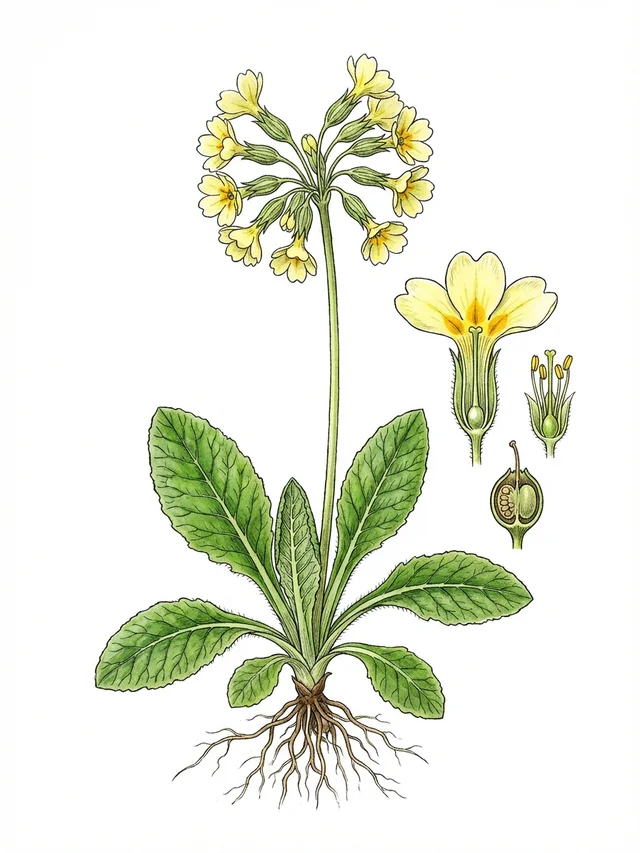
 Image to followAI-generated illustration
Allium cepa
Allium cepa
FamilyGenus: Lauchnative in Germany
🌿
17
Species
interact
🔗
26
Interactions
documented
🐛
9
Host relationships
Species
About this species
An introduced terrestrial herb, established in Great Britain, bearing broad leaves and reaching around 0.5 m in height. Umbels of small flowers appear from June to August, offering modest nectar and pollen.
Ecological network
Click to highlight connections · Click again to open the species page
Loading network...
PollinationLarval host
Ecological significance
No ecological impact information is available in the provided evidence.
Annual cycle
Flowers from June to August.
Standort & Merkmale
Light
Sonne
Moisture
Frisch (Mäßig feucht)
Soil
—
Flowering period
Jun – Aug
Bioregion
Continental
Nectar value
1
Pollen value
1
Growth form
Krautige Pflanze
Woodiness
Nicht verholzt
Leaf type
Breitblättrig
Plant height
0.487 m
Morphological traits: TRY ID3 (CC BY 3.0) & TRY ID81 (CC BY)
Nectar
193.7739 µl/Blüte
Pflege & Anbau
•
Light: Full sun.
•
Soil: Moderately moist, well-drained, nutrient-rich, neutral to slightly acidic.
•
Temperature: Warm sites preferred.
•
Mycorrhiza: Forms arbuscular mycorrhiza; soils containing beneficial mycorrhizal fungi may support growth.
Scientific profile
Allium cepa is an introduced, established terrestrial herbaceous plant in Great Britain. It has broad, non-woody leaves and typically attains a height of about 0.5 m. Originating from parts of Asia and Africa, it has been recorded in cultivation and as an escape in Europe since at least 1500. The plant favours sunny positions, moderately moist, nutrient-rich, neutral to weakly acidic soils, and warm conditions. It forms arbuscular mycorrhizal associations. Flowering takes place from June to August, providing a low supply of nectar and pollen (each rated 1 on a relative scale).
Pollinators & visitors
8 Arten interagieren mit dieser Pflanze
Mamestra brassicaeHalictus scabiosaeApis melliferaPhilanthus triangulumAgrotis ipsilonXylocopa valgaLasioglossum zonulumAnthophora plumipes
Host relationships
9 species use this plant as a host
Sources & data origin
•Interaktionsdaten via GloBI (CC-BY 4.0)
•pollinator_interactions
•Baden-Böhm F, App M, Thiele J (2022) — The FloRes Database: A floral resources trait database for pollinator habitat-assessment generated by a multistep workflow. Johann Heinrich von Thünen-Institut, Dryad, DOI: 10.5061/dryad.djh9w0w29 (CC0)
•EIVE 1.0 — Dengler et al. (2023), DOI: 10.3897/VCS.98324 (CC BY 4.0)
•EuPPollNet — Kuppler et al. (2025), DOI: 10.1111/geb.70000 (CC BY 4.0)
•Database of Pollinator Interactions (DoPI) — Pocock et al. (2022), DOI: 10.1002/ecy.3801 (CC BY)
•GBIF Backbone Taxonomy — GBIF Secretariat (2024), DOI: 10.15468/39omei (CC BY 4.0)
•TRY Categorical Traits (ID3) — Kattge et al. (2012), DOI: 10.17871/TRY.3 (CC BY 3.0)
•TRY Global Spectrum (ID81) — Díaz et al. (2016/2021), DOI: 10.17871/TRY.81 (CC BY)
•Checklist Alien Plants Belgium — Verloove F (2023), Botanic Garden Meise (CC BY 4.0)
•Govaerts R et al. (2025) — World Checklist of Vascular Plants (WCVP) v14. Royal Botanic Gardens, Kew. DOI: 10.34885/xs7h-ze42 (CC BY 4.0)
All data is licensed under CC BY 4.0, CC0, or compatible terms. Attribution according to license conditions. Full source overview →