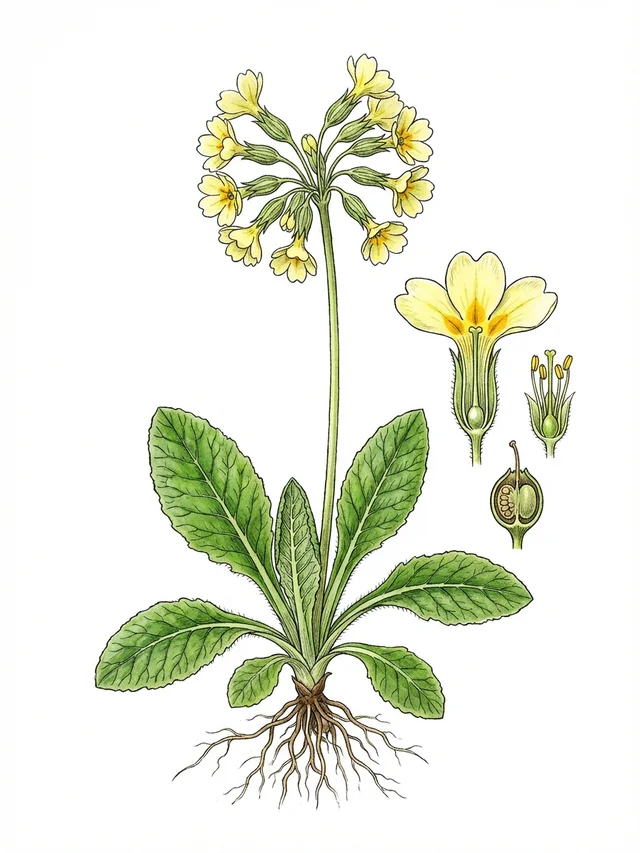
 Image to followAI-generated illustration
Blackstonia perfoliata
Blackstonia perfoliata
FamilyGenus: Blackstonianative in Germany
🌿
43
Species
interact
🔗
108
Interactions
documented
About this species
Native to Great Britain, Blackstonia perfoliata is a herbaceous plant that reaches about 25 cm in height. It bears flowers from April to August and provides both nectar and pollen, each rated 4, for visiting insects. The plant prefers sunny, moderately moist conditions on poor, alkaline soils and shows some tolerance of slight salinity. It is typically found in low-disturbance habitats.
Ecological network
Click to highlight connections · Click again to open the species page
Loading network...
PollinationFlower visit
Ecological significance
As a native species, Blackstonia perfoliata contributes nectar and pollen to local insect populations. Its nectar and pollen values are both rated 4, indicating a meaningful benefit for pollinators.
Annual cycle
Flowering is recorded from April to August. Details of the full yearly cycle beyond the flowering period are not provided in the evidence.
Safety note
No safety information is available for this plant.
Standort & Merkmale
Light
Sonne
Moisture
Frisch (Mäßig feucht)
Soil
Schwachzehrer (Magerer Boden)
Flowering period
Apr – Aug
Soil reaction
Basisch / Kalkhold
Bioregion
Continental
Nectar value
4
Pollen value
4
Growth form
Krautige Pflanze
Woodiness
Nicht verholzt
Leaf type
Breitblättrig
Plant height
0.25 m
Morphological traits: TRY ID3 (CC BY 3.0) & TRY ID81 (CC BY)
Pflege & Anbau
For cultivation, choose a sunny site with low-fertility, alkaline soil that retains some moisture. Provide fresh, moderately moist conditions. The plant is suited to nutrient-poor substrates and will tolerate a degree of salinity. Ensure minimal disturbance.
Scientific profile
Blackstonia perfoliata is a herbaceous, non-woody plant with broad leaves, native in Great Britain. It typically grows to a height of 0.25 m. Flowering takes place from April to August, offering nectar and pollen resources for pollinators, both valued at 4 on the available scale. The species is adapted to full sun and fresh, moderately moist conditions. It is indicative of calcareous or basic soils and is a poor-soil specialist, thriving where nutrient levels are low. Disturbance tolerance is low (severity 0.58), and slight salinity tolerance is noted. Its Ellenberg-type indicator values underline an affinity for strongly lit, alkaline environments.
Pollinators & visitors
27 Arten interagieren mit dieser Pflanze
Andrena flavipesLasioglossum puncticolleLasioglossum villosulumCeratina chalcitesLasioglossum subhirtumTrachusa byssinaMerodon albifronsEpisyrphus balteatusOsmia spinulosaLasioglossum albipesSeladonia tumulorumCeratina cyaneaHylaeus gredleriEristalis tenaxHylaeus brevicornisLasioglossum morioEristalis arbustorumMegachile versicolorSphaerophoria scriptaEupeodes lunigerOsmia rufohirtaSyrphus ribesiiHalictusLasioglossum malachurumLasioglossum transitoriumEucera oraniensisHalictus gemmeus
Other flower visitors
16 other species visit the flowers
SphaerophoriaSeladonia gemmeaAnthaxia scutellarisOedemera flavipesStomorhina lunataLepidargyrus ancoriferEmpis genualisAnthaxia parallelaOedemera barbaraSmicronyxAnthaxia dimidiataHemipenthes morioBraconidaeMerodon cf. albifronsSmicronyx sp1Braconinae sp1
Sources & data origin
•Interaktionsdaten via GloBI (CC-BY 4.0)
•pollinator_interactions
•FloraWeb / BfN
•EIVE 1.0 — Dengler et al. (2023), DOI: 10.3897/VCS.98324 (CC BY 4.0)
•EuPPollNet — Kuppler et al. (2025), DOI: 10.1111/geb.70000 (CC BY 4.0)
•Database of Pollinator Interactions (DoPI) — Pocock et al. (2022), DOI: 10.1002/ecy.3801 (CC BY)
•GBIF Backbone Taxonomy — GBIF Secretariat (2024), DOI: 10.15468/39omei (CC BY 4.0)
•TRY Categorical Traits (ID3) — Kattge et al. (2012), DOI: 10.17871/TRY.3 (CC BY 3.0)
•TRY Global Spectrum (ID81) — Díaz et al. (2016/2021), DOI: 10.17871/TRY.81 (CC BY)
•Govaerts R et al. (2025) — World Checklist of Vascular Plants (WCVP) v14. Royal Botanic Gardens, Kew. DOI: 10.34885/xs7h-ze42 (CC BY 4.0)
All data is licensed under CC BY 4.0, CC0, or compatible terms. Attribution according to license conditions. Full source overview →