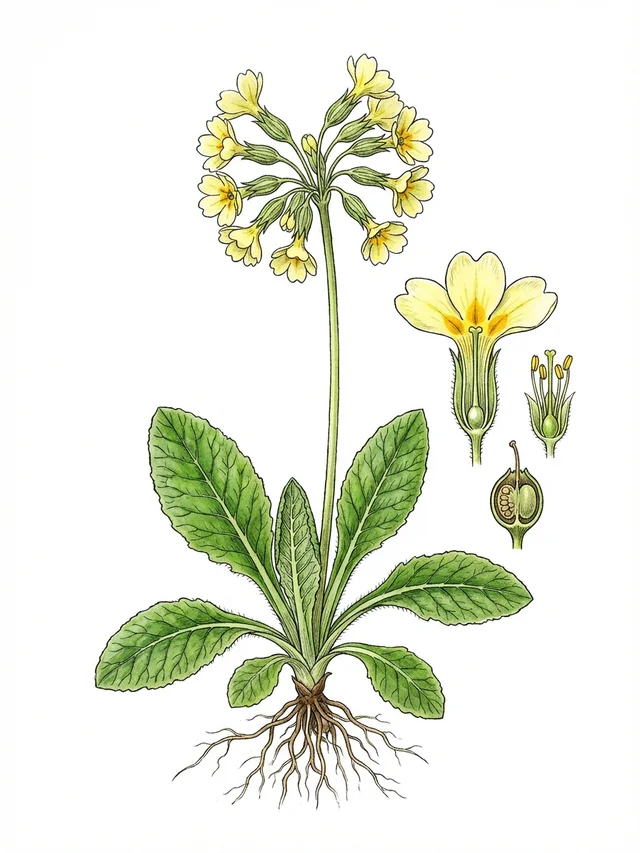
 Image to followAI-generated illustration
Hypericum androsaemum
Hypericum androsaemum
FamilyGenus: Johanniskräuternative in Germany
🌿
17
Species
interact
🔗
31
Interactions
documented
About this species
A native deciduous shrub of semi-shaded, moist places, Hypericum androsaemum bears bright yellow flowers in July and August. Its blossoms offer a moderate resource of nectar and pollen for bees and other pollinators.
Ecological network
Click to highlight connections · Click again to open the species page
Loading network...
PollinationFlower visit
Ecological significance
The flowers supply moderate amounts of nectar and pollen for insects during midsummer. As a native shrub, it integrates well into local ecological webs. It also engages in arbuscular mycorrhizal symbioses, which can support soil structure and nutrient cycling.
Annual cycle
A deciduous shrub that drops its leaves in winter and flushes anew in spring. Flowers appear in July and August, with fruits and seeds maturing thereafter.
Standort & Merkmale
Light
Halbschatten
Moisture
Feucht
Soil
—
Flowering period
Jul – Aug
Bioregion
Continental
Nectar value
3
Pollen value
3
Growth form
Strauch
Woodiness
Verholzt
Leaf type
Breitblättrig
Leaf phenology
Laubabwerfend
Plant height
0.654 m
Morphological traits: TRY ID3 (CC BY 3.0) & TRY ID81 (CC BY)
Pflege & Anbau
Grow in partial shade in a moisture-retentive, neutral to slightly acid soil that is not overly rich. Water during dry spells to maintain evenly moist conditions. Little pruning is needed; simply cut out dead or untidy stems after flowering. Avoid excessive disturbance of the root zone.
Scientific profile
Hypericum androsaemum is a deciduous, broad-leaved shrub that typically attains a height of about 65 cm. The plant has a preference for semi-shade and moist, neutral to slightly acid soils of medium nutrient status, and it thrives in relatively warm, low-disturbance situations. It forms arbuscular mycorrhizal associations. The leaves are broad, averaging 675 mm² in area, and the small seeds (diaspores) weigh around 0.07 mg. Yellow flowers open between July and August, contributing nectar and pollen each rated at 3 on a relative scale. Native in Great Britain, the species also occurs in its natural range across Europe.
Pollinators & visitors
16 Arten interagieren mit dieser Pflanze
Sources & data origin
•Interaktionsdaten via GloBI (CC-BY 4.0)
•pollinator_interactions
•EIVE 1.0 — Dengler et al. (2023), DOI: 10.3897/VCS.98324 (CC BY 4.0)
•EuPPollNet — Kuppler et al. (2025), DOI: 10.1111/geb.70000 (CC BY 4.0)
•Database of Pollinator Interactions (DoPI) — Pocock et al. (2022), DOI: 10.1002/ecy.3801 (CC BY)
•GBIF Backbone Taxonomy — GBIF Secretariat (2024), DOI: 10.15468/39omei (CC BY 4.0)
•TRY Categorical Traits (ID3) — Kattge et al. (2012), DOI: 10.17871/TRY.3 (CC BY 3.0)
•TRY Global Spectrum (ID81) — Díaz et al. (2016/2021), DOI: 10.17871/TRY.81 (CC BY)
•Govaerts R et al. (2025) — World Checklist of Vascular Plants (WCVP) v14. Royal Botanic Gardens, Kew. DOI: 10.34885/xs7h-ze42 (CC BY 4.0)
All data is licensed under CC BY 4.0, CC0, or compatible terms. Attribution according to license conditions. Full source overview →