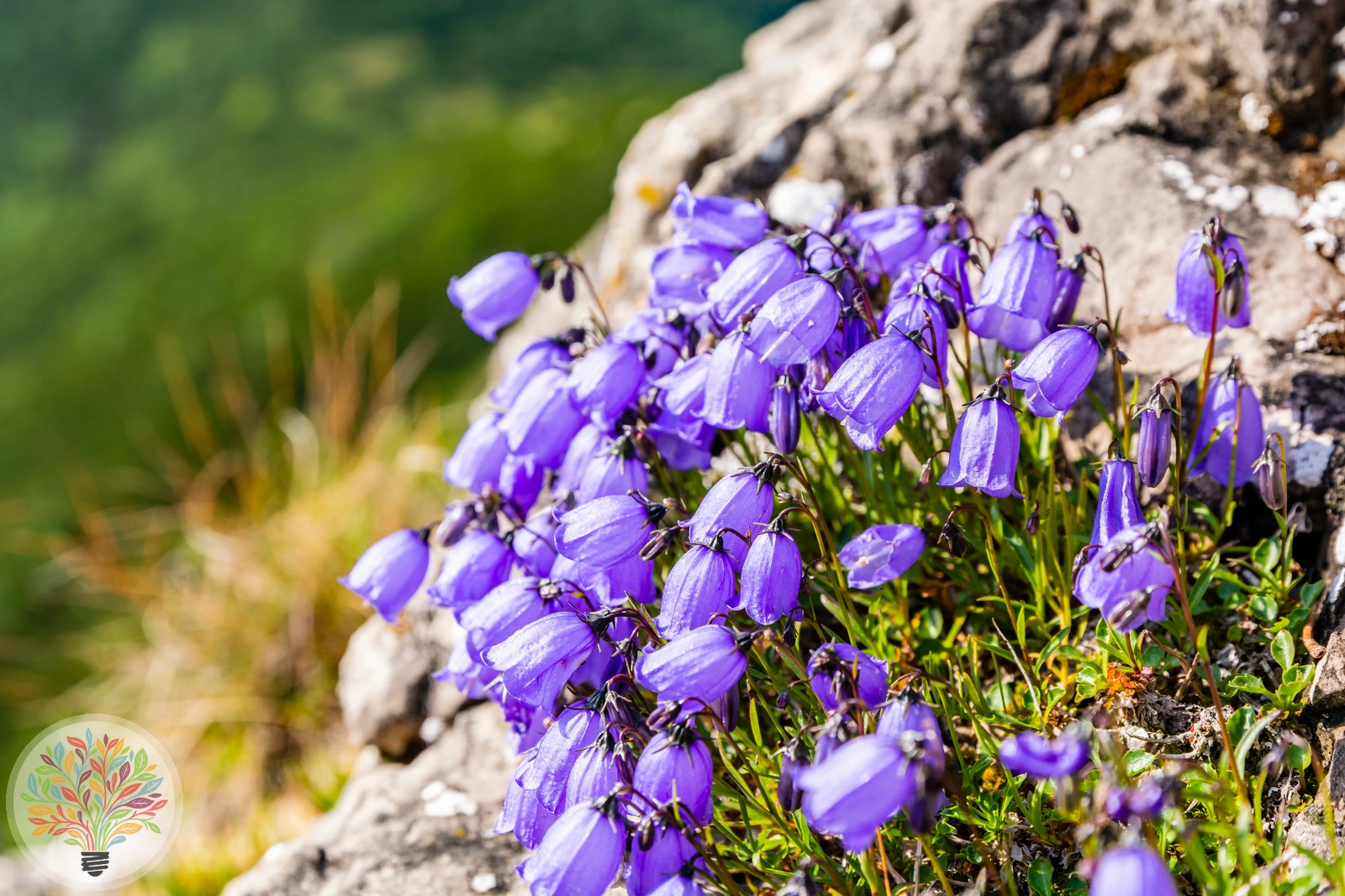
Campanula cochleariifolia
Campanula cochleariifolia
FamilyGenus: Campanulanative in Germany
🌿
7
Species
interact
🔗
32
Interactions
documented
About this species
Campanula cochleariifolia is a low-growing, evergreen herbaceous perennial that flowers from May to September, providing nectar and pollen for insects. In Great Britain it is recorded as an introduced and established species.
Ecological network
Click to highlight connections · Click again to open the species page
Loading network...
PollinationFlower visit
Ecological significance
The flowers produce nectar and pollen (rated 4 out of 9), providing a resource for pollinating insects.
Annual cycle
Flowering from May to September, with evergreen foliage present throughout the year.
Standort & Merkmale
Light
Sonne
Moisture
—
Soil
—
Flowering period
Mai – Sep
Bioregion
Continental
Nectar value
4
Pollen value
4
Growth form
Krautige Pflanze
Woodiness
Nicht verholzt
Leaf type
Breitblättrig
Leaf phenology
Immergrün
Plant height
0.055 m
Morphological traits: TRY ID3 (CC BY 3.0) & TRY ID81 (CC BY)
Pflege & Anbau
Prefers a sunny position in well-drained, calcareous soil of low fertility. Ideal for a rock garden or alpine trough where its compact, evergreen habit can be appreciated. Avoid rich soils and waterlogged conditions.
Scientific profile
Campanula cochleariifolia belongs to the bellflower family (Campanulaceae). It is an evergreen, non-woody, herbaceous plant with broad leaves. It typically reaches about 5.5 centimetres in height. The plant favours full sun on calcareous, nutrient-poor soils. The flowers appear from May to September, each offering nectar and pollen (rated 4 on a 0–9 scale). In Great Britain the species is introduced and established. It is associated with cold alpine or northern climates and low levels of disturbance.
Pollinators & visitors
4 Arten interagieren mit dieser Pflanze
Other flower visitors
3 other species visit the flowers
Coenosia obscuricolaDelia platuraBotanophila tuxeni
Sources & data origin
•Interaktionsdaten via GloBI (CC-BY 4.0)
•pollinator_interactions
•FloraWeb / BfN
•EIVE 1.0 — Dengler et al. (2023), DOI: 10.3897/VCS.98324 (CC BY 4.0)
•EuPPollNet — Kuppler et al. (2025), DOI: 10.1111/geb.70000 (CC BY 4.0)
•Database of Pollinator Interactions (DoPI) — Pocock et al. (2022), DOI: 10.1002/ecy.3801 (CC BY)
•GBIF Backbone Taxonomy — GBIF Secretariat (2024), DOI: 10.15468/39omei (CC BY 4.0)
•TRY Categorical Traits (ID3) — Kattge et al. (2012), DOI: 10.17871/TRY.3 (CC BY 3.0)
•TRY Global Spectrum (ID81) — Díaz et al. (2016/2021), DOI: 10.17871/TRY.81 (CC BY)
•Govaerts R et al. (2025) — World Checklist of Vascular Plants (WCVP) v14. Royal Botanic Gardens, Kew. DOI: 10.34885/xs7h-ze42 (CC BY 4.0)
•Foto: © Pawel Gubernat / Adobe Stock / AdobeStock_296934121
All data is licensed under CC BY 4.0, CC0, or compatible terms. Attribution according to license conditions. Full source overview →