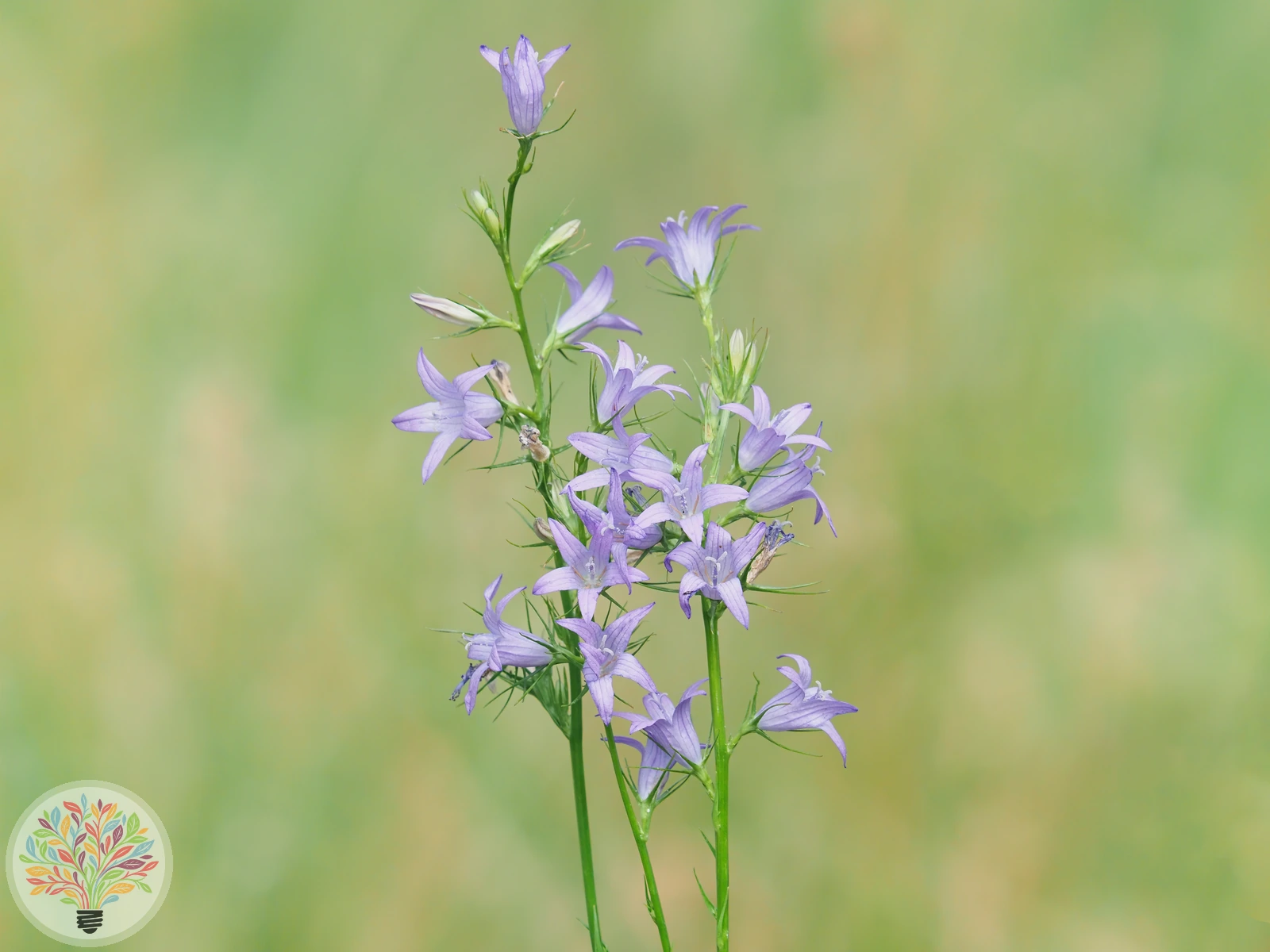
Campanula rapunculus
Campanula rapunculus
FamilyGenus: Campanulanative in Germany
🌿
20
Species
interact
🔗
36
Interactions
documented
About this species
Campanula rapunculus is an archaeophyte herbaceous perennial of dry, sunny places in Great Britain. It flowers from June to August, typically reaches about 60 cm in height, and thrives in warm, low-disturbance conditions.
Ecological network
Click to highlight connections · Click again to open the species page
Loading network...
PollinationFlower visit
Ecological significance
The flowers offer nectar and pollen, providing forage for bees and other pollinating insects.
Annual cycle
Flowering takes place from June to August, with bell-shaped blooms opening in succession. Seeds ripen in late summer and are dispersed by wind.
Standort & Merkmale
Light
Sonne
Moisture
Trocken
Soil
—
Flowering period
Jun – Aug
Bioregion
Continental
Nectar value
3
Pollen value
3
Growth form
Krautige Pflanze
Woodiness
Nicht verholzt
Leaf type
Breitblättrig
Plant height
0.596 m
Morphological traits: TRY ID3 (CC BY 3.0) & TRY ID81 (CC BY)
Pflege & Anbau
Grow Campanula rapunculus in full sun and well-drained, dry soil. It tolerates neutral to mildly acid conditions and requires minimal disturbance once established. Being mycorrhizal, it benefits from undisturbed ground with moderate fertility. Flowering occurs from early summer; little supplementary watering is needed.
Scientific profile
Campanula rapunculus is a herbaceous plant of the bellflower family, Campanulaceae, recorded as an archaeophyte in Great Britain. It typically reaches around 60 centimetres in height and bears broad leaves and upright stems topped with a spike of bell-shaped blossoms from June until August. The species favours full sun and dry, neutral to slightly acid soils, occurring in habitats that experience only light disturbance. The tiny seeds, with a mass of approximately 0.03 milligrams, are wind-dispersed. Roots form arbuscular mycorrhizal associations, which support nutrient uptake in moderately fertile conditions.
Pollinators & visitors
18 Arten interagieren mit dieser Pflanze
Bombus pascuorumBombus lapidariusBombus sylvestrisAndrena clarkellaPolyommatus icarusAndrena pandelleiChelostoma rapunculiChrysotoxum bicinctumLasioglossum costulatumCeratina cyaneaSphaerophoria scriptaBombus terrestrisEucera clypeataSeladonia tumulorumLasioglossum subhirtumChelostoma campanularumEpisyrphus balteatusPipizella zeneggenensis
Other flower visitors
2 other species visit the flowers
Synema globosumChelostoma.distinctum
Sources & data origin
•Interaktionsdaten via GloBI (CC-BY 4.0)
•pollinator_interactions
•FloraWeb / BfN
•EIVE 1.0 — Dengler et al. (2023), DOI: 10.3897/VCS.98324 (CC BY 4.0)
•EuPPollNet — Kuppler et al. (2025), DOI: 10.1111/geb.70000 (CC BY 4.0)
•Database of Pollinator Interactions (DoPI) — Pocock et al. (2022), DOI: 10.1002/ecy.3801 (CC BY)
•GBIF Backbone Taxonomy — GBIF Secretariat (2024), DOI: 10.15468/39omei (CC BY 4.0)
•TRY Categorical Traits (ID3) — Kattge et al. (2012), DOI: 10.17871/TRY.3 (CC BY 3.0)
•TRY Global Spectrum (ID81) — Díaz et al. (2016/2021), DOI: 10.17871/TRY.81 (CC BY)
•Govaerts R et al. (2025) — World Checklist of Vascular Plants (WCVP) v14. Royal Botanic Gardens, Kew. DOI: 10.34885/xs7h-ze42 (CC BY 4.0)
•Foto: © Adobe Stock / AdobeStock_1804275690
All data is licensed under CC BY 4.0, CC0, or compatible terms. Attribution according to license conditions. Full source overview →