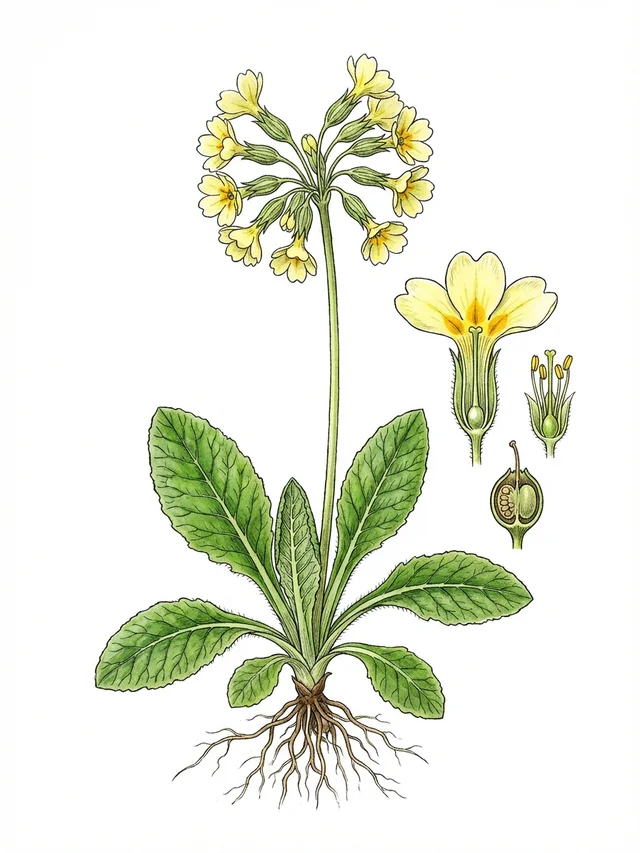
 Image to followAI-generated illustration
Cardamine hirsuta
Cardamine hirsuta
FamilyGenus: Cardaminenative in Germany
🌿
10
Species
interact
🔗
17
Interactions
documented
🐛
1
Host relationships
Species
About this species
Cardamine hirsuta is a small, native annual herb widespread in Great Britain. It forms a low rosette of broad, pinnate leaves and bears clusters of minute white flowers from March to June. Typically found in semi-shaded places with moist, fertile soil, it frequently colonises garden borders, path edges and disturbed ground.
Ecological network
Click to highlight connections · Click again to open the species page
Loading network...
PollinationLarval hostFlower visit
Ecological significance
No specific ecological impact data are available.
Annual cycle
Flowers from March to June.
Standort & Merkmale
Light
Halbschatten
Moisture
Frisch (Mäßig feucht)
Soil
Starkzehrer (Nährstoffreicher/Fetter Boden)
Flowering period
Mär – Jun
Soil reaction
Mäßig sauer bis neutral
Bioregion
Continental
Growth form
Krautige Pflanze
Woodiness
Nicht verholzt
Leaf type
Breitblättrig
Plant height
0.121 m
Morphological traits: TRY ID3 (CC BY 3.0) & TRY ID81 (CC BY)
Pflege & Anbau
Prefers semi-shade, moist soil and nutrient-rich ground.
Scientific profile
Cardamine hirsuta (Brassicaceae) is a terrestrial, non-woody annual. Mature plants attain a height of around 12 cm, with broad leaves averaging 322 mm² in area. Its exceptionally light seeds (diaspore mass ca 0.1 mg) are typical of small-seeded ruderal herbs. The species prefers semi-shaded conditions, neutral to weakly acid soil reaction, and consistently moist, nutrient-rich substrates. Disturbance tolerance is low (indicator severity 0.6). In Great Britain it is native and currently not threatened (Red List *).
Pollinators & visitors
6 Arten interagieren mit dieser Pflanze
Other flower visitors
3 other species visit the flowers
Kalcapion semivittatumDelia radicumBombylius
Sources & data origin
•Cook et al. (2025) UK Butterfly & Moth Traits (DOI: 10.5285/dbc7cc17-cbbd-49dd-bab4-8e8855768d66)
•Interaktionsdaten via GloBI (CC-BY 4.0)
•pollinator_interactions
•Baden-Böhm F, App M, Thiele J (2022) — The FloRes Database: A floral resources trait database for pollinator habitat-assessment generated by a multistep workflow. Johann Heinrich von Thünen-Institut, Dryad, DOI: 10.5061/dryad.djh9w0w29 (CC0)
•FloraWeb / BfN
•EIVE 1.0 — Dengler et al. (2023), DOI: 10.3897/VCS.98324 (CC BY 4.0)
•GBIF Backbone Taxonomy — GBIF Secretariat (2024), DOI: 10.15468/39omei (CC BY 4.0)
•TRY Categorical Traits (ID3) — Kattge et al. (2012), DOI: 10.17871/TRY.3 (CC BY 3.0)
•TRY Global Spectrum (ID81) — Díaz et al. (2016/2021), DOI: 10.17871/TRY.81 (CC BY)
•Govaerts R et al. (2025) — World Checklist of Vascular Plants (WCVP) v14. Royal Botanic Gardens, Kew. DOI: 10.34885/xs7h-ze42 (CC BY 4.0)
All data is licensed under CC BY 4.0, CC0, or compatible terms. Attribution according to license conditions. Full source overview →