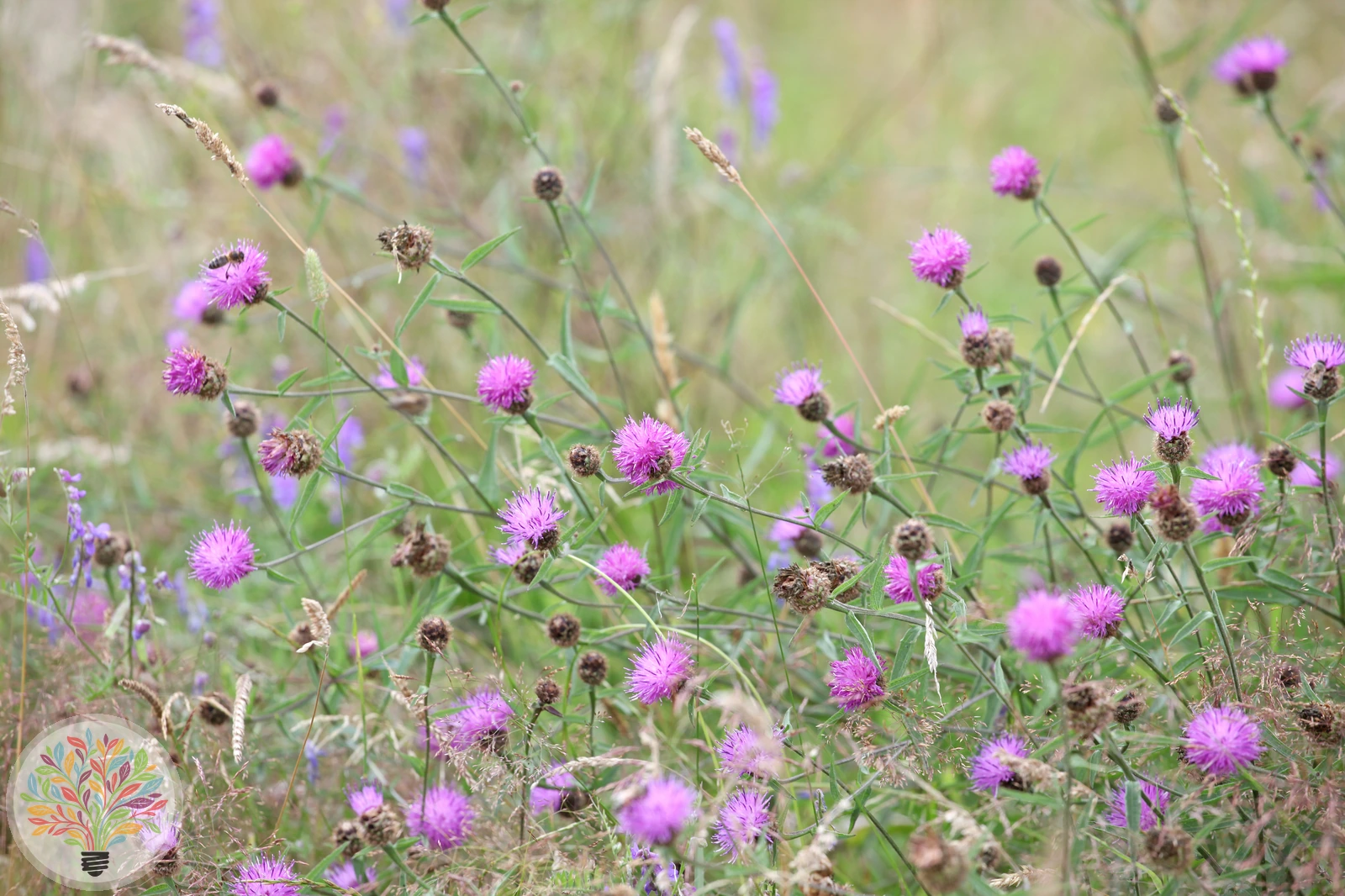
Centaurea nigra
Centaurea nigra
FamilyGenus: Centaureanative in Germany
🌿
180
Species
interact
🔗
769
Interactions
documented
🐛
4
Host relationships
Species
About this species
A native broad-leaved herbaceous plant of Great Britain, Centaurea nigra produces knapweed-like flower heads in July and August. It reaches about half a metre in height, thrives in full sun and moderately moist, neutral to slightly acid soils, and is safe for children.
Ecological network
Click to highlight connections · Click again to open the species page
Loading network...
PollinationLarval hostFlower visit
Ecological significance
As a native species, Centaurea nigra integrates into existing plant communities and is not recorded as invasive. It may be a nectar source for pollinators, though specific wildlife associations are not detailed in the available evidence.
Annual cycle
Flowering occurs in July and August. As a herbaceous species, its aerial growth is non-woody and it likely undergoes seasonal dieback, though specific winter hardiness details are not provided in the source data.
Safety note
The plant is non-toxic and safe around children.
Standort & Merkmale
Light
Sonne
Moisture
Frisch (Mäßig feucht)
Soil
Mittelzehrer (Normaler Boden)
Flowering period
Jul – Aug
Soil reaction
Mäßig sauer bis neutral
Bioregion
Continental
Growth form
Krautige Pflanze
Woodiness
Nicht verholzt
Leaf type
Breitblättrig
Plant height
0.497 m
Morphological traits: TRY ID3 (CC BY 3.0) & TRY ID81 (CC BY)
Pflege & Anbau
•
Light: Full sun.
•
Soil: Normal garden soil, fresh to moderately moist, neutral to slightly acid.
•
Feeding: None required; it is a moderate feeder.
•
Maintenance: Allow to self-seed and naturalise. Deadhead spent blooms if self-seeding is not wanted.
•
Safety: Non-toxic; suitable for gardens where children play.
Scientific profile
A non-woody herbaceous plant belonging to the Asteraceae family, Centaurea nigra is native in Great Britain. It commonly grows to approximately 0.5 metres tall and bears broad leaves. The flowering period extends from July to August. Ellenberg indicator values suggest a preference for full sun, fresh to moderately moist soil, moderate nutrient levels, and a neutral to slightly acid reaction. The species shows low disturbance tolerance. Individual diaspores have a mass of 2.53 mg, and leaves average around 1025 mm² in area.
Pollinators & visitors
120 Arten interagieren mit dieser Pflanze
Sphecodes rubicundusNomada fucataAndrena minutulaAndrena dorsataMacropis europaeaBombus terrestrisHalictus sexcinctusOsmia spinulosaAndrena flavipesBombus lapidariusBombus pascuorumLasioglossum leucozoniumBombus hortorumManiola jurtinaPieris napiMelanargia galatheaBombus barbutellusBombus vestalisHalictus tumulorumEristalis nemorumMegachile willughbiellaAndrena nigricepsBombus pratorumApis melliferaBombus rupestrisBombus unknownBombus terrestris/lucorumBombus campestrisHelophilus hybridusInachis ioBombus lucorumEupeodes lunigerSyrphus ribesiiHalictus rubicundusBombus muscorumVolucella bombylansEpistrophe grossulariaeSyrphus vitripennisPlatycheirus manicatusRhingia campestrisBombus sylvarumZygaena filipendulaePlatycheirus albimanusScaeva seleniticaLasioglossum nitidiusculumBombus soroeensisChrysotoxum bicinctumCheilosia vernalisEpistrophe diaphanaEristalis arbustorum
Host relationships
4 species use this plant as a host
Other flower visitors
56 other species visit the flowers
Bellardia vulgarisoedemera luridaRhagonycha fulvaOncotylus viridiflavusPhaonia incanaSphaerophoria scripta.groupCoccinella septempunctataDelia coarctataConops quadrifasciatusEmpis tessellataHelina setiventrisLagria hirtaMelanomya nanaMyospila meditabundaPherbellia cinerellaHylemya vagansGeomyza tripunctataNeomyia viridescensSaltella sphondyliiSiphona geniculataLucilia caesarEmpis lividaTenthredo brevicornisExorista rusticaScathophaga stercorariaPollenia rudisEriothrix rufomaculataAdia cinerellaChloromyia formosaRhinophora lepidaDrymeia hamataSicus ferrugineusMorellia hortorumHelina reversioOedemera nobilisAnthomyia liturataActia lamiaBithia spretaBotanophila brunneilineaPollenia pediculataSarcophaga carnariaEmpis griseaEmpis scoticaMeligethes viridescensCetema paramyopinaRhagonycha luteaSarcophaga variegataSarcophaga nigriventrisBotanophila fugaxPegoplata infirma
Sources & data origin
•Cook et al. (2025) UK Butterfly & Moth Traits (DOI: 10.5285/dbc7cc17-cbbd-49dd-bab4-8e8855768d66)
•pollinator_interactions
•FloraWeb / BfN
•EIVE 1.0 — Dengler et al. (2023), DOI: 10.3897/VCS.98324 (CC BY 4.0)
•GBIF Backbone Taxonomy — GBIF Secretariat (2024), DOI: 10.15468/39omei (CC BY 4.0)
•TRY Categorical Traits (ID3) — Kattge et al. (2012), DOI: 10.17871/TRY.3 (CC BY 3.0)
•TRY Global Spectrum (ID81) — Díaz et al. (2016/2021), DOI: 10.17871/TRY.81 (CC BY)
•Govaerts R et al. (2025) — World Checklist of Vascular Plants (WCVP) v14. Royal Botanic Gardens, Kew. DOI: 10.34885/xs7h-ze42 (CC BY 4.0)
•Foto: © Adobe Stock / AdobeStock_914534251
All data is licensed under CC BY 4.0, CC0, or compatible terms. Attribution according to license conditions. Full source overview →