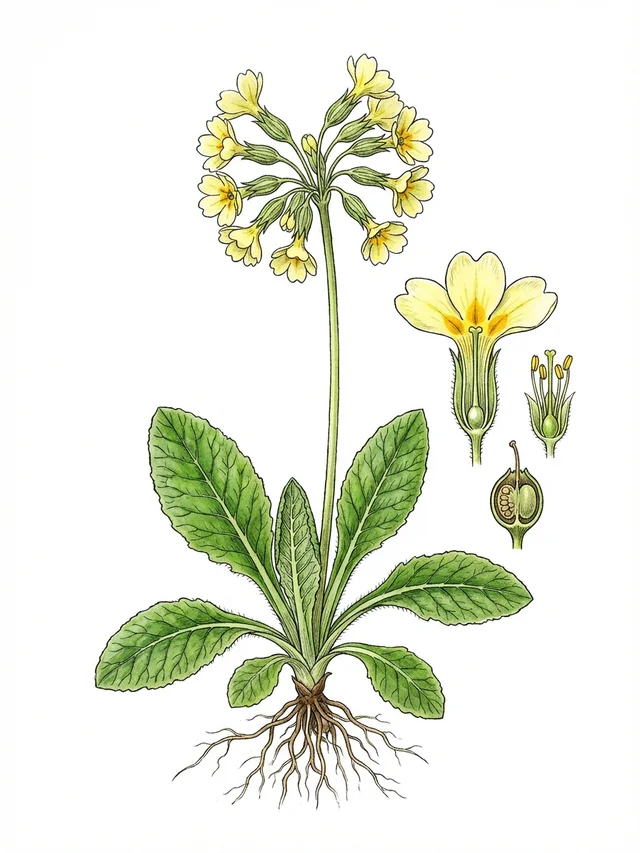
 Image to followAI-generated illustration
Cochlearia officinalis
Cochlearia officinalis
FamilyGenus: Cochlearianative in Germany
🌿
9
Species
interact
🔗
10
Interactions
documented
About this species
A native herbaceous plant of Great Britain, Cochlearia officinalis is a broad-leaved, non-woody species that grows in full sun on fresh to moist, moderately fertile soils. It is slightly salt-tolerant and well adapted to low-disturbance habitats. White flowers appear from May to June, attracting local wildlife.
Ecological network
Click to highlight connections · Click again to open the species page
Loading network...
PollinationFlower visit
Ecological significance
As a native species, Cochlearia officinalis supports local insect life with its early summer flowers. It is particularly at home in coastal and damp grassland habitats, contributing to the natural diversity of these communities without posing any known ecological threat.
Annual cycle
Foliage appears in spring and dies back in autumn, with the flowering period concentrated in May and June.
Standort & Merkmale
Light
Sonne
Moisture
Frisch (Mäßig feucht)
Soil
Mittelzehrer (Normaler Boden)
Flowering period
Mai – Jun
Soil reaction
Mäßig sauer bis neutral
Bioregion
Continental
Growth form
Krautige Pflanze
Woodiness
Nicht verholzt
Leaf type
Breitblättrig
Plant height
0.219 m
Morphological traits: TRY ID3 (CC BY 3.0) & TRY ID81 (CC BY)
Pflege & Anbau
## Cultivation
•
Light: Full sun
•
Soil: Moderately fertile, neutral to slightly acid, fresh to moist. Tolerates slight salinity.
•
Watering: Keep the soil evenly moist, especially in dry periods.
•
Position: Suitable for coastal gardens, rockeries or wildflower meadows with low disturbance.
•
Maintenance: Minimal; cut back spent stems after flowering if desired.
Scientific profile
Cochlearia officinalis is a native wildflower in Great Britain. It is a terrestrial, herbaceous plant with broad leaves and non-woody stems, typically reaching around 22 cm in height. The species prefers full sun and fresh to moist soil of neutral to slightly acid reaction, with moderate nutrient supply. It is slightly salt-tolerant, a feature that suits coastal locations, and it occurs in habitats with low disturbance levels. The leaf area averages about 155 mm², and the small seeds have a diaspore mass of around 0.45 mg. Blooming from May to June, the plant provides pollen and nectar for visiting insects.
Other flower visitors
8 other species visit the flowers
Fulmarus glacialisLagopus mutaBrassicogethes aeneusAnthophagus alpinusCeutorhynchus contractusDrymeia hamataMeligethes aeneusDelia radicum
Sources & data origin
•Interaktionsdaten via GloBI (CC-BY 4.0)
•pollinator_interactions
•FloraWeb / BfN
•EIVE 1.0 — Dengler et al. (2023), DOI: 10.3897/VCS.98324 (CC BY 4.0)
•GBIF Backbone Taxonomy — GBIF Secretariat (2024), DOI: 10.15468/39omei (CC BY 4.0)
•TRY Categorical Traits (ID3) — Kattge et al. (2012), DOI: 10.17871/TRY.3 (CC BY 3.0)
•TRY Global Spectrum (ID81) — Díaz et al. (2016/2021), DOI: 10.17871/TRY.81 (CC BY)
•Govaerts R et al. (2025) — World Checklist of Vascular Plants (WCVP) v14. Royal Botanic Gardens, Kew. DOI: 10.34885/xs7h-ze42 (CC BY 4.0)
All data is licensed under CC BY 4.0, CC0, or compatible terms. Attribution according to license conditions. Full source overview →