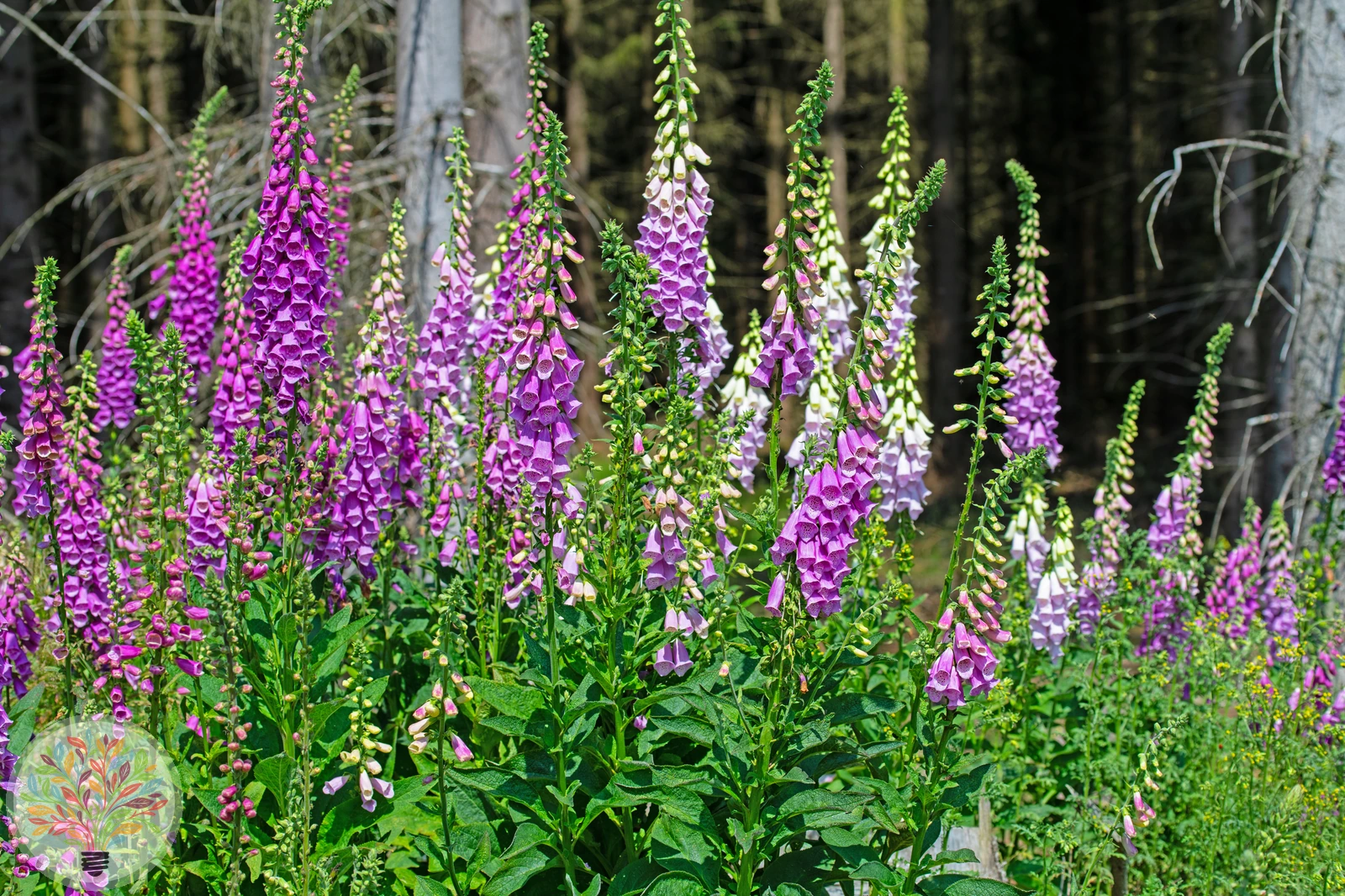
Digitalis purpurea
Digitalis purpurea
FamilyGenus: Digitalisnative in Germany
🌿
43
Species
interact
🔗
104
Interactions
documented
🐛
9
Host relationships
Species
About this species
Digitalis purpurea is a native herbaceous plant in Great Britain, producing tall spikes of bell-shaped flowers during June and July. It thrives in partial shade on fresh, acidic, normal soils, and its large leaves and fine seeds are characteristic traits.
Ecological network
Click to highlight connections · Click again to open the species page
Loading network...
PollinationLarval hostFlower visit
Ecological significance
Digitalis purpurea is a natural component of British woodland edges, hedgerows and heathland. It is not recorded as introduced or invasive in Great Britain, and its presence is considered a normal part of native vegetation dynamics.
Annual cycle
In spring, basal rosettes of large leaves are visible. Flowering spikes elongate through early summer, with the main bloom period falling in June and July. After pollination, numerous tiny seeds are shed; the parent plant then typically dies back, relying on seed for renewal.
Safety note
All parts of Digitalis purpurea contain toxic cardiac glycosides. Ingestion can cause serious illness, and the sap may irritate skin. Always wear gloves when handling the plant, and ensure it is kept out of reach of children and pets.
Standort & Merkmale
Light
Halbschatten
Moisture
Frisch (Mäßig feucht)
Soil
Mittelzehrer (Normaler Boden)
Flowering period
Jun – Jul
Soil reaction
Sauer (Säurezeiger)
Bioregion
Continental
Growth form
Krautige Pflanze
Woodiness
Nicht verholzt
Leaf type
Breitblättrig
Plant height
0.814 m
Morphological traits: TRY ID3 (CC BY 3.0) & TRY ID81 (CC BY)
Pflege & Anbau
Plant Digitalis purpurea in partial shade, in moisture-retentive but well-drained acidic soil. Keep the ground fresh to moderately moist, watering during dry spells. A normal soil with moderate fertility is sufficient; heavy feeding is unnecessary. Choose a location with low disturbance to respect its natural growth rhythm. Allow some flower spikes to set seed for natural regeneration, as the small diaspores drift readily into gaps. Wear gloves when handling, as all parts of the plant are toxic; keep away from children and pets.
Scientific profile
A native wild plant of Great Britain, Digitalis purpurea is an upright herbaceous perennial or biennial that commonly reaches about 0.8 metres in height. The broad leaves form a basal rosette in the first year, followed in the second year by a tall flowering stem. Blooming takes place from June to July, when the characteristic tubular flowers open. The plant is non-woody and has markedly large leaves averaging over 32,000 mm², while the minute seeds weigh less than 0.1 mg each. It is typically found in half-shade, on fresh to moderately moist, acidic soils with low disturbance, and tolerates a normal nutrient supply. The species is not listed under any threat category and maintains a stable presence in suitable habitats.
Pollinators & visitors
29 Arten interagieren mit dieser Pflanze
Bombus hypnorumBombus sylvestrisBombus lucorumApis melliferaVespula germanicaManiola jurtinaArgynnis paphiaLeptidea sinapisBombus vestalisBombus pratorumBombus lapidariusBombus ruderatusBombus barbutellusBombus jonellusBombus campestrisBombus humilisBombus pascuorumPieris rapaeBombus muscorumBombus hortorumMelitaea didymaLasioglossum sexnotatumBombus soroeensisAnthidium manicatumBombus terrestrisMellicta athaliaPararge aegeriaEpisyrphus balteatusEristalis horticola
Host relationships
9 species use this plant as a host
Melitaea athaliaCallimorpha dominulaEuplexia luciparaGortyna flavagoDiarsia rubiNoctua pronubaDiarsia brunneaNoctua comes HübnerAntitype chi
Other flower visitors
5 other species visit the flowers
Sources & data origin
•Cook et al. (2025) UK Butterfly & Moth Traits (DOI: 10.5285/dbc7cc17-cbbd-49dd-bab4-8e8855768d66)
•Interaktionsdaten via GloBI (CC-BY 4.0)
•pollinator_interactions
•Baden-Böhm F, App M, Thiele J (2022) — The FloRes Database: A floral resources trait database for pollinator habitat-assessment generated by a multistep workflow. Johann Heinrich von Thünen-Institut, Dryad, DOI: 10.5061/dryad.djh9w0w29 (CC0)
•FloraWeb / BfN
•EIVE 1.0 — Dengler et al. (2023), DOI: 10.3897/VCS.98324 (CC BY 4.0)
•GBIF Backbone Taxonomy — GBIF Secretariat (2024), DOI: 10.15468/39omei (CC BY 4.0)
•TRY Categorical Traits (ID3) — Kattge et al. (2012), DOI: 10.17871/TRY.3 (CC BY 3.0)
•TRY Global Spectrum (ID81) — Díaz et al. (2016/2021), DOI: 10.17871/TRY.81 (CC BY)
•Govaerts R et al. (2025) — World Checklist of Vascular Plants (WCVP) v14. Royal Botanic Gardens, Kew. DOI: 10.34885/xs7h-ze42 (CC BY 4.0)
•Foto: © Adobe Stock / AdobeStock_916549946
All data is licensed under CC BY 4.0, CC0, or compatible terms. Attribution according to license conditions. Full source overview →