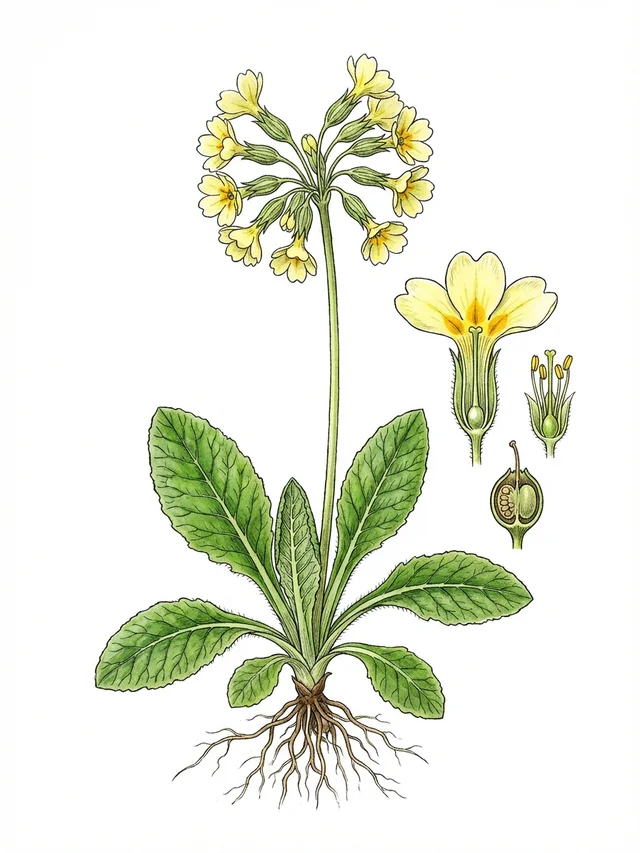
 Image to followAI-generated illustration
Dioscorea communis
Dioscorea communis
FamilyGenus: Dioscoreanative in Germany
🌿
41
Species
interact
🔗
50
Interactions
documented
About this species
A native climbing plant found in Great Britain, Dioscorea communis is non-woody and broad-leaved, reaching around 2 m in height. It thrives in semi-shaded places with fresh, moderately moist, calcareous soil and flowers from April to June.
Ecological network
Click to highlight connections · Click again to open the species page
Loading network...
PollinationFlower visit
Ecological significance
It contributes structural diversity in hedgerows and woodland edges as a climbing plant and forms arbuscular mycorrhizal associations. Further ecological interactions are not detailed in the available evidence.
Annual cycle
Flowering takes place from April to June.
Safety note
No adverse effects or hazards are recorded in the available evidence.
Standort & Merkmale
Light
Halbschatten
Moisture
Frisch (Mäßig feucht)
Soil
Mittelzehrer (Normaler Boden)
Flowering period
Apr – Jun
Soil reaction
Basisch / Kalkhold
Bioregion
Continental
Growth form
Kletterpflanze
Woodiness
Nicht verholzt
Leaf type
Breitblättrig
Plant height
2.163 m
Morphological traits: TRY ID3 (CC BY 3.0) & TRY ID81 (CC BY)
Pflege & Anbau
This native climber is best suited to wilder, semi-shaded situations with a moisture-retentive but well-drained, lime-rich soil. It can be allowed to scramble through shrubs or over a support. Little maintenance is required once it is established.
Scientific profile
Dioscorea communis is a native climbing plant in Great Britain. It is non-woody and bears broad leaves. The plant typically attains a height of about 2.16 metres. It grows in semi-shaded conditions and favours fresh, moderately moist soil that is calcareous or basic. It is a moderate nutrient feeder and tolerates only low levels of disturbance. Flowering occurs from April to June. Mycorrhizal associations are of the arbuscular mycorrhiza type.
Other flower visitors
40 other species visit the flowers
Corvus coroneSturnus vulgarisTurdus philomelosTurdus pilarisTurdus torquatusPasser domesticusSylvia communisSylvia currucaAegithalos caudatusTurdus viscivorusSaxicola torquatusSylvia atricapillaGarrulus glandariusSylvia borinFringilla coelebsPyrrhula pyrrhulaPhoenicurus phoenicurusCettia cettiFicedula hypoleucaPhylloscopus bonelliErithacus rubeculaTurdus merulaFormica fuscaCapreolus capreolusPoecile montanusSitta europaeaPoecile palustrisTurdus iliacusPica picaPicus viridisParus majorColumba palumbusGallinula chloropusEmberiza ciaCyanistes caeruleusPhylloscopus trochilusSylvia cantillansSylvia undataLuscinia megarhynchosMuscicapa striata
Sources & data origin
•Interaktionsdaten via GloBI (CC-BY 4.0)
•pollinator_interactions
•FloraWeb / BfN
•EIVE 1.0 — Dengler et al. (2023), DOI: 10.3897/VCS.98324 (CC BY 4.0)
•GBIF Backbone Taxonomy — GBIF Secretariat (2024), DOI: 10.15468/39omei (CC BY 4.0)
•TRY Categorical Traits (ID3) — Kattge et al. (2012), DOI: 10.17871/TRY.3 (CC BY 3.0)
•TRY Global Spectrum (ID81) — Díaz et al. (2016/2021), DOI: 10.17871/TRY.81 (CC BY)
•Govaerts R et al. (2025) — World Checklist of Vascular Plants (WCVP) v14. Royal Botanic Gardens, Kew. DOI: 10.34885/xs7h-ze42 (CC BY 4.0)
All data is licensed under CC BY 4.0, CC0, or compatible terms. Attribution according to license conditions. Full source overview →