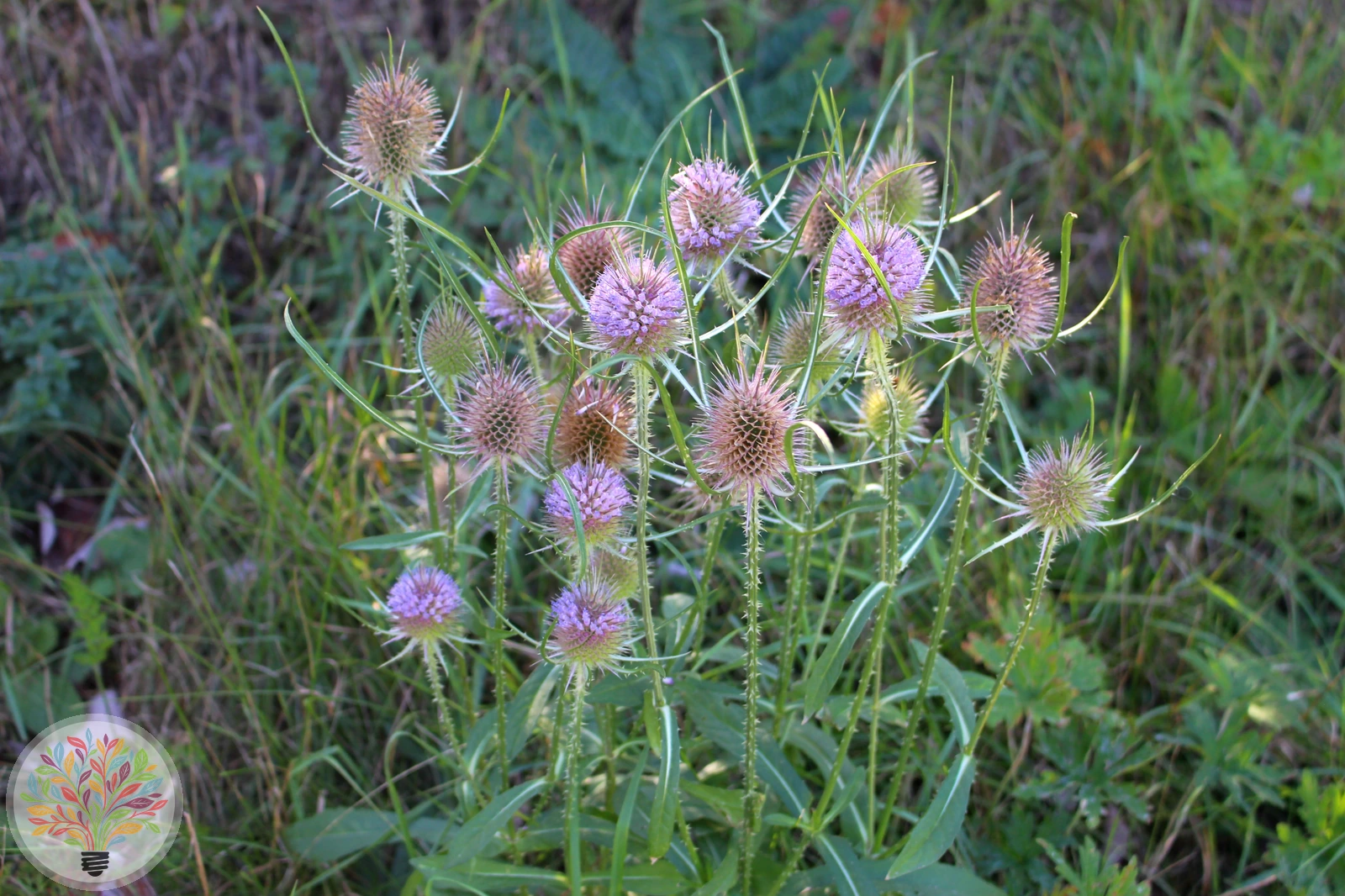
Dipsacus fullonum
Dipsacus fullonum
FamilyGenus: Dipsacusnative in Germany
🌿
67
Species
interact
🔗
142
Interactions
documented
🐛
2
Host relationships
Species
About this species
Dipsacus fullonum is a tall herbaceous plant with broad leaves, favouring sunny, nutrient-rich, alkaline soils. It produces nectar- and pollen-rich flowers in midsummer that are attractive to insects.
Ecological network
Click to highlight connections · Click again to open the species page
Loading network...
PollinationLarval hostFlower visit
Ecological significance
The flowers provide a rich source of nectar and pollen for bees, butterflies and other pollinators during mid-summer.
Annual cycle
Flowering occurs in July and August.
Safety note
No safety concerns are noted in the available evidence.
Standort & Merkmale
Light
Sonne
Moisture
Frisch (Mäßig feucht)
Soil
Starkzehrer (Nährstoffreicher/Fetter Boden)
Flowering period
Jul – Aug
Soil reaction
Basisch / Kalkhold
Bioregion
Continental
Nectar value
4
Pollen value
4
Growth form
Krautige Pflanze
Woodiness
Nicht verholzt
Leaf type
Breitblättrig
Plant height
1.22 m
Morphological traits: TRY ID3 (CC BY 3.0) & TRY ID81 (CC BY)
Corolla tube
10 mm
Nectar
9.7611 µl/Blüte
Pollen
14.5524 mg/Blüte
Pflege & Anbau
•
Light: Full sun
•
Soil: Moisture-retentive, nutrient-rich, calcareous (alkaline) loam
•
Watering: Maintain moderate soil moisture
•
Position: Sheltered from strong disturbance
•
Flowering: July to August
Scientific profile
Dipsacus fullonum is a herbaceous perennial of the honeysuckle family, Caprifoliaceae. It typically reaches 1.22 metres in height and bears broad, non-woody leaves on upright stems. The plant thrives in full sun on fresh, moderately moist soils that are nutrient-rich and calcareous, and it tolerates only low levels of disturbance. Cylindrical flower heads appear in July and August, each offering abundant nectar and pollen (value 4 on a standard scale) that attract a wide range of pollinating insects. A terrestrial species adapted to moderately warm conditions, it has no tolerance of salinity. Its original range covers much of Europe and temperate Asia, though it is not recorded as a wild plant in Great Britain.
Pollinators & visitors
56 Arten interagieren mit dieser Pflanze
Bombus sylvestrisSatyrium w-albumThymelicus sylvestrisPolyommatus icarusManiola jurtinaAglais urticaeSpeyeria aglajaBombus ruderariusLycaena phlaeasPararge aegeriaGonepteryx rhamniBombus ruderatusCelastrina argiolusHipparchia semeleBombus sylvarumBombus hortorumBombus hypnorumBombus humilisBombus campestrisBombus lapidariusBombus muscorumBombus pratorumBombus barbutellusBombus jonellusBombus pascuorumBombus lucorumPolygonia c-albumPyronia tithonusPieris napiBombus vestalisAromia moschataPieris rapaeIphiclides podaliriusBombus soroeensisZygaena carniolicaLasiommata megeraMelanargia galatheaTyta luctuosa (Denis & Schiffermüller), 1775Vanessa carduiPapilio machaonArgynnis paphiaApis melliferaZygaena filipendulaeHalictus scabiosaeVanessa atalantaBombus bohemicusPieris brassicaeBombus terrestrisHesperia commaSyrphus ribesii
Host relationships
2 species use this plant as a host
Euphydryas auriniaAglais io
Other flower visitors
9 other species visit the flowers
Carduelis carduelisHippodamia variegataCantharis fuscaOxythyrea funestaPatania ruralisChrysomela vigintipunctataCoccinella septempunctataChorebus tanisTrachusa interrupta
Sources & data origin
•Interaktionsdaten via GloBI (CC-BY 4.0)
•Cook et al. (2025) UK Butterfly & Moth Traits (DOI: 10.5285/dbc7cc17-cbbd-49dd-bab4-8e8855768d66)
•pollinator_interactions
•Baden-Böhm F, App M, Thiele J (2022) — The FloRes Database: A floral resources trait database for pollinator habitat-assessment generated by a multistep workflow. Johann Heinrich von Thünen-Institut, Dryad, DOI: 10.5061/dryad.djh9w0w29 (CC0)
•FloraWeb / BfN
•EIVE 1.0 — Dengler et al. (2023), DOI: 10.3897/VCS.98324 (CC BY 4.0)
•EuPPollNet — Kuppler et al. (2025), DOI: 10.1111/geb.70000 (CC BY 4.0)
•Database of Pollinator Interactions (DoPI) — Pocock et al. (2022), DOI: 10.1002/ecy.3801 (CC BY)
•GBIF Backbone Taxonomy — GBIF Secretariat (2024), DOI: 10.15468/39omei (CC BY 4.0)
•TRY Categorical Traits (ID3) — Kattge et al. (2012), DOI: 10.17871/TRY.3 (CC BY 3.0)
•TRY Global Spectrum (ID81) — Díaz et al. (2016/2021), DOI: 10.17871/TRY.81 (CC BY)
•Govaerts R et al. (2025) — World Checklist of Vascular Plants (WCVP) v14. Royal Botanic Gardens, Kew. DOI: 10.34885/xs7h-ze42 (CC BY 4.0)
•Foto: © Adobe Stock / AdobeStock_322498706
All data is licensed under CC BY 4.0, CC0, or compatible terms. Attribution according to license conditions. Full source overview →