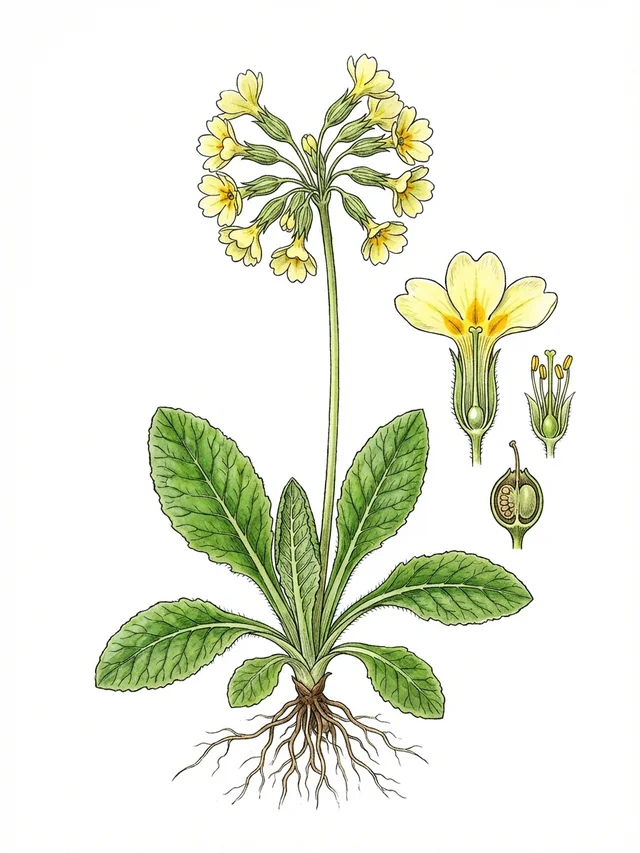
 Image to followAI-generated illustration
Drosera rotundifolia
Drosera rotundifolia
FamilyGenus: Sonnentaunative in Germany
🌿
1
Species
interact
🔗
2
Interactions
documented
About this species
Drosera rotundifolia is a native carnivorous plant of nutrient-poor, acidic wetlands in Great Britain. It catches insects with its round, sticky leaves to supplement the meagre nutrient supply. The small herbaceous plant reaches about 8 cm in height and produces white flowers from June to August.
Ecological network
Click to highlight connections · Click again to open the species page
Loading network...
Pollination
Ecological significance
As a carnivorous plant, Drosera rotundifolia supplements the extremely low nutrient availability in its bog habitat by capturing small invertebrates. It forms part of a specialised wetland community and contributes to local nutrient cycling without becoming invasive.
Annual cycle
Leaves are produced during the warmer months, with flowering taking place from June to August.
Safety note
No specific hazards are recorded for this species.
Standort & Merkmale
Light
Sonne
Moisture
Feucht
Soil
Schwachzehrer (Magerer Boden)
Flowering period
Jun – Aug
Soil reaction
Sauer (Säurezeiger)
Bioregion
Continental
Growth form
Krautige Pflanze
Woodiness
Nicht verholzt
Leaf type
Breitblättrig
Plant height
0.077 m
Morphological traits: TRY ID3 (CC BY 3.0) & TRY ID81 (CC BY)
Pflege & Anbau
Grow in full sun in a damp, acidic and nutrient-poor medium, such as a mixture of peat and sand. Keep the substrate constantly wet, using rainwater rather than tap water. Do not apply any fertiliser. The plant is well suited to bog gardens or containers placed in an open, bright position.
Scientific profile
Drosera rotundifolia is a small, herbaceous, non-woody carnivorous plant. It forms a ground-level rosette of broad, rounded leaves that are covered with glandular hairs exuding a sticky mucilage for trapping insects. The plant grows to a height of around 8 cm and has leaf areas of approximately 47 mm². It is a terrestrial species that requires full sun, permanently wet conditions, strongly acidic substrates and extremely nutrient-poor soils. Its roots associate with arbuscular mycorrhizal fungi. Flowering occurs from June to August, and the dust-like seeds weigh about 0.013 mg. The species is native in Great Britain, typically inhabiting bogs and other acidic, peaty wetlands.
Sources & data origin
•Interaktionsdaten via GloBI (CC-BY 4.0)
•FloraWeb / BfN
•EIVE 1.0 — Dengler et al. (2023), DOI: 10.3897/VCS.98324 (CC BY 4.0)
•GBIF Backbone Taxonomy — GBIF Secretariat (2024), DOI: 10.15468/39omei (CC BY 4.0)
•TRY Categorical Traits (ID3) — Kattge et al. (2012), DOI: 10.17871/TRY.3 (CC BY 3.0)
•TRY Global Spectrum (ID81) — Díaz et al. (2016/2021), DOI: 10.17871/TRY.81 (CC BY)
•Govaerts R et al. (2025) — World Checklist of Vascular Plants (WCVP) v14. Royal Botanic Gardens, Kew. DOI: 10.34885/xs7h-ze42 (CC BY 4.0)
All data is licensed under CC BY 4.0, CC0, or compatible terms. Attribution according to license conditions. Full source overview →