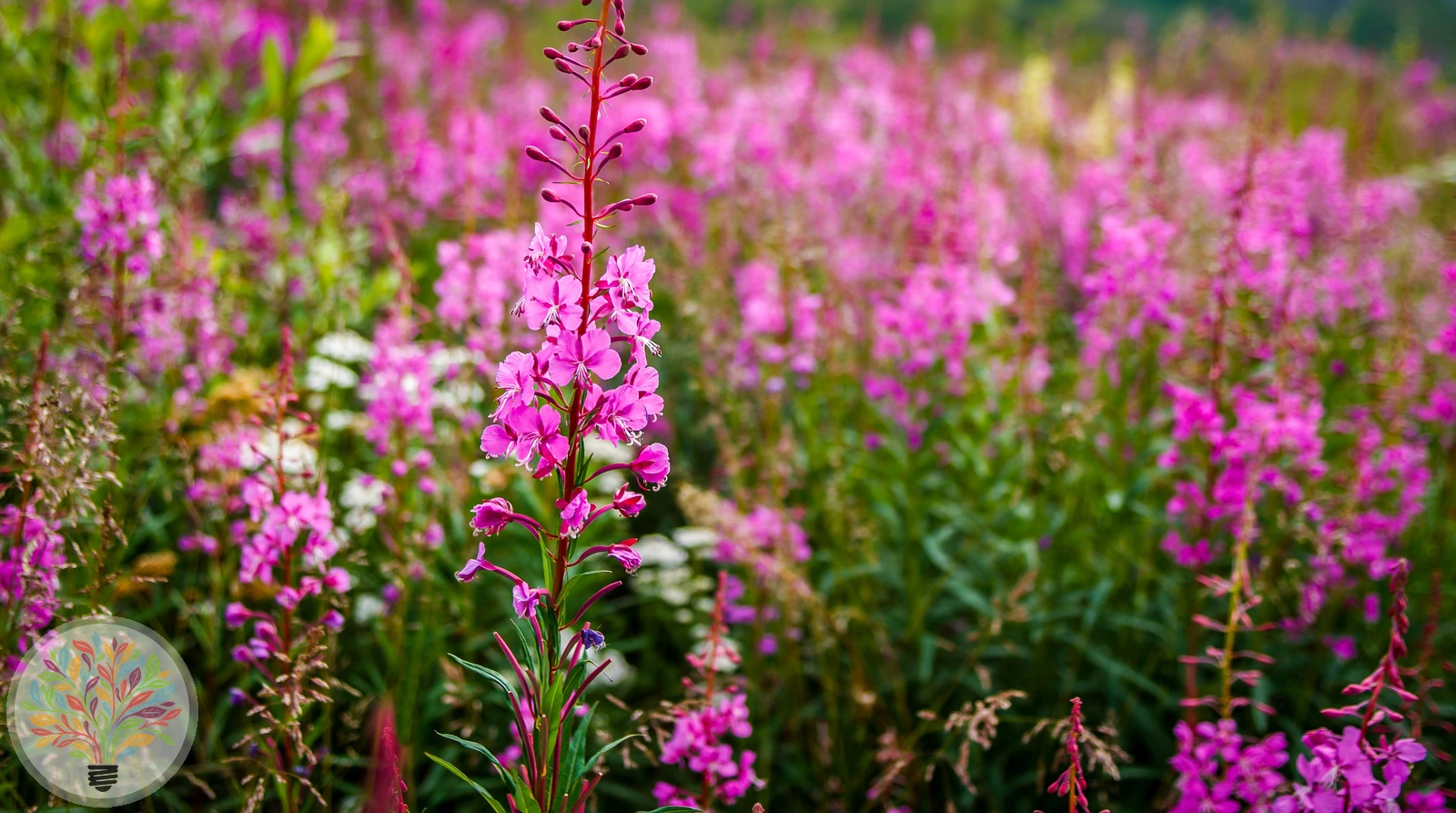
Epilobium angustifolium
Epilobium angustifolium
FamilyGenus: Weidenröschennative in Germany
🌿
84
Species
interact
🔗
1494
Interactions
documented
🐛
12
Host relationships
Species
About this species
A native herbaceous perennial of Great Britain, Epilobium angustifolium is typically found in sunny, moderately moist habitats on fertile soils. It produces flowers from June to August and forms arbuscular mycorrhizal associations. Reaching about 0.8 metres in height, it bears broad leaves and is associated with low-disturbance conditions.
Ecological network
Click to highlight connections · Click again to open the species page
Loading network...
PollinationLarval hostFlower visit
Ecological significance
The evidence records no adverse ecological impacts. As a native wildflower, it is likely to provide nectar and pollen for insects and to participate in arbuscular mycorrhizal networks, though detailed interaction data are not available.
Annual cycle
New shoots emerge in spring, elongating into leafy stems. The flowering period runs from June through August. Seeds are set in late summer, after which the above-ground parts die back in autumn. The plant overwinters as a rootstock.
Safety note
Nothing in the evidence indicates toxicity or other hazards to humans or animals.
Standort & Merkmale
Light
Sonne
Moisture
Frisch (Mäßig feucht)
Soil
Starkzehrer (Nährstoffreicher/Fetter Boden)
Flowering period
Jun – Aug
Soil reaction
Mäßig sauer bis neutral
Bioregion
Continental
Growth form
Krautige Pflanze
Woodiness
Nicht verholzt
Leaf type
Breitblättrig
Plant height
0.832 m
Morphological traits: TRY ID3 (CC BY 3.0) & TRY ID81 (CC BY)
0
Pollen
11.45 mg/Blüte
Pflege & Anbau
Plant in full sun and a moisture-retentive but well-drained soil that is rich in organic matter. Being a heavy feeder, it benefits from well-rotted compost or a balanced fertiliser at planting time. Little maintenance is required once established; cut back dead stems in late winter before new growth appears.
Scientific profile
Epilobium angustifolium is a herbaceous, non-woody perennial in the willowherb family. Native wild in Great Britain, it occurs in sunny situations on fresh, nutrient-rich soils and is associated with low-disturbance habitats. Ellenberg-type indicator values describe a light-demanding species (light value 7), moderately warm temperatures, and low disturbance severity. Broad-leaved, the plant typically reaches a height of around 0.8 metres and has a leaf area of about 675 mm². Flowering spans June to August. The roots form arbuscular mycorrhizal symbioses.
Pollinators & visitors
60 Arten interagieren mit dieser Pflanze
Megachile centuncularisDeilephila elpenorApis melliferaPieris napiManiola jurtinaDolichovespula saxonicaAnastrangalia sanguinolentaBombus jonellusBombus wurfleniiBombus pratorumHalictus rubicundusBombus soroeensisEnoplognatha ovataHylaeus annulatusAnthophila fabricianaPolistes dominulamacroglossum stellatarumHesperia commaBombus pascuorumBombus hypnorumPieris rapaeLacanobia oleraceaThymelicus lineolaMegachile lapponicaBombus lucorumMellinus arvensisBombus bohemicusMacropis europaeaHalictus confususZygaena transalpinaBombus hortorumBombus monticolaBombus ruderariusBombus terrestrisBombus lapidariusBombus sylvarumBombus veteranusBombus sylavrumBombus cryptarumPsithyrus rupestrisPsithyrus campestrisPsithyrus vestalisPsithyrus sylvestrisPsithyrus bohemicusBombus schrenckiBombus distinguendusEpisyrphus balteatusSyritta pipiensPlatycheirus peltatusBombus missing
Host relationships
12 species use this plant as a host
Deilephila porcellusScoliopteryx libatrixOrthosia gothicaAmphipyra tragopoginisEupithecia subfuscataEcliptopera silaceataDiacrisia sannioDiaphora mendicaXestia c-nigrumCerastis rubricosaPhragmatobia fuliginosaGymnoscelis rufifasciata
Other flower visitors
12 other species visit the flowers
Misumena vatiaMacrothylacia rubiOxythyrea funestaPhyllobius oblongusPhyllopertha horticolaCoccinella septempunctataPyrausta aurataHarmonia axyridisOnesia floralisPhaonia angelicaeSicus ferrugineusSciara hemerobioides
Sources & data origin
•Interaktionsdaten via GloBI (CC-BY 4.0)
•pollinator_interactions
•Baden-Böhm F, App M, Thiele J (2022) — The FloRes Database: A floral resources trait database for pollinator habitat-assessment generated by a multistep workflow. Johann Heinrich von Thünen-Institut, Dryad, DOI: 10.5061/dryad.djh9w0w29 (CC0)
•FloraWeb / BfN
•EIVE 1.0 — Dengler et al. (2023), DOI: 10.3897/VCS.98324 (CC BY 4.0)
•GBIF Backbone Taxonomy — GBIF Secretariat (2024), DOI: 10.15468/39omei (CC BY 4.0)
•TRY Categorical Traits (ID3) — Kattge et al. (2012), DOI: 10.17871/TRY.3 (CC BY 3.0)
•TRY Global Spectrum (ID81) — Díaz et al. (2016/2021), DOI: 10.17871/TRY.81 (CC BY)
•Govaerts R et al. (2025) — World Checklist of Vascular Plants (WCVP) v14. Royal Botanic Gardens, Kew. DOI: 10.34885/xs7h-ze42 (CC BY 4.0)
•Foto: © Adobe Stock / AdobeStock_250135930
All data is licensed under CC BY 4.0, CC0, or compatible terms. Attribution according to license conditions. Full source overview →