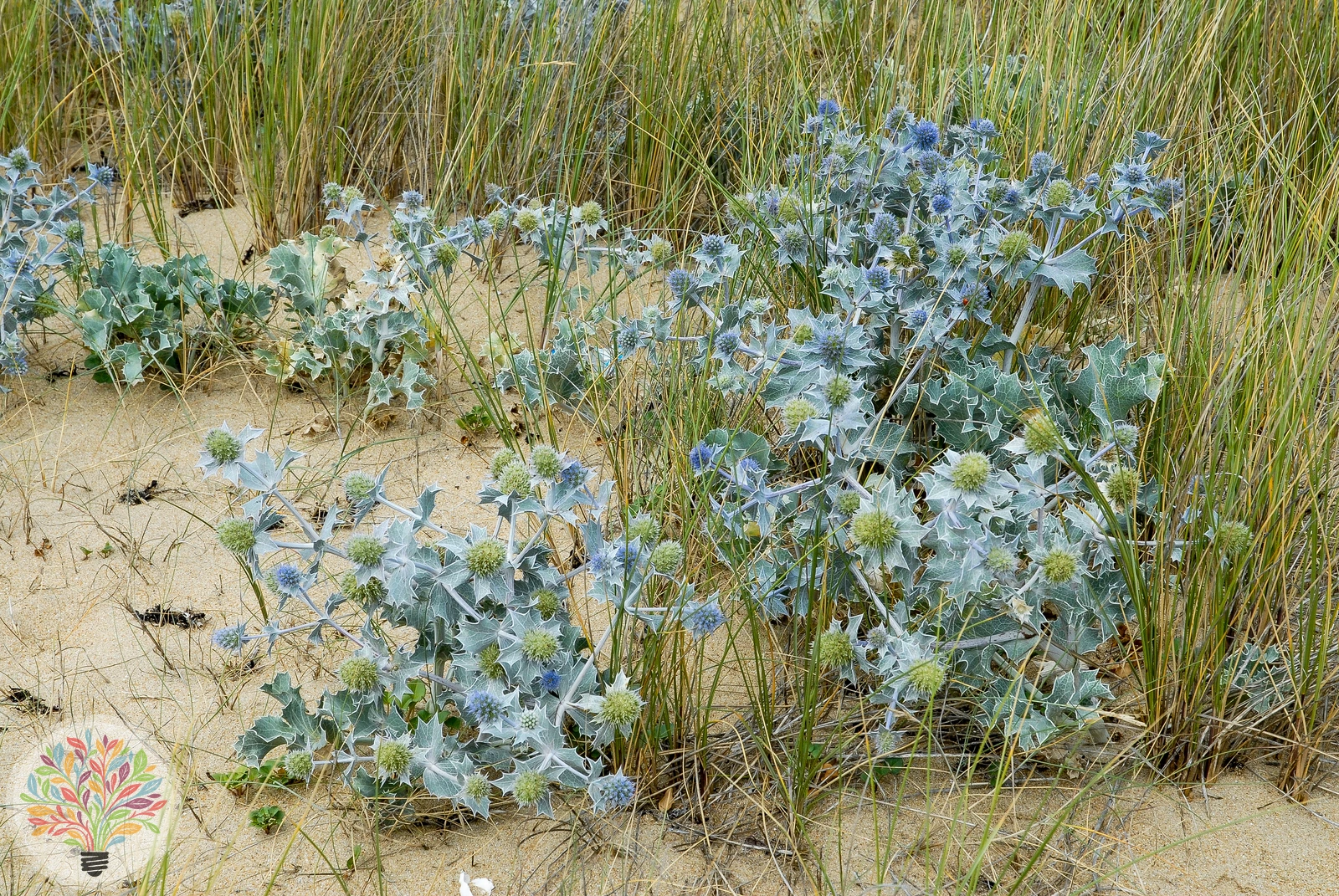
Eryngium maritimum
Eryngium maritimum
FamilyGenus: Eryngiumnative in Germany
🌿
76
Species
interact
🔗
231
Interactions
documented
About this species
A native coastal perennial with spiny, blue-grey foliage and metallic-blue flower heads in summer, thriving in sunny, free-draining, calcareous conditions.
Ecological network
Click to highlight connections · Click again to open the species page
Loading network...
PollinationFlower visit
Ecological significance
As a native species of stable sand dunes and shingle, Eryngium maritimum forms part of Britain's coastal plant communities. It is adapted to low disturbance and slight salinity, reflecting its role in these maritime habitats.
Annual cycle
Flowers from June to August.
Standort & Merkmale
Light
Sonne
Moisture
Frisch (Mäßig feucht)
Soil
Mittelzehrer (Normaler Boden)
Flowering period
Jun – Aug
Soil reaction
Basisch / Kalkhold
Bioregion
Continental
Growth form
Krautige Pflanze
Woodiness
Nicht verholzt
Leaf type
Breitblättrig
Plant height
0.349 m
Morphological traits: TRY ID3 (CC BY 3.0) & TRY ID81 (CC BY)
Pflege & Anbau
If grown in the garden, provide a sunny, open position with sharply drained, moderately moist, neutral to calcareous soil. Avoid overfeeding or rich soils, as it naturally thrives in low-nutrient conditions. It is well adapted to coastal exposure and some salt spray. Flowering occurs from June to August.
Scientific profile
Eryngium maritimum is a herbaceous perennial native to the coastline of Great Britain, where it typically grows on stable sand dunes and shingle beaches. It reaches about 35 cm in height, forming a rosette of broad, leathery, blue-grey leaves with spiny margins. From June to August it produces branching stems topped by dense, cone-like flower heads, each surrounded by a ruff of spiny bracts, in shades of metallic blue. The plant favours full sun and moderately moist, free-draining soils that are calcareous to basic; it tolerates slight salinity and low levels of disturbance, reflecting its adaptation to maritime environments.
Pollinators & visitors
63 Arten interagieren mit dieser Pflanze
Hylaeus cornutusSphecodes monilicornisLasioglossum calceatumHipparchia semeleHylaeus hyalinatusBombus sylvarumBombus hortorumAndrena flavipesAndrena dorsataBombus pratorumBombus humilisBombus lucorumBombus ruderariusBombus lapidariusHylaeus communisBombus rupestrisBombus pascuorumXylocopa violaceaScolia hirtaCteniopus sulphureusBombus jonellusBombus muscorumPieris rapaeAglais urticaeApis melliferaPhilanthus triangulumMegachile rotundataIcteranthidium lateraleBombus terrestrisManiola jurtinaVanessa carduiPararge aegeriaPolistes dominulaSphecodes albilabrisSphecodes puncticepsLasioglossum malachurumNomioides minutissimusAndrena pilipesHylaeus angustatusEristalis tenaxEristalis similisEumenes coarctatusSphex funerariusPrionyx viduatusPolyommatus celinaHalictus scabiosaeColletes gallicusCoenonympha pamphilusMegachile leachellaAricia cramera
Other flower visitors
13 other species visit the flowers
Hippodamia variegataMeria tripunctataLucilia silvarumStomorhina lunataPsilothrix viridicoeruleaStenopterus rufusOxythyrea funestaEristalinus sepulchlarisLucilia sericataSeladonia gemmeaEuceraSarcophagaBruchidius
Sources & data origin
•Interaktionsdaten via GloBI (CC-BY 4.0)
•pollinator_interactions
•FloraWeb / BfN
•EIVE 1.0 — Dengler et al. (2023), DOI: 10.3897/VCS.98324 (CC BY 4.0)
•GBIF Backbone Taxonomy — GBIF Secretariat (2024), DOI: 10.15468/39omei (CC BY 4.0)
•TRY Categorical Traits (ID3) — Kattge et al. (2012), DOI: 10.17871/TRY.3 (CC BY 3.0)
•TRY Global Spectrum (ID81) — Díaz et al. (2016/2021), DOI: 10.17871/TRY.81 (CC BY)
•Govaerts R et al. (2025) — World Checklist of Vascular Plants (WCVP) v14. Royal Botanic Gardens, Kew. DOI: 10.34885/xs7h-ze42 (CC BY 4.0)
•Foto: © ©Alain Guerrier / Adobe Stock / AdobeStock_799085232
All data is licensed under CC BY 4.0, CC0, or compatible terms. Attribution according to license conditions. Full source overview →