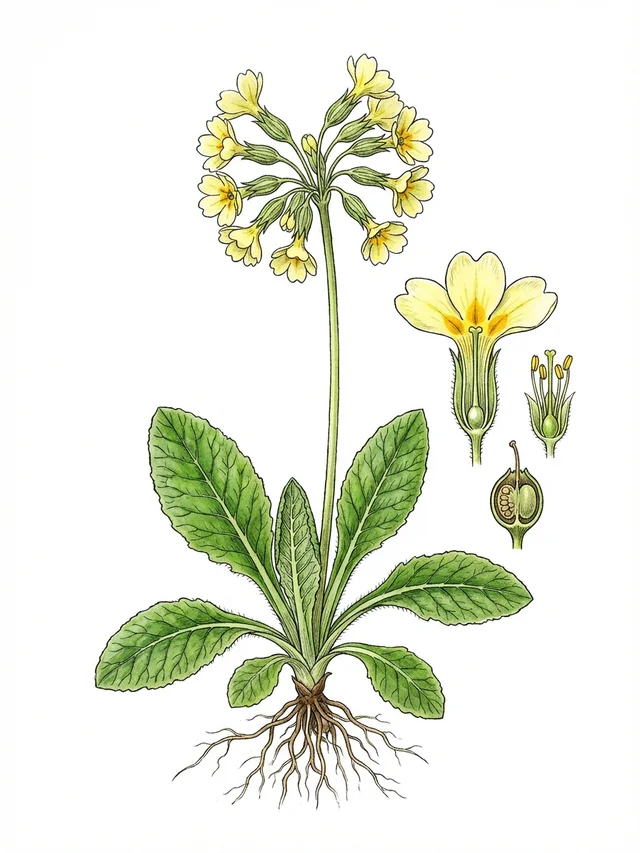
 Image to followAI-generated illustration
Eruca vesicaria
Eruca vesicaria
FamilyGenus: Erucanative in Germany
🌿
23
Species
interact
🔗
35
Interactions
documented
About this species
Eruca vesicaria is an introduced and established herbaceous plant in Great Britain. It is a non-woody, broad-leaved species reaching about 0.31 m in height. Flowering occurs from June to August, and it favours sunny, moderately moist, calcareous soils of medium fertility.
Ecological network
Click to highlight connections · Click again to open the species page
Loading network...
PollinationFlower visit
Ecological significance
Eruca vesicaria is an introduced species that has become established in Great Britain. No specific information on its ecological impact is available from the current data.
Annual cycle
This herbaceous plant emerges in spring, flowers from June to August, and sets seed in late summer. It thrives in full sun and moderately moist conditions. The small diaspores aid wind or water dispersal.
Safety note
No specific safety risks are recorded for this species.
Standort & Merkmale
Light
Sonne
Moisture
Frisch (Mäßig feucht)
Soil
—
Flowering period
Jun – Aug
Bioregion
Continental
Growth form
Krautige Pflanze
Woodiness
Nicht verholzt
Leaf type
Breitblättrig
Plant height
0.314 m
Morphological traits: TRY ID3 (CC BY 3.0) & TRY ID81 (CC BY)
Pflege & Anbau
**Light:** Full sun.
**Moisture:** Moderately moist, well-drained soil.
**Soil:** Prefers calcareous or basic soils with moderate fertility.
**Bloom time:** June to August.
**Growth habit:** Herbaceous, non-woody.
Scientific profile
Eruca vesicaria belongs to the family Brassicaceae. It is a herbaceous, non-woody plant with broad leaves, a leaf area averaging 359 mm², and a typical height of 0.31 m. Its small seeds (diaspores) weigh around 1.03 mg. In Great Britain the species is introduced and established. Ecological indicator values from central Europe show a preference for full sun, moderately moist conditions, and calcareous to basic soils of moderate nutrient status. It is not salt tolerant and is associated with low levels of physical disturbance. Arbuscular mycorrhizal associations have been recorded. Flowering extends from June to August.
Pollinators & visitors
20 Arten interagieren mit dieser Pflanze
Andrena fulvaLasioglossum morioLasioglossum albipesPieris brassicaeCarcharodus alceaeOsmia aurulentaPieris rapaeApis melliferaEnoplognatha ovataHalictus scabiosaeVanessa carduiPararge aegeriaAndrena cinerariaAndrena minutulaBombus pascuorumBombus terrestrisBombus lapidariusAndrena flavipesAndrena tibialisAndrena dorsata
Other flower visitors
3 other species visit the flowers
Sources & data origin
•Interaktionsdaten via GloBI (CC-BY 4.0)
•Baden-Böhm F, App M, Thiele J (2022) — The FloRes Database: A floral resources trait database for pollinator habitat-assessment generated by a multistep workflow. Johann Heinrich von Thünen-Institut, Dryad, DOI: 10.5061/dryad.djh9w0w29 (CC0)
•EIVE 1.0 — Dengler et al. (2023), DOI: 10.3897/VCS.98324 (CC BY 4.0)
•GBIF Backbone Taxonomy — GBIF Secretariat (2024), DOI: 10.15468/39omei (CC BY 4.0)
•TRY Categorical Traits (ID3) — Kattge et al. (2012), DOI: 10.17871/TRY.3 (CC BY 3.0)
•TRY Global Spectrum (ID81) — Díaz et al. (2016/2021), DOI: 10.17871/TRY.81 (CC BY)
•Checklist Alien Plants Belgium — Verloove F (2023), Botanic Garden Meise (CC BY 4.0)
•Govaerts R et al. (2025) — World Checklist of Vascular Plants (WCVP) v14. Royal Botanic Gardens, Kew. DOI: 10.34885/xs7h-ze42 (CC BY 4.0)
All data is licensed under CC BY 4.0, CC0, or compatible terms. Attribution according to license conditions. Full source overview →