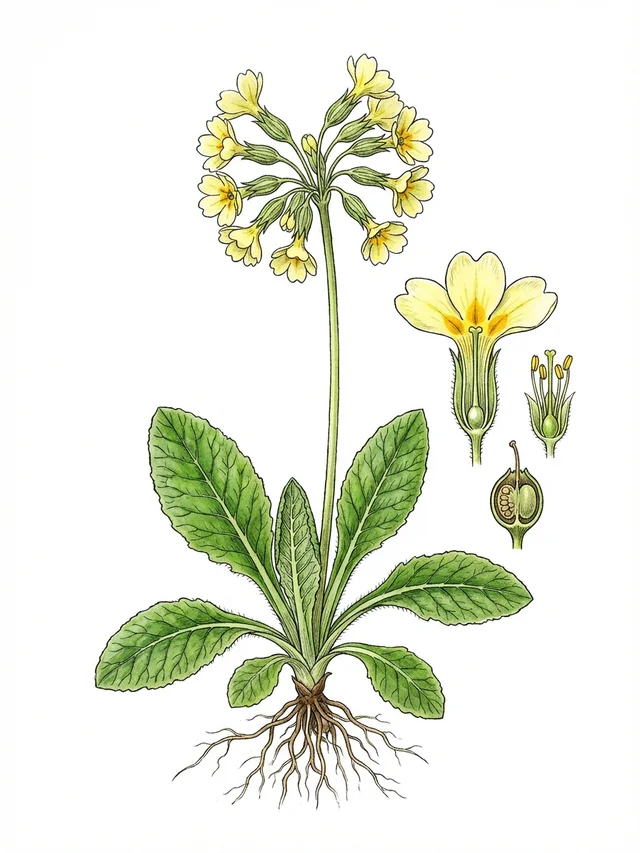
 Image to followAI-generated illustration
Geranium dissectum
Geranium dissectum
FamilyGenus: Geraniumnative in Germany
🌿
49
Species
interact
🔗
78
Interactions
documented
About this species
An archaeophyte of sunny, lime-rich ground, flowering from April to August, reaching about 23 cm tall.
Ecological network
Click to highlight connections · Click again to open the species page
Loading network...
PollinationFlower visit
Ecological significance
Geranium dissectum has been present in the British flora for centuries as an archaeophyte and is integrated into local ecosystems without any recorded negative impacts.
Annual cycle
Spring emergence is followed by flowering from April through August. The plant dies back to ground level over winter.
Safety note
Detailed safety information is not recorded for this species.
Standort & Merkmale
Light
Sonne
Moisture
Frisch (Mäßig feucht)
Soil
Mittelzehrer (Normaler Boden)
Flowering period
Apr – Aug
Soil reaction
Basisch / Kalkhold
Bioregion
Continental
Growth form
Krautige Pflanze
Woodiness
Nicht verholzt
Leaf type
Breitblättrig
Plant height
0.234 m
Morphological traits: TRY ID3 (CC BY 3.0) & TRY ID81 (CC BY)
Pflege & Anbau
This plant requires a sunny position in moderately moist, lime-rich, moderately fertile soil. It is not suited to saline sites and thrives under low-disturbance conditions.
Scientific profile
Geranium dissectum is an archaeophyte in Great Britain, belonging to the family Geraniaceae. It is a non-woody, terrestrial species with broad leaves and a typical height of around 23 cm. Flowering from April to August, it produces small diaspores weighing about 2.4 mg. It grows in sunny, moderately moist conditions on lime-rich, mesotrophic soils, typically in sites with low disturbance, and does not tolerate saline conditions. Its natural distribution covers Europe, southwestern and southeastern Europe, Africa and western Asia. In Great Britain it is thought to have arrived as a seed contaminant by 1500 and is now well established.
Pollinators & visitors
46 Arten interagieren mit dieser Pflanze
Andrena dorsataThymelicus sylvestrisPyronia tithonusVanessa atalantaPolyommatus icarusChelostoma campanularumMelitta haemorrhoidalisMegachile versicolorAglais urticaeGonepteryx rhamniPieris brassicaeMegachile centuncularisOsmia bicornisAnthocharis cardaminesManiola jurtinaLasiommata megeraPararge aegeriaMegachile willughbiellaAnthophora furcataBombus lapidariusBombus pascuorumBombus hortorumAndrena wilkellaBombus hypnorumBombus pratorumPieris napiCelastrina argiolusAndrena bicolorBombus muscorumBombus lucorumApis melliferaAricia agestisMegachile maritimaPieris rapaeBombus terrestrisHylaeus hyalinatusLasioglossum glabriusculumLycaena phlaeasLasioglossum zonulumHalictus confususLasioglossum pauxillumAndrena simontornyellaLasioglossum malachurumLasioglossum parvulumSphaerophoria scriptaPlatycheirus manicatus
Other flower visitors
3 other species visit the flowers
Sources & data origin
•Interaktionsdaten via GloBI (CC-BY 4.0)
•pollinator_interactions
•Baden-Böhm F, App M, Thiele J (2022) — The FloRes Database: A floral resources trait database for pollinator habitat-assessment generated by a multistep workflow. Johann Heinrich von Thünen-Institut, Dryad, DOI: 10.5061/dryad.djh9w0w29 (CC0)
•FloraWeb / BfN
•EIVE 1.0 — Dengler et al. (2023), DOI: 10.3897/VCS.98324 (CC BY 4.0)
•GBIF Backbone Taxonomy — GBIF Secretariat (2024), DOI: 10.15468/39omei (CC BY 4.0)
•TRY Categorical Traits (ID3) — Kattge et al. (2012), DOI: 10.17871/TRY.3 (CC BY 3.0)
•TRY Global Spectrum (ID81) — Díaz et al. (2016/2021), DOI: 10.17871/TRY.81 (CC BY)
•Govaerts R et al. (2025) — World Checklist of Vascular Plants (WCVP) v14. Royal Botanic Gardens, Kew. DOI: 10.34885/xs7h-ze42 (CC BY 4.0)
All data is licensed under CC BY 4.0, CC0, or compatible terms. Attribution according to license conditions. Full source overview →