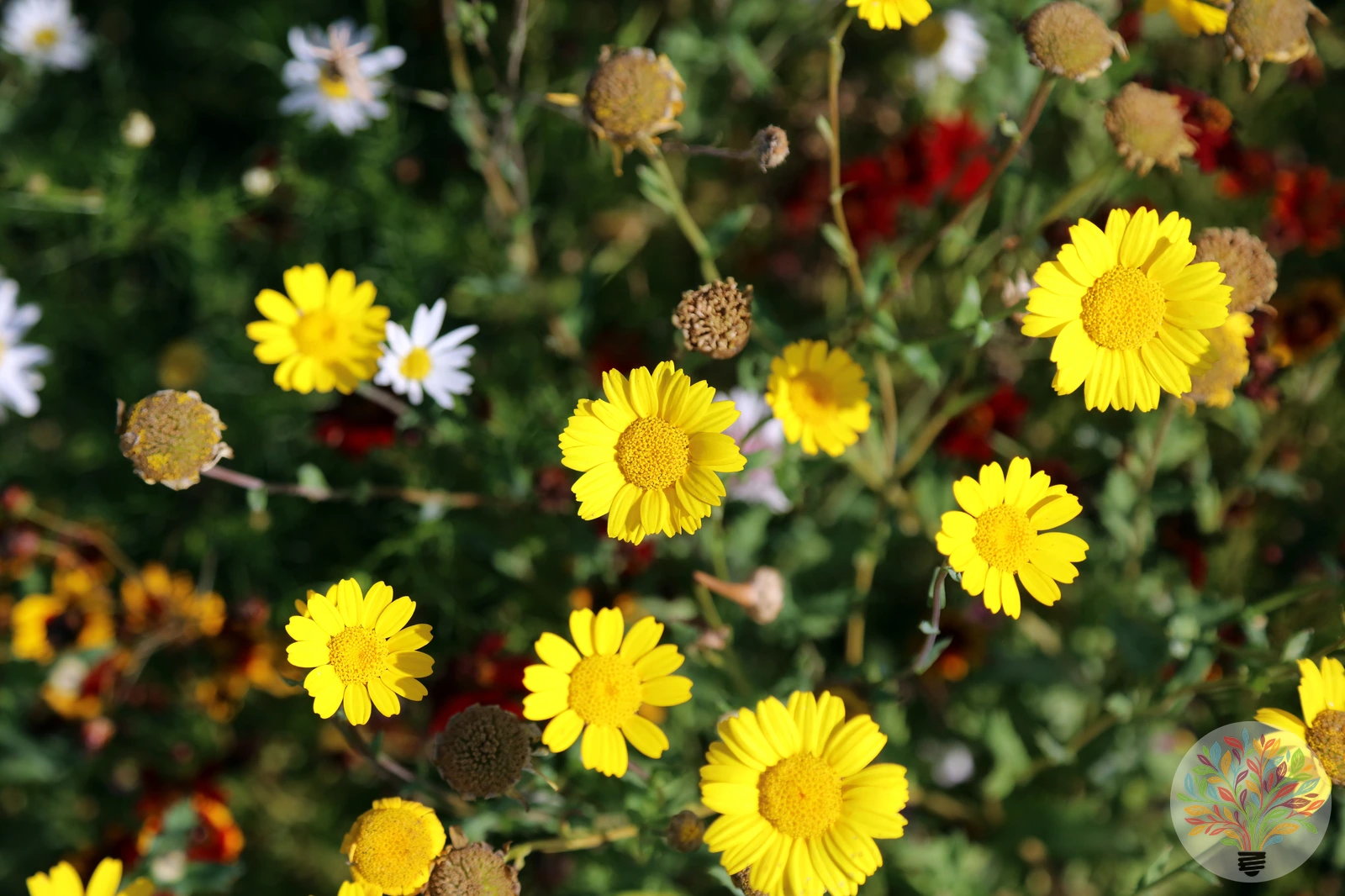
Glebionis segetum
Glebionis segetum
FamilyGenus: Glebionisnative in Germany
🌿
45
Species
interact
🔗
56
Interactions
documented
About this species
Glebionis segetum is a long-established herbaceous plant in Great Britain, reaching about 37 cm tall with broad leaves. It thrives in full sun on moderately moist, normal soil and produces flowers from July to October. Its small, light seeds weigh around 1.67 mg.
Ecological network
Click to highlight connections · Click again to open the species page
Loading network...
PollinationFlower visit
Ecological significance
An archaeophyte long integrated into the British flora, found in open, sunny habitats with moderate fertility and low disturbance. It shows no indicators of invasiveness and typically occupies arable or ruderal niches.
Annual cycle
Flowers from July to October.
Standort & Merkmale
Light
Sonne
Moisture
Frisch (Mäßig feucht)
Soil
Mittelzehrer (Normaler Boden)
Flowering period
Jul – Okt
Soil reaction
Mäßig sauer bis neutral
Bioregion
Continental
Growth form
Krautige Pflanze
Woodiness
Nicht verholzt
Leaf type
Breitblättrig
Plant height
0.372 m
Morphological traits: TRY ID3 (CC BY 3.0) & TRY ID81 (CC BY)
Pollen
1.4329 mg/Blüte
Pflege & Anbau
Sow in a sunny spot with ordinary, moderately moist soil. Once established it needs little care and flowers from late summer into autumn. Deadheading can prolong bloom, but leaving some flowerheads will allow self-seeding. Avoid waterlogged ground.
Scientific profile
Glebionis segetum is a herbaceous, non-woody, broad-leaved terrestrial plant. Mature height averages 0.37 m and leaf area is about 734.5 mm². Flowering lasts from July to October. The species strongly favours full sun (light indicator value 7) and moderately moist, average-nutrient soil (nutrient indicator value 5). It is associated with low disturbance (severity 0.86). Diaspore mass averages 1.67 mg. In Great Britain it is an archaeophyte, established since pre-medieval times and now widely naturalised in open, sunny habitats.
Pollinators & visitors
21 Arten interagieren mit dieser Pflanze
Bombus sylvestrisBombus lapidariusApis melliferaHalictus subauratusPanurgus calcaratusPolyommatus icarusLasioglossum.glabriusculumLasioglossum.pauxillumEristalis arbustorumPlatycheirus clypeatusBombus terrestrisLasioglossum malachurumDasypodaBombus pascuorumLasioglossum glabriusculumLasioglossum pauxillumAndrena agilissimaEupeodes corollaeAcontia lucidaEucera oraniensisSphecodes gibbus
Other flower visitors
24 other species visit the flowers
Lucilia caesarDelia radicumHydrotaea dentipesEbaeusPsilothrix viridicoeruleaLygus pratensisStenotus binotatusHoristus orientalisMiridaeSarcophagaEuceraHeliotaurus ruficollisTropinota squalidaThaumatomyia notataMyopa extricataOlibrusOxythyrea funestaAtherigonaEliozeta helluoExorista deciduaForficulaHydrotaea ignavaPyrellia vividaTettigonia viridissima
Sources & data origin
•Interaktionsdaten via GloBI (CC-BY 4.0)
•pollinator_interactions
•Baden-Böhm F, App M, Thiele J (2022) — The FloRes Database: A floral resources trait database for pollinator habitat-assessment generated by a multistep workflow. Johann Heinrich von Thünen-Institut, Dryad, DOI: 10.5061/dryad.djh9w0w29 (CC0)
•FloraWeb / BfN
•EIVE 1.0 — Dengler et al. (2023), DOI: 10.3897/VCS.98324 (CC BY 4.0)
•GBIF Backbone Taxonomy — GBIF Secretariat (2024), DOI: 10.15468/39omei (CC BY 4.0)
•TRY Categorical Traits (ID3) — Kattge et al. (2012), DOI: 10.17871/TRY.3 (CC BY 3.0)
•TRY Global Spectrum (ID81) — Díaz et al. (2016/2021), DOI: 10.17871/TRY.81 (CC BY)
•Govaerts R et al. (2025) — World Checklist of Vascular Plants (WCVP) v14. Royal Botanic Gardens, Kew. DOI: 10.34885/xs7h-ze42 (CC BY 4.0)
•Foto: © Adobe Stock / AdobeStock_1035769283
All data is licensed under CC BY 4.0, CC0, or compatible terms. Attribution according to license conditions. Full source overview →