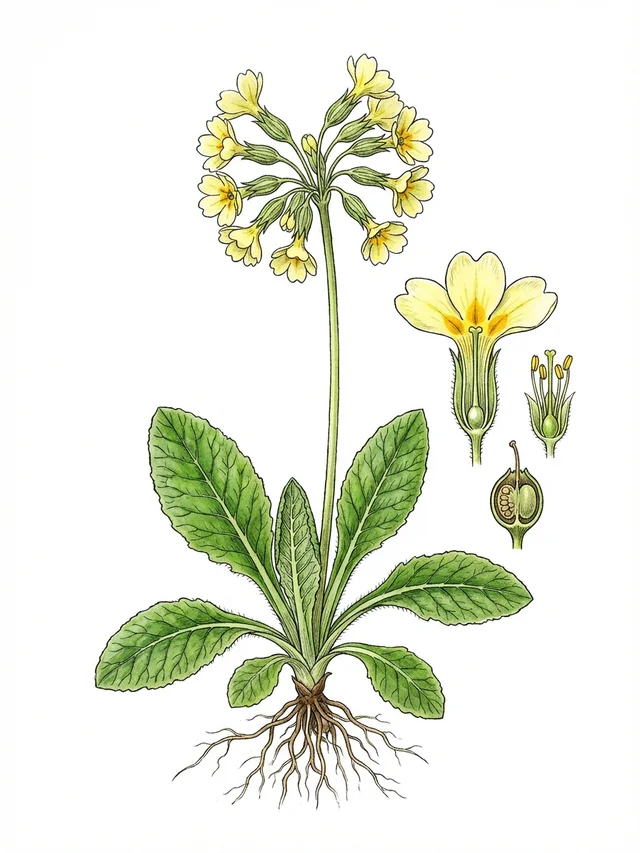
 Image to followAI-generated illustration
Helianthemum nummularium
Helianthemum nummularium subsp. grandiflorum
FamilyGenus: Helianthemumnative in Germany
🌿
44
Species
interact
🔗
53
Interactions
documented
About this species
Helianthemum nummularium is a low, evergreen subshrub native in Great Britain, typically reaching about 12 cm in height. It bears broad leaves and flowers from May to July, thriving in dry, sunny situations on lime-rich, nutrient-poor soils.
Ecological network
Click to highlight connections · Click again to open the species page
Loading network...
PollinationFlower visit
Ecological significance
Helianthemum nummularium is a constituent of native calcareous grassland communities and is adapted to the local climate and soils.
Annual cycle
The evergreen foliage is present year-round. Flowers appear from May to July. After the flowering period, seeds mature and are dispersed. The plant remains low and green through autumn and winter.
Standort & Merkmale
Light
Sonne
Moisture
Trocken
Soil
Schwachzehrer (Magerer Boden)
Flowering period
Mai – Jul
Soil reaction
Basisch / Kalkhold
Bioregion
Continental
Growth form
Halbstrauch
Woodiness
Nicht verholzt
Leaf type
Breitblättrig
Leaf phenology
Immergrün
Plant height
0.117 m
Morphological traits: TRY ID3 (CC BY 3.0) & TRY ID81 (CC BY)
Pflege & Anbau
Plant in full sun in sharply drained, alkaline to neutral, low-fertility soil. Suitable for rock gardens, crevices and dry banks. Water sparingly once established and avoid rich soil or fertiliser. Trim lightly after flowering to maintain a compact shape.
Scientific profile
Helianthemum nummularium is an evergreen, broad-leaved subshrub that typically forms a low mat and reaches about 12 cm in height. The stems do not become woody, and the leaves persist throughout the year. Flowering takes place from May to July. The species is native in Great Britain, where it is found on dry, sunny, calcareous and nutrient-poor soils, often in open grassland and rocky sites. It requires full sun and alkaline conditions, and forms arbuscular mycorrhizal associations in the soil.
Pollinators & visitors
39 Arten interagieren mit dieser Pflanze
Plebejus argusPieris napiEuphydryas auriniaCallophrys rubiAricia agestisLysandra bellargusOsmia bicolorBombus lucorumPyronia tithonusPieris rapaeLycaena phlaeasLasioglossum pauxillumBombus hortorumApis melliferaLasioglossum glabriusculumBombus pratorumLasioglossum fratellumAndrena nigroaeneaLasioglossum interruptumHalictus tumulorumLasioglossum morioBombus hypnorumBombus terrestrisBombus lapidariusTenthredo nothaLasioglossum fulvicorneLasioglossum leucopusLasioglossum calceatumBombus sylvarumHalictus simplexaricia artaxerxesAglais urticaeAcalymma vittatumCryptocephalus aureolusHylaeus hyalinatusAnthophora quadrimaculataAnthophora aestivalisBombus pascuorumCeratina cyanea
Other flower visitors
5 other species visit the flowers
Sources & data origin
•Interaktionsdaten via GloBI (CC-BY 4.0)
•FloraWeb / BfN
•EIVE 1.0 — Dengler et al. (2023), DOI: 10.3897/VCS.98324 (CC BY 4.0)
•GBIF Backbone Taxonomy — GBIF Secretariat (2024), DOI: 10.15468/39omei (CC BY 4.0)
•TRY Categorical Traits (ID3) — Kattge et al. (2012), DOI: 10.17871/TRY.3 (CC BY 3.0)
•TRY Global Spectrum (ID81) — Díaz et al. (2016/2021), DOI: 10.17871/TRY.81 (CC BY)
•Govaerts R et al. (2025) — World Checklist of Vascular Plants (WCVP) v14. Royal Botanic Gardens, Kew. DOI: 10.34885/xs7h-ze42 (CC BY 4.0)
All data is licensed under CC BY 4.0, CC0, or compatible terms. Attribution according to license conditions. Full source overview →