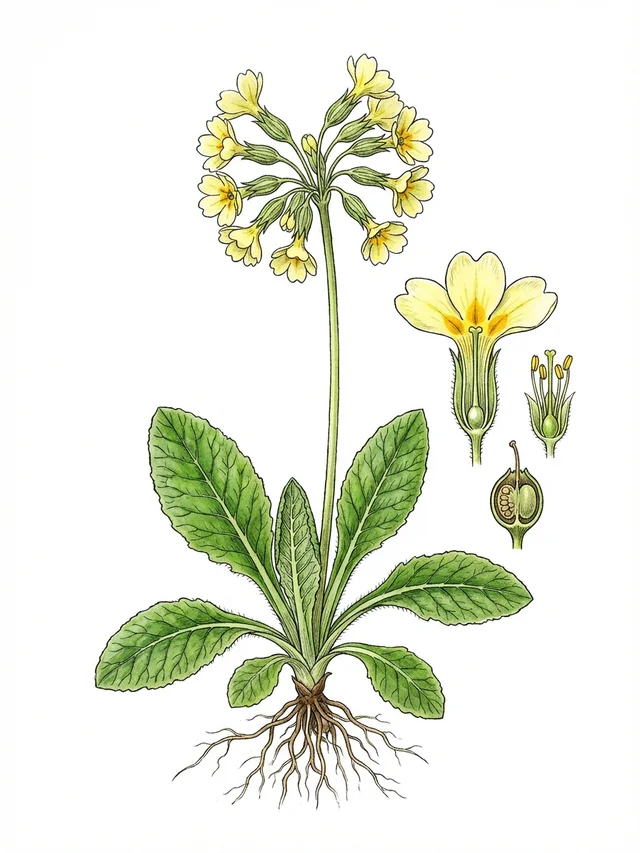
 Image to followAI-generated illustration
Helminthotheca echioides
Helminthotheca echioides
FamilyGenus: Helminthothecanative in Germany
🌿
73
Species
interact
🔗
552
Interactions
documented
About this species
Helminthotheca echioides is an archaeophyte herbaceous plant of sunny, moderately moist, calcareous places. It bears broad leaves and reaches about half a metre in height, producing yellow composite flowerheads in June and July. It favours low-disturbance habitats on medium-nutrient soils.
Ecological network
Click to highlight connections · Click again to open the species page
Loading network...
PollinationFlower visit
Ecological significance
Limited ecological data are available. As an archaeophyte it persists in open, low-disturbance, sunny habitats, and no invasive tendencies are documented.
Annual cycle
The herbaceous growth emerges in spring, developing a rosette of broad leaves. Flowering extends from June into July, followed by seed set in late summer. Above-ground parts die back in autumn.
Safety note
Safety information is not documented.
Standort & Merkmale
Light
Sonne
Moisture
Frisch (Mäßig feucht)
Soil
Mittelzehrer (Normaler Boden)
Flowering period
Jun – Jul
Soil reaction
Basisch / Kalkhold
Bioregion
Continental
Growth form
Krautige Pflanze
Woodiness
Nicht verholzt
Leaf type
Breitblättrig
Plant height
0.493 m
Morphological traits: TRY ID3 (CC BY 3.0) & TRY ID81 (CC BY)
Pflege & Anbau
Grow in full sun on moderately moist but well-drained soil. A neutral to alkaline, medium-nutrient loam is ideal. The plant tolerates only low disturbance and may self-seed in suitable open sites.
Scientific profile
An archaeophyte established in Great Britain, Helminthotheca echioides belongs to the Asteraceae family. The plant is a non-woody herbaceous perennial with a terrestrial habit and broad leaves; leaf area averages 2707.7 mm². Typically it grows to around 0.49 m in height, with tiny diaspores weighing roughly 1.3 mg. It is strongly light-demanding (Ellenberg light value 8), occurring in full sun, and prefers fresh, moderately moist conditions. It shows a clear preference for calcareous or basic substrates (reaction value 7) and medium nutrient levels (value 6). Disturbance tolerance is low (disturbance severity 0.72). Flowering takes place in June and July. Its Red List status is recorded as ‘nb’ (not assessed).
Pollinators & visitors
59 Arten interagieren mit dieser Pflanze
Pieris napiDasypoda hirtipesLasioglossum morioSphecodes puncticepsOsmia spinulosaLasioglossum villosulumBombus terrestrisBombus vestalisBombus pratorumBombus lapidariusBombus lucorumBombus pascuorumAndrena flavipesPieris brassicaeSphecodes monilicornisLasioglossum malachurumLasioglossum leucozoniumBombus rupestrisLasioglossum puncticolleHalictus tumulorumLasioglossum pauxillumBombus muscorumAnthidium manicatumAndrena dorsataBombus sylvarumThymelicus lineolaBombus sylvestrisBombus humilisApis melliferaPyrgus malvoidesAnthophora bimaculataHalictus scabiosaeVanessa carduiPieris rapaeLycaena phlaeasHelicoverpa armigeraEuclidia glyphicaColias croceusHylaeus brevicornisLasioglossum glabriusculumSphaerophoria scriptaHalictus maculatusLasioglossum medinaiEristalis arbustorumEristalis tenaxHalictus simplexMelanostoma mellinumEristalinus sepulchralisLasioglossum nigripesEristalinus aeneus
Other flower visitors
14 other species visit the flowers
Passer domesticusCorvus frugilegusCarduelis carduelisFringilla coelebsLinaria cannabinaoedemera luridaCrocothemis erythraeaMangora acalyphaNomophila noctuellaArgiope bruennichiHippodamia variegataPhalangium opilioOedemera nobilisPipizella
Sources & data origin
•Interaktionsdaten via GloBI (CC-BY 4.0)
•pollinator_interactions
•FloraWeb / BfN
•EIVE 1.0 — Dengler et al. (2023), DOI: 10.3897/VCS.98324 (CC BY 4.0)
•GBIF Backbone Taxonomy — GBIF Secretariat (2024), DOI: 10.15468/39omei (CC BY 4.0)
•TRY Categorical Traits (ID3) — Kattge et al. (2012), DOI: 10.17871/TRY.3 (CC BY 3.0)
•TRY Global Spectrum (ID81) — Díaz et al. (2016/2021), DOI: 10.17871/TRY.81 (CC BY)
•Govaerts R et al. (2025) — World Checklist of Vascular Plants (WCVP) v14. Royal Botanic Gardens, Kew. DOI: 10.34885/xs7h-ze42 (CC BY 4.0)
All data is licensed under CC BY 4.0, CC0, or compatible terms. Attribution according to license conditions. Full source overview →