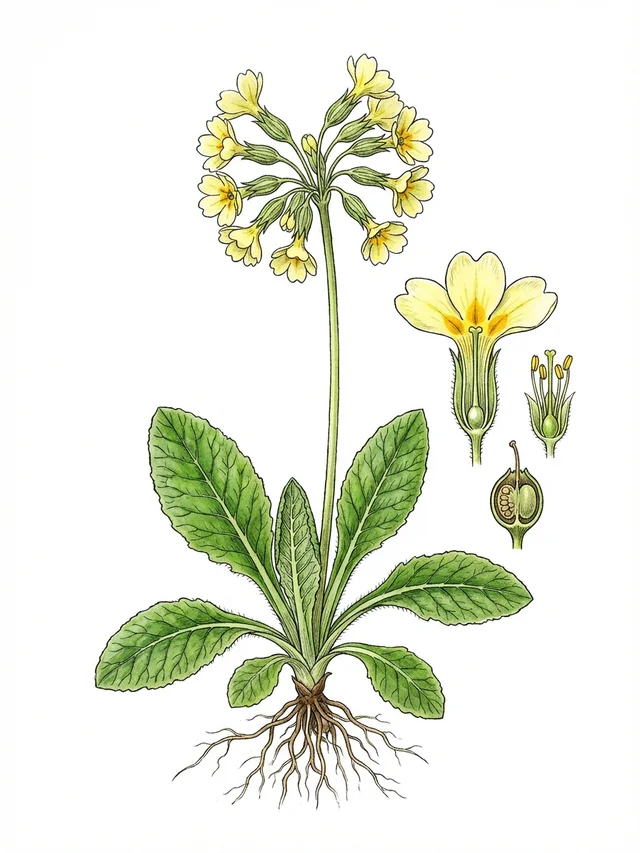
 Image to followAI-generated illustration
Holcus mollis
Holcus mollis
FamilyGenus: Holcusnative in Germany
🌿
5
Species
interact
🔗
11
Interactions
documented
🐛
2
Host relationships
Species
About this species
Holcus mollis is a native perennial grass of partial shade, reaching about 41 cm in height. It bears broad leaves and flowers from June to August, thriving in fresh, moderately moist, acidic, nutrient-poor soils. It is native in Great Britain, forming part of the ground flora in damp, shaded habitats.
Ecological network
Click to highlight connections · Click again to open the species page
Loading network...
PollinationLarval host
Ecological significance
Holcus mollis is a native grass that contributes to the ground layer in damp, acidic, semi-shaded habitats, such as woodland edges, heaths, and rough grasslands. Its presence helps maintain the structure and biodiversity of these plant communities.
Annual cycle
A perennial grass, Holcus mollis produces new growth in spring. Flowering stems appear from June to August, after which seeds are set. Foliage may die back in late autumn, with the plant remaining dormant over winter before resuming growth the following spring.
Standort & Merkmale
Light
Halbschatten
Moisture
Frisch (Mäßig feucht)
Soil
Schwachzehrer (Magerer Boden)
Flowering period
Jun – Aug
Soil reaction
Sauer (Säurezeiger)
Bioregion
Continental
Growth form
Gras
Woodiness
Nicht verholzt
Leaf type
Breitblättrig
Plant height
0.41 m
Morphological traits: TRY ID3 (CC BY 3.0) & TRY ID81 (CC BY)
Pflege & Anbau
Plant in partial shade in a moderately moist, acidic, nutrient-poor soil. Avoid rich garden soils and full sun, which do not reflect its natural preferences. Once established, it requires little maintenance and tolerates low fertility.
Scientific profile
Holcus mollis is a perennial grass in the family Poaceae. It has broad, green leaves and non-woody stems, typically reaching heights around 41 cm. This species grows in partial shade and prefers fresh to moderately moist conditions, thriving on acidic, nutrient-poor soils. Flowering takes place from June to August. Holcus mollis is native in Great Britain, occurring in a variety of semi-shaded habitats on damp, infertile ground, such as open woodlands, heathlands, and rough grasslands.
Pollinators & visitors
3 Arten interagieren mit dieser Pflanze
Host relationships
2 species use this plant as a host
Hipparchia hermioneMythimna turca
Sources & data origin
•Cook et al. (2025) UK Butterfly & Moth Traits (DOI: 10.5285/dbc7cc17-cbbd-49dd-bab4-8e8855768d66)
•Interaktionsdaten via GloBI (CC-BY 4.0)
•FloraWeb / BfN
•EIVE 1.0 — Dengler et al. (2023), DOI: 10.3897/VCS.98324 (CC BY 4.0)
•GBIF Backbone Taxonomy — GBIF Secretariat (2024), DOI: 10.15468/39omei (CC BY 4.0)
•TRY Categorical Traits (ID3) — Kattge et al. (2012), DOI: 10.17871/TRY.3 (CC BY 3.0)
•TRY Global Spectrum (ID81) — Díaz et al. (2016/2021), DOI: 10.17871/TRY.81 (CC BY)
•Govaerts R et al. (2025) — World Checklist of Vascular Plants (WCVP) v14. Royal Botanic Gardens, Kew. DOI: 10.34885/xs7h-ze42 (CC BY 4.0)
All data is licensed under CC BY 4.0, CC0, or compatible terms. Attribution according to license conditions. Full source overview →