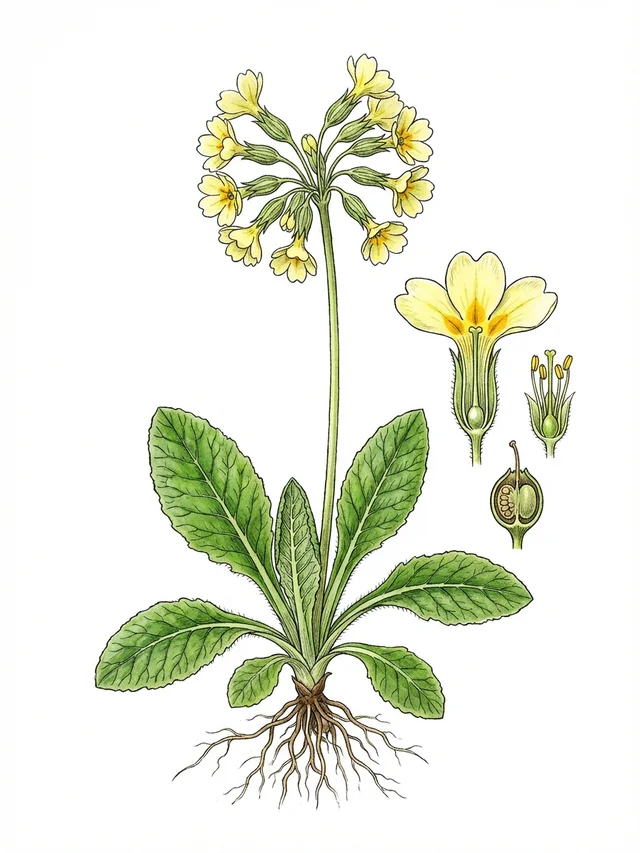
 Image to followAI-generated illustration
Hypericum elodes
Hypericum elodes
FamilyGenus: Hypericumnative in Germany
🌿
5
Species
interact
🔗
5
Interactions
documented
🐛
4
Host relationships
Species
About this species
A small native herbaceous plant of very wet, acidic, nutrient-poor bogs and mires in Great Britain. It flowers from August to September, reaches about 18 cm in height, and is listed on the British Red List.
Ecological network
Click to highlight connections · Click again to open the species page
Loading network...
Larval hostFlower visit
Ecological significance
As a component of bog and wet heath communities, Hypericum elodes forms part of these specialised, low-nutrient ecosystems.
Annual cycle
Flowering takes place in August and September. The plant is herbaceous and, in its native habitat, follows a seasonal cycle typical of wetland herbs, with above-ground growth probably dying back over winter.
Safety note
No data available on safety aspects.
Standort & Merkmale
Light
Sonne
Moisture
Feucht
Soil
Schwachzehrer (Magerer Boden)
Flowering period
Aug – Sep
Soil reaction
Sauer (Säurezeiger)
Bioregion
Continental
Growth form
Krautige Pflanze
Woodiness
Nicht verholzt
Leaf type
Breitblättrig
Plant height
0.181 m
Morphological traits: TRY ID3 (CC BY 3.0) & TRY ID81 (CC BY)
Pflege & Anbau
This species requires permanently wet, acidic, nutrient-poor soil in full sun. It naturally inhabits low-disturbance environments such as bogs and mires, so successful cultivation relies on replicating those conditions – for example, a bog garden or a container maintained with an acidic, infertile, waterlogged substrate.
Scientific profile
Hypericum elodes is a non-woody, broad-leaved herbaceous plant that typically attains a height of around 18 cm. Its leaves are broad, with an average leaf area of approximately 102 mm². Flowers appear in late summer, from August to September, and develop into very small seeds weighing about 0.07 mg. The plant grows in full sun on permanently waterlogged, strongly acidic, nutrient-poor soils, occurring naturally in bogs, wet heaths and similar low-disturbance habitats. In Great Britain it is a native wild species and appears on the national Red List.
Host relationships
4 species use this plant as a host
Other flower visitors
1 other species visit the flowers
Hydrotaea dentipes
Sources & data origin
•Cook et al. (2025) UK Butterfly & Moth Traits (DOI: 10.5285/dbc7cc17-cbbd-49dd-bab4-8e8855768d66)
•pollinator_interactions
•FloraWeb / BfN
•EIVE 1.0 — Dengler et al. (2023), DOI: 10.3897/VCS.98324 (CC BY 4.0)
•GBIF Backbone Taxonomy — GBIF Secretariat (2024), DOI: 10.15468/39omei (CC BY 4.0)
•TRY Categorical Traits (ID3) — Kattge et al. (2012), DOI: 10.17871/TRY.3 (CC BY 3.0)
•TRY Global Spectrum (ID81) — Díaz et al. (2016/2021), DOI: 10.17871/TRY.81 (CC BY)
•Govaerts R et al. (2025) — World Checklist of Vascular Plants (WCVP) v14. Royal Botanic Gardens, Kew. DOI: 10.34885/xs7h-ze42 (CC BY 4.0)
All data is licensed under CC BY 4.0, CC0, or compatible terms. Attribution according to license conditions. Full source overview →