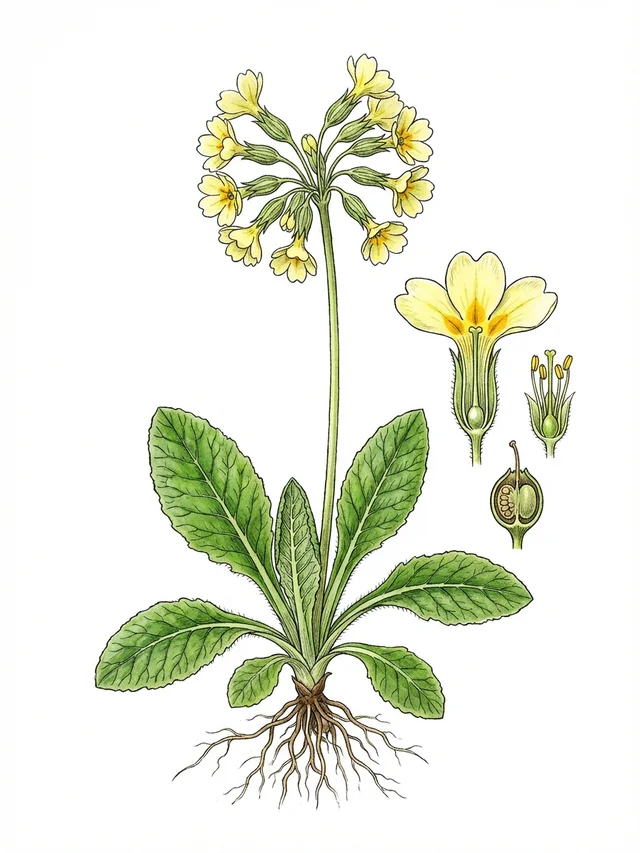
 Image to followAI-generated illustration
Hypericum hirsutum
Hypericum hirsutum
FamilyGenus: Hypericumnative in Germany
🌿
12
Species
interact
🔗
16
Interactions
documented
About this species
Hypericum hirsutum, commonly known as hairy St John’s-wort, is a native wildflower found in tall herb communities on moist, calcareous soils. Its summer flowers provide nectar and pollen for insects.
Ecological network
Click to highlight connections · Click again to open the species page
Loading network...
PollinationFlower visit
Ecological significance
Being a native wildflower, hairy St John’s-wort supports local insect populations by providing a reliable source of nectar and pollen during the summer months. It is not invasive and blends well into naturalistic plantings.
Annual cycle
Fresh growth emerges in spring. Flowering takes place from June to August. Seed ripens in late summer and early autumn, and the above-ground parts die back by winter. The plant stays dormant underground until the following spring.
Standort & Merkmale
Light
Halbschatten
Moisture
Frisch (Mäßig feucht)
Soil
Mittelzehrer (Normaler Boden)
Flowering period
Jun – Aug
Soil reaction
Basisch / Kalkhold
Bioregion
Continental
Nectar value
2
Pollen value
2
Growth form
Krautige Pflanze
Woodiness
Nicht verholzt
Leaf type
Breitblättrig
Plant height
0.614 m
Morphological traits: TRY ID3 (CC BY 3.0) & TRY ID81 (CC BY)
Pflege & Anbau
**Light:** Partial shade.
**Soil:** Moist, well-drained soil; neutral to alkaline (calcareous) conditions suit it best.
**Watering:** Maintain consistent moisture, especially during dry spells, but avoid waterlogging.
**Maintenance:** Low. Trim back dead top growth in late autumn or early spring. No supplementary feeding is required.
Scientific profile
Hairy St John’s-wort (Hypericum hirsutum) is a non-woody, herbaceous perennial that reaches a height of around 60 centimetres. It has broad leaves and occurs in tall-herb communities on fresh, base-rich and often calcareous soils, usually in sites with partial shade or dappled sunlight. The plant flowers from June through August, with blooms that supply a moderate level of both nectar and pollen to visiting insects. It dies back to ground level in autumn, overwintering as a rootstock.
Pollinators & visitors
8 Arten interagieren mit dieser Pflanze
Lasioglossum nigripesLasioglossum leucozoniumBombus pascuorumBombus hypnorumBombus lapidariusBombus lucorumBombus pratorumEpisyrphus balteatus
Other flower visitors
4 other species visit the flowers
Chrysolina hypericiChrysolina variansEmpis vitripennisScathophaga inquinata
Sources & data origin
•Interaktionsdaten via GloBI (CC-BY 4.0)
•pollinator_interactions
•FloraWeb / BfN
•EIVE 1.0 — Dengler et al. (2023), DOI: 10.3897/VCS.98324 (CC BY 4.0)
•EuPPollNet — Kuppler et al. (2025), DOI: 10.1111/geb.70000 (CC BY 4.0)
•Database of Pollinator Interactions (DoPI) — Pocock et al. (2022), DOI: 10.1002/ecy.3801 (CC BY)
•GBIF Backbone Taxonomy — GBIF Secretariat (2024), DOI: 10.15468/39omei (CC BY 4.0)
•TRY Categorical Traits (ID3) — Kattge et al. (2012), DOI: 10.17871/TRY.3 (CC BY 3.0)
•TRY Global Spectrum (ID81) — Díaz et al. (2016/2021), DOI: 10.17871/TRY.81 (CC BY)
•Govaerts R et al. (2025) — World Checklist of Vascular Plants (WCVP) v14. Royal Botanic Gardens, Kew. DOI: 10.34885/xs7h-ze42 (CC BY 4.0)
All data is licensed under CC BY 4.0, CC0, or compatible terms. Attribution according to license conditions. Full source overview →