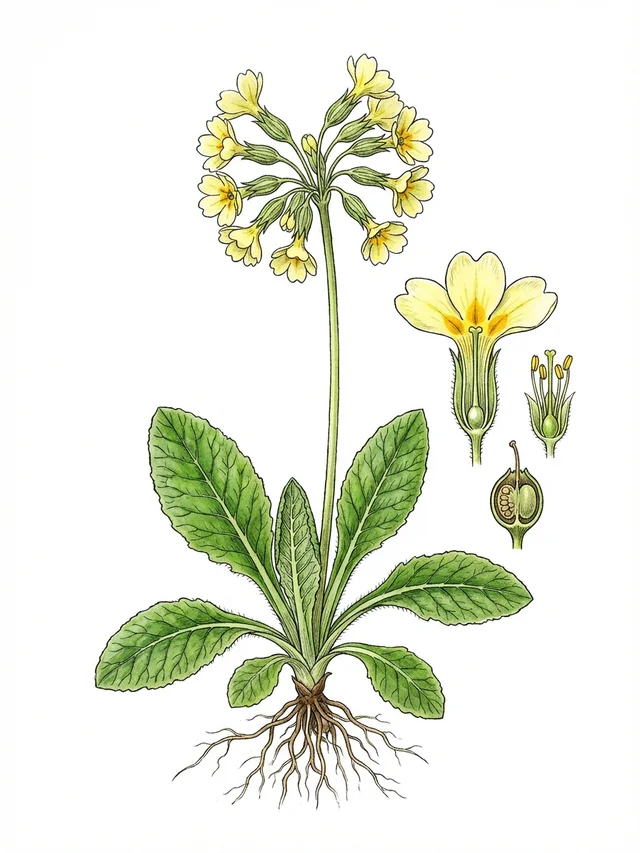
 Image to followAI-generated illustration
Hypericum humifusum
Hypericum humifusum
FamilyGenus: Hypericumnative in Germany
🌿
7
Species
interact
🔗
7
Interactions
documented
About this species
Trailing St John's-wort is a low-growing native perennial that forms sprawling mats in open, sunny habitats. Its small, five-petalled yellow flowers appear from June to October on moist, nutrient-poor ground.
Ecological network
Click to highlight connections · Click again to open the species page
Loading network...
Flower visit
Ecological significance
As a native species, trailing St John's-wort naturally occupies open, low-nutrient habitats in Britain without exhibiting invasive tendencies or causing ecological disruption.
Annual cycle
A herbaceous perennial that sends out fresh creeping stems from a persistent rootstock in spring. Flowering is concentrated between June and October, after which the stems die back and the plant overwinters as a tight cluster of buds at or just below the soil surface.
Safety note
No specific hazards are documented for this species.
Standort & Merkmale
Light
Sonne
Moisture
Frisch (Mäßig feucht)
Soil
Schwachzehrer (Magerer Boden)
Flowering period
Jun – Okt
Soil reaction
Mäßig sauer bis neutral
Bioregion
Continental
Growth form
Krautige Pflanze
Woodiness
Nicht verholzt
Leaf type
Breitblättrig
Plant height
0.083 m
Morphological traits: TRY ID3 (CC BY 3.0) & TRY ID81 (CC BY)
Pflege & Anbau
Site in full sun on a moisture-retentive but free-draining, low-fertility soil – light sand, gravel or impoverished loam suits it best. Water during prolonged dry spells to keep the ground moderately moist; avoid feeding, as rich soils encourage floppy growth and competition from more vigorous plants. The mat-forming habit needs little maintenance; trim back any wayward stems after flowering if a tidier appearance is desired. Propagation is easiest by seed sown on the surface of damp, sandy compost in autumn, or by careful division of rooted stem sections in spring.
Scientific profile
Hypericum humifusum is a prostrate, herbaceous perennial of the St John's-wort family, native in Great Britain. Reaching only about 8 cm in height, it produces numerous slender, often reddish stems that spread across the ground. The paired, broad, untoothed leaves are dotted with translucent glands, and the star-shaped yellow flowers, about 1 cm across, are borne singly or in small clusters at the stem tips. Flowering extends from June to October. It favours full sunlight and moist, infertile, slightly disturbed soils on heaths, grassy tracks, woodland rides and open banks. The tiny seeds, each weighing around 0.04 mg, are dispersed close to the parent plant, helping the species to persist in stable patches of suitable habitat.
Other flower visitors
7 other species visit the flowers
Regulus regulusSylvia atricapillaSerinus serinusCarduelis carduelisTurdus merulaErithacus rubeculaFringilla coelebs
Sources & data origin
•Interaktionsdaten via GloBI (CC-BY 4.0)
•FloraWeb / BfN
•EIVE 1.0 — Dengler et al. (2023), DOI: 10.3897/VCS.98324 (CC BY 4.0)
•GBIF Backbone Taxonomy — GBIF Secretariat (2024), DOI: 10.15468/39omei (CC BY 4.0)
•TRY Categorical Traits (ID3) — Kattge et al. (2012), DOI: 10.17871/TRY.3 (CC BY 3.0)
•TRY Global Spectrum (ID81) — Díaz et al. (2016/2021), DOI: 10.17871/TRY.81 (CC BY)
•Govaerts R et al. (2025) — World Checklist of Vascular Plants (WCVP) v14. Royal Botanic Gardens, Kew. DOI: 10.34885/xs7h-ze42 (CC BY 4.0)
All data is licensed under CC BY 4.0, CC0, or compatible terms. Attribution according to license conditions. Full source overview →