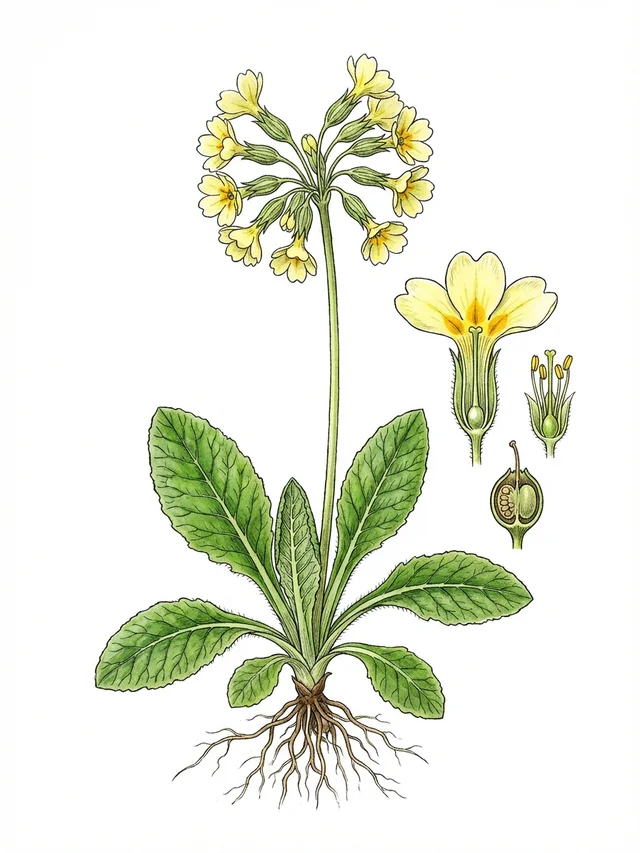
 Image to followAI-generated illustration
Kalmia angustifolia
Kalmia angustifolia
FamilyGenus: Lorbeerrosennative in Germany
🌿
4
Species
interact
🔗
4
Interactions
documented
🐛
1
Host relationships
Species
About this species
Kalmia angustifolia is an introduced evergreen shrub in Great Britain, established from ornamental plantings. Growing to around 75 cm, it bears broad leaves and blooms in early summer, thriving in sunny, acidic, moist, low-nutrient conditions.
Ecological network
Click to highlight connections · Click again to open the species page
Loading network...
PollinationLarval hostFlower visit
Ecological significance
Kalmia angustifolia is an introduced shrub in Great Britain, first recorded in 1870 and now established through ornamental use. It forms ericoid mycorrhizal associations typical of the heather family.
Annual cycle
Evergreen foliage persists throughout the year. Flowers open from June into July.
Standort & Merkmale
Light
Sonne
Moisture
Feucht
Soil
Schwachzehrer (Magerer Boden)
Flowering period
Jun – Jul
Bioregion
Continental
Growth form
Strauch
Woodiness
Verholzt
Leaf type
Breitblättrig
Leaf phenology
Immergrün
Plant height
0.756 m
Morphological traits: TRY ID3 (CC BY 3.0) & TRY ID81 (CC BY)
Pflege & Anbau
Plant in full sun, in moist, acidic, low-nutrient soil. A peaty or sandy ericaceous bed is ideal, and mulching with pine needles or bark helps retain moisture and acidity. Avoid nutrient-rich or limey ground. Container growing is possible using ericaceous compost; ensure the pot drains freely but the root area remains consistently moist. No regular feeding is required—this shrub is adapted to infertile conditions.
Scientific profile
Kalmia angustifolia belongs to the heather family (Ericaceae) and originates from northern America, including the northeastern and southeastern United States. In Great Britain it is an introduced shrub that has become established; the first European record in the wild dates from 1870, and its pathway is ornamental horticulture. The plant is a small, woody, broad-leaved evergreen, typically reaching about 0.76 m in height. A plant of sunny, moist, strongly acidic and nutrient-poor soils, it blooms from June to July. Like many members of the Ericaceae, it forms ericoid mycorrhizae.
Sources & data origin
•Interaktionsdaten via GloBI (CC-BY 4.0)
•FloraWeb / BfN
•EIVE 1.0 — Dengler et al. (2023), DOI: 10.3897/VCS.98324 (CC BY 4.0)
•GBIF Backbone Taxonomy — GBIF Secretariat (2024), DOI: 10.15468/39omei (CC BY 4.0)
•TRY Categorical Traits (ID3) — Kattge et al. (2012), DOI: 10.17871/TRY.3 (CC BY 3.0)
•TRY Global Spectrum (ID81) — Díaz et al. (2016/2021), DOI: 10.17871/TRY.81 (CC BY)
•Checklist Alien Plants Belgium — Verloove F (2023), Botanic Garden Meise (CC BY 4.0)
•Govaerts R et al. (2025) — World Checklist of Vascular Plants (WCVP) v14. Royal Botanic Gardens, Kew. DOI: 10.34885/xs7h-ze42 (CC BY 4.0)
All data is licensed under CC BY 4.0, CC0, or compatible terms. Attribution according to license conditions. Full source overview →