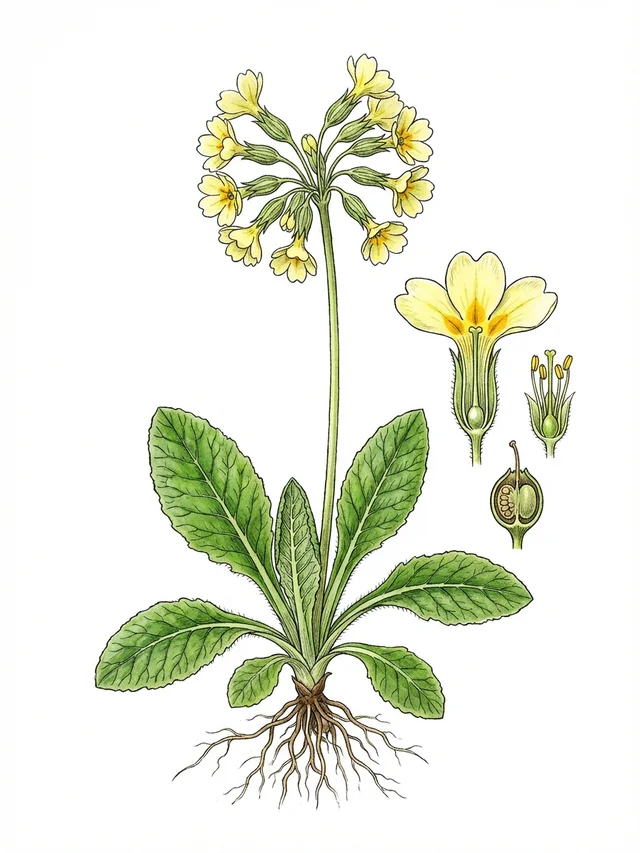
 Image to followAI-generated illustration
Limonium vulgare
Limonium vulgare
FamilyGenus: Limoniumnative in Germany
🌿
23
Species
interact
🔗
24
Interactions
documented
🐛
3
Host relationships
Species
About this species
A native perennial herb of wet, saline meadows, Limonium vulgare produces its flowers in late summer. It reaches about 24 centimetres in height and has broad leaves. This halophyte is strongly tolerant of salt and grows in full sun on moist, calcareous, moderately fertile soils.
Ecological network
Click to highlight connections · Click again to open the species page
Loading network...
PollinationLarval host
Ecological significance
As a native halophyte, Limonium vulgare forms part of the natural flora of Britain's damp, saline grassland communities.
Annual cycle
Flowering occurs in August and September.
Standort & Merkmale
Light
Sonne
Moisture
Frisch (Mäßig feucht)
Soil
Mittelzehrer (Normaler Boden)
Flowering period
Aug – Sep
Soil reaction
Basisch / Kalkhold
Growth form
Krautige Pflanze
Woodiness
Nicht verholzt
Leaf type
Breitblättrig
Plant height
0.24 m
Morphological traits: TRY ID3 (CC BY 3.0) & TRY ID81 (CC BY)
Pflege & Anbau
Grow in full sun with moisture-retentive, moderately fertile soil. The species thrives on calcareous ground and tolerates saline conditions. Flower spikes appear in late summer, from August into September.
Scientific profile
Limonium vulgare is a herbaceous, non-woody perennial with broad leaves. Plants reach a typical height of 24 centimetres. The species is strongly salt-tolerant and behaves as a halophyte, occurring in habitats with high soil moisture, a calcareous reaction and moderate nutrient levels. Full sun is required for optimum growth. Derived habitat indications place it primarily in nutrient‑rich meadowland, occasionally extending into arable ground as a secondary habitat. The flowering period spans August and September. The plant is native in Great Britain.
Pollinators & visitors
20 Arten interagieren mit dieser Pflanze
Thymelicus sylvestrisPyronia tithonusThymelicus lineolaPolygonia c-albumMelitta leporinaNomada flavopictaNomada fulvicornisBombus pascuorumApis melliferaAndrena dorsataAndrena flavipesAglais urticaeBombus lucorumPieris brassicaePieris rapaeBombus jonellusZygaena filipendulaeAutographa gammaBombus lapidariusBombus hortorum
Host relationships
3 species use this plant as a host
Sources & data origin
•Interaktionsdaten via GloBI (CC-BY 4.0)
•Cook et al. (2025) UK Butterfly & Moth Traits (DOI: 10.5285/dbc7cc17-cbbd-49dd-bab4-8e8855768d66)
•pollinator_interactions
•FloraWeb / BfN
•EIVE 1.0 — Dengler et al. (2023), DOI: 10.3897/VCS.98324 (CC BY 4.0)
•GBIF Backbone Taxonomy — GBIF Secretariat (2024), DOI: 10.15468/39omei (CC BY 4.0)
•TRY Categorical Traits (ID3) — Kattge et al. (2012), DOI: 10.17871/TRY.3 (CC BY 3.0)
•TRY Global Spectrum (ID81) — Díaz et al. (2016/2021), DOI: 10.17871/TRY.81 (CC BY)
•Govaerts R et al. (2025) — World Checklist of Vascular Plants (WCVP) v14. Royal Botanic Gardens, Kew. DOI: 10.34885/xs7h-ze42 (CC BY 4.0)
All data is licensed under CC BY 4.0, CC0, or compatible terms. Attribution according to license conditions. Full source overview →