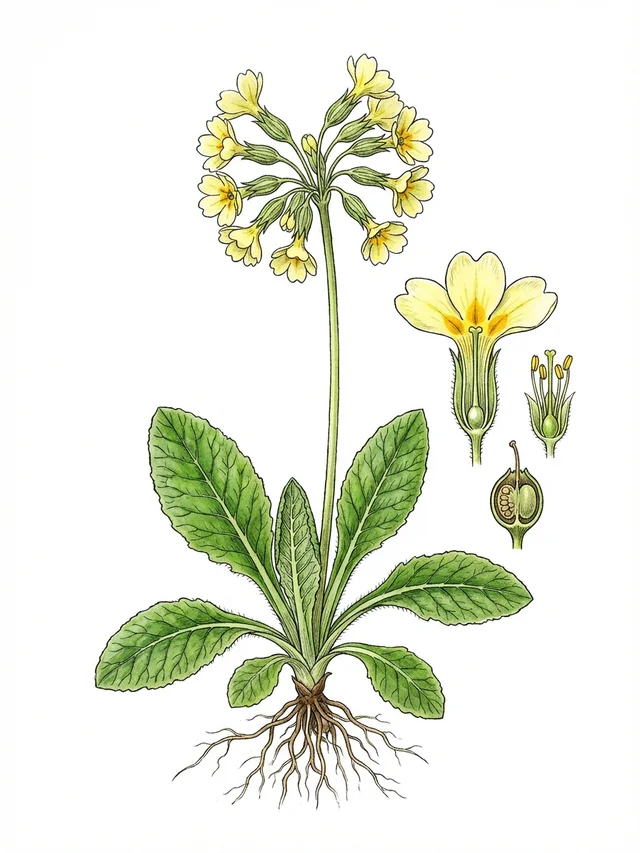
 Image to followAI-generated illustration
Luzula campestris
Luzula campestris
FamilyGenus: Luzulanative in Germany
🌿
5
Species
interact
🔗
5
Interactions
documented
🐛
3
Host relationships
Species
About this species
An evergreen, native rush of sunny, moist, nutrient-poor ground, Luzula campestris forms loose tufts of broad leaves and flowers from March to April.
Ecological network
Click to highlight connections · Click again to open the species page
Loading network...
PollinationLarval host
Ecological significance
The ecological interactions of Luzula campestris are not detailed in the available evidence.
Annual cycle
Foliage is evergreen and remains present year-round. Flowering occurs from March to April. After flowering, seeds are produced and dispersed.
Safety note
No safety information is provided in the source data.
Standort & Merkmale
Light
Sonne
Moisture
Frisch (Mäßig feucht)
Soil
Schwachzehrer (Magerer Boden)
Flowering period
Mär – Apr
Soil reaction
Mäßig sauer bis neutral
Bioregion
Continental
Growth form
Gras
Woodiness
Nicht verholzt
Leaf type
Breitblättrig
Leaf phenology
Immergrün
Plant height
0.134 m
Morphological traits: TRY ID3 (CC BY 3.0) & TRY ID81 (CC BY)
Pflege & Anbau
**Light:** Full sun.
**Soil:** Moist, nutrient-poor soil.
**Watering:** Keep the soil moderately moist.
**Maintenance:** Little needed; old foliage can be trimmed back in late winter. Avoid areas of heavy trampling or frequent disturbance, as the species does not tolerate high levels of disturbance.
Scientific profile
Luzula campestris is a low-growing, evergreen rush native in Great Britain. It reaches a height of about 13 cm and produces flat, broad leaves and loose grassy clumps. Its small flowers appear from March to April. The species favours sunny positions and moist but well-drained, nutrient-poor soils. It tolerates only low levels of disturbance. Leaves are evergreen, with an average leaf area of 211 mm², and the tiny seeds weigh around 0.62 mg.
Sources & data origin
•Cook et al. (2025) UK Butterfly & Moth Traits (DOI: 10.5285/dbc7cc17-cbbd-49dd-bab4-8e8855768d66)
•pollinator_interactions
•FloraWeb / BfN
•EIVE 1.0 — Dengler et al. (2023), DOI: 10.3897/VCS.98324 (CC BY 4.0)
•GBIF Backbone Taxonomy — GBIF Secretariat (2024), DOI: 10.15468/39omei (CC BY 4.0)
•TRY Categorical Traits (ID3) — Kattge et al. (2012), DOI: 10.17871/TRY.3 (CC BY 3.0)
•TRY Global Spectrum (ID81) — Díaz et al. (2016/2021), DOI: 10.17871/TRY.81 (CC BY)
•Govaerts R et al. (2025) — World Checklist of Vascular Plants (WCVP) v14. Royal Botanic Gardens, Kew. DOI: 10.34885/xs7h-ze42 (CC BY 4.0)
All data is licensed under CC BY 4.0, CC0, or compatible terms. Attribution according to license conditions. Full source overview →