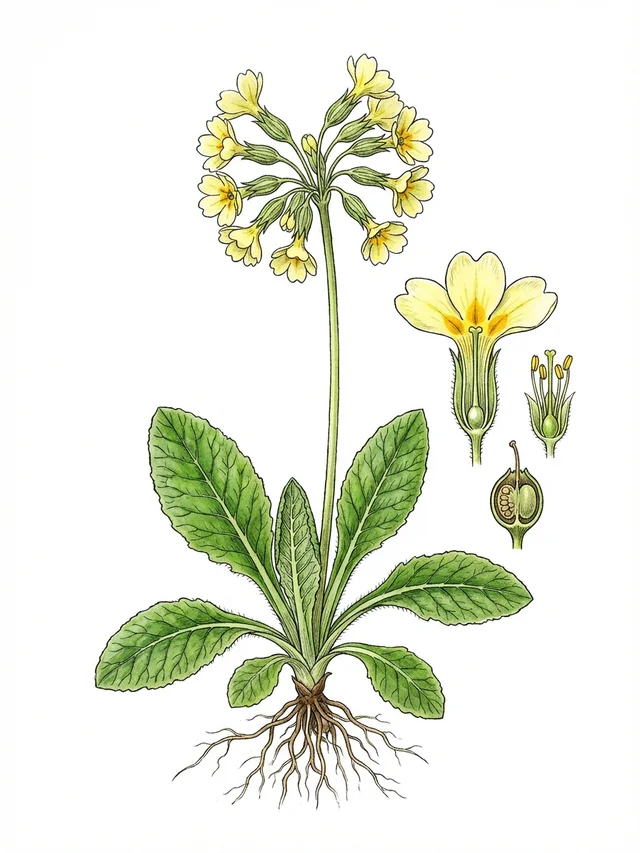
 Image to followAI-generated illustration
Lysimachia thyrsiflora
Lysimachia thyrsiflora
FamilyGenus: Lysimachianative in Germany
🌿
2
Species
interact
🔗
2
Interactions
documented
🐛
1
Host relationships
Species
About this species
A native perennial of damp habitats, producing dense clusters of small flowers from late spring to early summer.
Ecological network
Click to highlight connections · Click again to open the species page
Loading network...
Larval hostFlower visit
Ecological significance
It forms part of fen, wet woodland and damp grassland plant communities, contributing to the structure of these native wetland habitats.
Annual cycle
Herbaceous perennial. New growth emerges in spring. Flowering occurs from May to July, followed by seed set. Top growth dies back in autumn and the plant overwinters as underground parts.
Safety note
No specific safety information is available for this plant.
Standort & Merkmale
Light
Halbschatten
Moisture
Feucht
Soil
Mittelzehrer (Normaler Boden)
Flowering period
Mai – Jul
Soil reaction
Mäßig sauer bis neutral
Bioregion
Continental
Growth form
Krautige Pflanze
Woodiness
Nicht verholzt
Leaf type
Breitblättrig
Plant height
0.504 m
Morphological traits: TRY ID3 (CC BY 3.0) & TRY ID81 (CC BY)
Pflege & Anbau
This species prefers a partially shaded spot with soil that remains moist throughout the growing season. A moderately fertile, neutral to slightly acidic soil suits it well. Water thoroughly during dry periods. It grows best beside a pond or in a damp border, flowering from May to July.
Scientific profile
Lysimachia thyrsiflora is a herbaceous, non-woody perennial native in Great Britain. It reaches about 50 cm in height and bears broad leaves. Flowering takes place between May and July. The plant grows best in partial shade and consistently moist, moderately fertile soils that are neutral to slightly acidic. In the wild it is often associated with fen, wet woodland and damp grassland communities, typically occurring in places with low levels of disturbance. The species carries a red-list status of V in the source data used here, though its precise conservation status in Britain is not specified.
Sources & data origin
•Interaktionsdaten via GloBI (CC-BY 4.0)
•FloraWeb / BfN
•EIVE 1.0 — Dengler et al. (2023), DOI: 10.3897/VCS.98324 (CC BY 4.0)
•GBIF Backbone Taxonomy — GBIF Secretariat (2024), DOI: 10.15468/39omei (CC BY 4.0)
•TRY Categorical Traits (ID3) — Kattge et al. (2012), DOI: 10.17871/TRY.3 (CC BY 3.0)
•TRY Global Spectrum (ID81) — Díaz et al. (2016/2021), DOI: 10.17871/TRY.81 (CC BY)
•Govaerts R et al. (2025) — World Checklist of Vascular Plants (WCVP) v14. Royal Botanic Gardens, Kew. DOI: 10.34885/xs7h-ze42 (CC BY 4.0)
All data is licensed under CC BY 4.0, CC0, or compatible terms. Attribution according to license conditions. Full source overview →