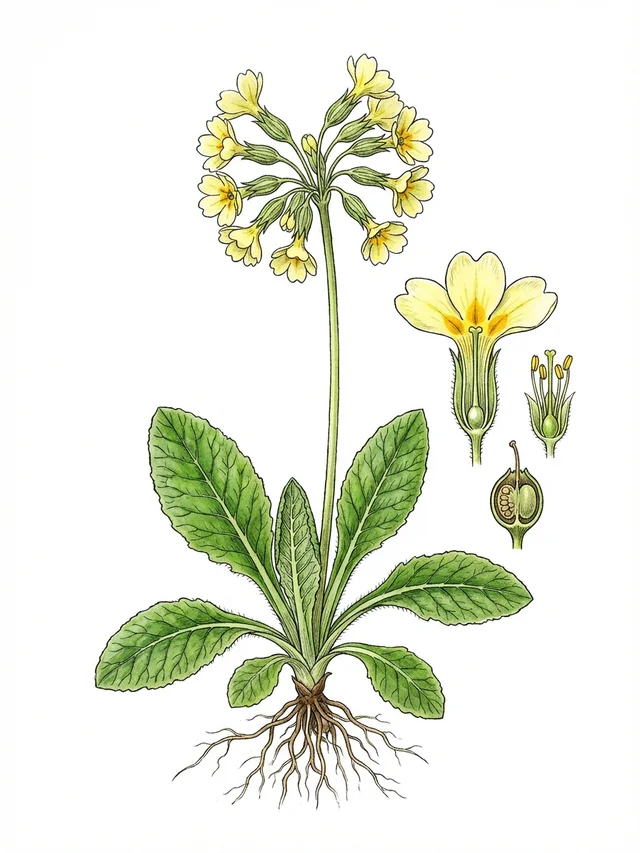
 Image to followAI-generated illustration
Melica nutans
Melica nutans
FamilyGenus: Melicanative in Germany
🌿
3
Species
interact
🔗
6
Interactions
documented
🐛
1
Host relationships
Species
About this species
A perennial grass native in Great Britain, Melica nutans occurs in shaded places on fresh, often calcareous soils. It grows to about half a metre tall, producing its loose nodding inflorescences between May and July.
Ecological network
Click to highlight connections · Click again to open the species page
Loading network...
PollinationLarval host
Ecological significance
As a native grass of shaded, calcareous habitats with low nutrient status and minimal disturbance, Melica nutans contributes to the ground flora of such communities. Its presence indicates fairly undisturbed, base-rich conditions under a tree canopy or in comparable shady environments.
Annual cycle
Flowering takes place from May to July. The plant is a perennial grass that persists through the year.
Safety note
No detailed safety information is recorded for this species.
Standort & Merkmale
Light
Schatten
Moisture
Frisch (Mäßig feucht)
Soil
Mittelzehrer (Normaler Boden)
Flowering period
Mai – Jul
Soil reaction
Mäßig sauer bis neutral
Bioregion
Continental
Growth form
Gras
Woodiness
Nicht verholzt
Leaf type
Breitblättrig
Plant height
0.474 m
Morphological traits: TRY ID3 (CC BY 3.0) & TRY ID81 (CC BY)
Pflege & Anbau
This grass is best suited to shady sites with fresh, moderately moist, calcareous soil of low to normal fertility. It tolerates only light disturbance and thrives where conditions remain relatively stable.
Scientific profile
Melica nutans is a broad-leaved, non-woody grass that typically reaches a height of roughly 0.47 m. Its leaves have a relatively large area, averaging about 395 mm², while the diaspores are light, around 2.2 mg. The species is native in Great Britain and forms associations with arbuscular mycorrhizal fungi. It is found in deeply shaded habitats with fresh, moderately moist soils that tend to be calcareous or basic in reaction. Nutrient levels at its sites are generally low, and it shows a preference for places that experience only slight disturbance. Temperature conditions are moderately warm. Flowering occurs from late spring into summer, spanning May to July.
Host relationships
1 species use this plant as a host
Coenonympha iphis (Denis & Schiffermüller), 1776
Sources & data origin
•Interaktionsdaten via GloBI (CC-BY 4.0)
•FloraWeb / BfN
•EIVE 1.0 — Dengler et al. (2023), DOI: 10.3897/VCS.98324 (CC BY 4.0)
•GBIF Backbone Taxonomy — GBIF Secretariat (2024), DOI: 10.15468/39omei (CC BY 4.0)
•TRY Categorical Traits (ID3) — Kattge et al. (2012), DOI: 10.17871/TRY.3 (CC BY 3.0)
•TRY Global Spectrum (ID81) — Díaz et al. (2016/2021), DOI: 10.17871/TRY.81 (CC BY)
•Govaerts R et al. (2025) — World Checklist of Vascular Plants (WCVP) v14. Royal Botanic Gardens, Kew. DOI: 10.34885/xs7h-ze42 (CC BY 4.0)
All data is licensed under CC BY 4.0, CC0, or compatible terms. Attribution according to license conditions. Full source overview →