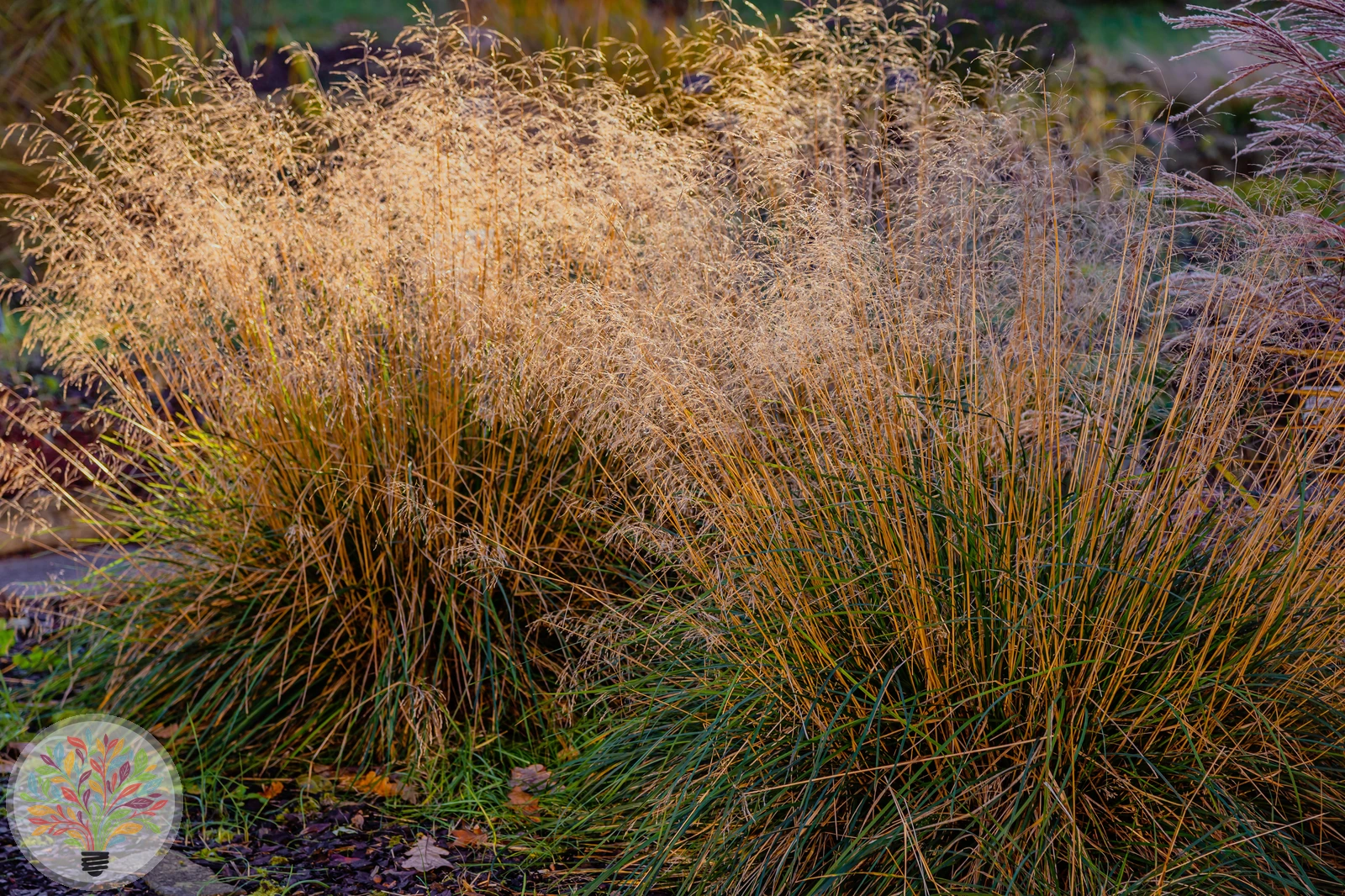
Molinia caerulea
Molinia caerulea
FamilyGenus: Molinianative in Germany
🌿
12
Species
interact
🔗
12
Interactions
documented
🐛
12
Host relationships
Species
About this species
Molinia caerulea is a native broad-leaved grass of Great Britain, reaching about 0.94 m in height. It flowers between August and September and thrives in sunny, moderately moist, nutrient-poor soils.
Ecological network
Click to highlight connections · Click again to open the species page
Loading network...
Larval host
Ecological significance
As a native grass of nutrient-poor habitats, Molinia caerulea plays a role in supporting local wildlife associated with such plant communities.
Annual cycle
Flowers from August to September.
Standort & Merkmale
Light
Sonne
Moisture
Frisch (Mäßig feucht)
Soil
Schwachzehrer (Magerer Boden)
Flowering period
Aug – Sep
Soil reaction
Mäßig sauer bis neutral
Bioregion
Continental
Growth form
Gras
Woodiness
Nicht verholzt
Leaf type
Breitblättrig
Plant height
0.938 m
Morphological traits: TRY ID3 (CC BY 3.0) & TRY ID81 (CC BY)
Pflege & Anbau
Grow in full sun on a lean, moderately moist, neutral to slightly acidic soil. Avoid rich or fertile ground, as this species is adapted to nutrient-poor conditions. Once established it requires little attention beyond removing old foliage in late winter.
Scientific profile
Molinia caerulea is a terrestrial, non-woody grass native in Great Britain. It forms clumps of broad leaves and achieves a typical height of approximately 0.94 m. The plant flowers from August to September. Its ecological preferences are for sunny positions (light value 7), fresh to moderately moist soils (moisture value 6), and nutrient-poor, weakly acidic to neutral ground (nutrient value 2, reaction value 5). It favours moderately warm temperatures (value 4). The species is associated with arbuscular mycorrhizal fungi and produces small diaspores of about 1.8 mg.
Host relationships
12 species use this plant as a host
Carterocephalus palaemonErebia aethiopsRivula sericealisEuclidia miDeltote pygargaDeltote bankianaAmphipoea lucensMythimna pudorinaCerapteryx graminisXylena vetustaPhragmatobia fuliginosaEuthrix potatoria
Sources & data origin
•Cook et al. (2025) UK Butterfly & Moth Traits (DOI: 10.5285/dbc7cc17-cbbd-49dd-bab4-8e8855768d66)
•FloraWeb / BfN
•EIVE 1.0 — Dengler et al. (2023), DOI: 10.3897/VCS.98324 (CC BY 4.0)
•GBIF Backbone Taxonomy — GBIF Secretariat (2024), DOI: 10.15468/39omei (CC BY 4.0)
•TRY Categorical Traits (ID3) — Kattge et al. (2012), DOI: 10.17871/TRY.3 (CC BY 3.0)
•TRY Global Spectrum (ID81) — Díaz et al. (2016/2021), DOI: 10.17871/TRY.81 (CC BY)
•Checklist Alien Plants Belgium — Verloove F (2023), Botanic Garden Meise (CC BY 4.0)
•Govaerts R et al. (2025) — World Checklist of Vascular Plants (WCVP) v14. Royal Botanic Gardens, Kew. DOI: 10.34885/xs7h-ze42 (CC BY 4.0)
•Foto: © Adobe Stock / AdobeStock_468436865
All data is licensed under CC BY 4.0, CC0, or compatible terms. Attribution according to license conditions. Full source overview →