Nardus stricta
Nardus stricta
FamilyGenus: Nardusnative in Germany
🌿
9
Species
interact
🔗
15
Interactions
documented
🐛
4
Host relationships
Species
About this species
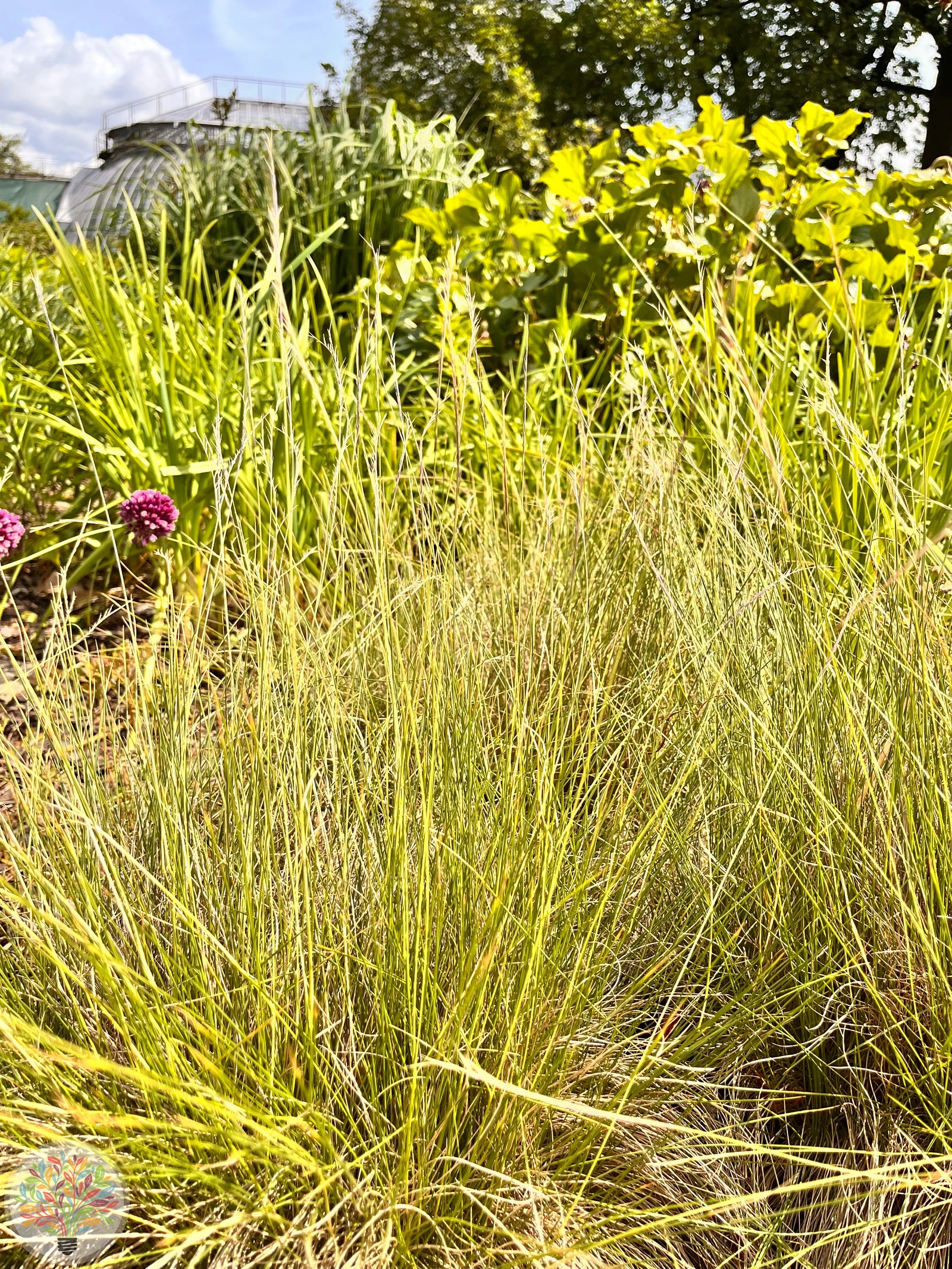
Nardus stricta is a native grass of acid grasslands and heaths in Great Britain. Forming tight tufts of broad leaves, it grows to about 20 cm tall and produces flowering spikes from May to June. It requires full sun and fresh, moderately moist, nutrient-poor acidic soils and copes with a low level of disturbance.
Ecological network
Click to highlight connections · Click again to open the species page
Loading network...
PollinationLarval hostFlower visit
Ecological significance
As a native component of species‑poor acidic grasslands and heaths, Nardus stricta helps bind low‑nutrient soils and forms part of the fabric of extensively grazed or disturbed upland and lowland swards. Its resistance to mild disturbance makes it a persistent feature of traditional pastures without becoming invasive.
Annual cycle
Flowers in May and June.
Standort & Merkmale
Light
Sonne
Moisture
Frisch (Mäßig feucht)
Soil
Schwachzehrer (Magerer Boden)
Flowering period
Mai – Jun
Soil reaction
Sauer (Säurezeiger)
Bioregion
Continental
Growth form
Gras
Woodiness
Nicht verholzt
Leaf type
Breitblättrig
Plant height
0.196 m
Morphological traits: TRY ID3 (CC BY 3.0) & TRY ID81 (CC BY)
Pflege & Anbau
Site in full sun on a fresh, moderately moist, freely draining soil that is markedly acidic and low in nutrients. Avoid any form of fertiliser, liming or organic enrichment, as the plant is adapted to infertile conditions. Water sparingly during prolonged drought; the natural preference is for soils that remain fresh but never become waterlogged. Use in naturalistic grass‑only swards, acid grassland restorations or heath‑style plantings where a low‑growth, block‑forming character is desired.
Scientific profile
Nardus stricta is a non-woody, terrestrial grass with broad leaves and a compact tufted habit. It typically reaches a height of around 0.2 metres (20 cm). The species shows a strong preference for full sun (Ellenberg light value 8) and grows on fresh to moderately moist soils (moisture value 6). Nutrient availability is very low, with an indicator value of 2 for nitrogen, and it is restricted to distinctly acidic ground (reaction value 2). A disturbance severity of 0.4 reflects its tolerance of only mild, infrequent soil disturbance. The temperature indicator value of 4 places it in a moderately warm regime. Its fine, wind‑dispersed seeds weigh just 0.3056 mg, and leaf area averages 82.82 mm². Roots form arbuscular mycorrhizal (AM) associations.
Pollinators & visitors
4 Arten interagieren mit dieser Pflanze
Host relationships
4 species use this plant as a host
Other flower visitors
1 other species visit the flowers
Chionomys nivalis
Sources & data origin
•Cook et al. (2025) UK Butterfly & Moth Traits (DOI: 10.5285/dbc7cc17-cbbd-49dd-bab4-8e8855768d66)
•Interaktionsdaten via GloBI (CC-BY 4.0)
•FloraWeb / BfN
•EIVE 1.0 — Dengler et al. (2023), DOI: 10.3897/VCS.98324 (CC BY 4.0)
•GBIF Backbone Taxonomy — GBIF Secretariat (2024), DOI: 10.15468/39omei (CC BY 4.0)
•TRY Categorical Traits (ID3) — Kattge et al. (2012), DOI: 10.17871/TRY.3 (CC BY 3.0)
•TRY Global Spectrum (ID81) — Díaz et al. (2016/2021), DOI: 10.17871/TRY.81 (CC BY)
•Govaerts R et al. (2025) — World Checklist of Vascular Plants (WCVP) v14. Royal Botanic Gardens, Kew. DOI: 10.34885/xs7h-ze42 (CC BY 4.0)
•Foto: © Adobe Stock / AdobeStock_1613949400
All data is licensed under CC BY 4.0, CC0, or compatible terms. Attribution according to license conditions. Full source overview →