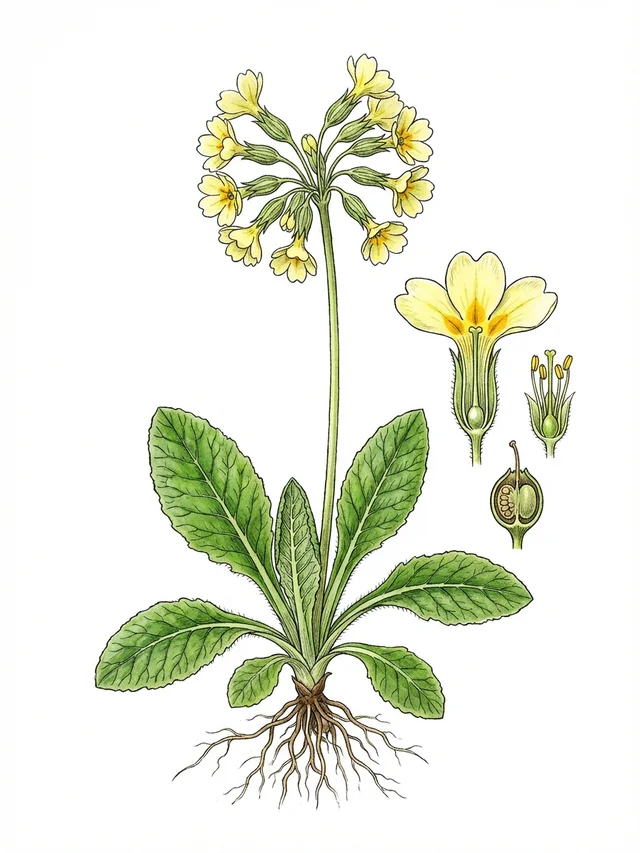
 Image to followAI-generated illustration
Oenanthe crocata
Oenanthe crocata
FamilyGenus: Oenanthenative in Germany
🌿
94
Species
interact
🔗
202
Interactions
documented
About this species
A native, rare aquatic herb of sunny, wet habitats, flowering in early summer. Its broad leaves and moderate nectar and pollen yields support visiting insects.
Ecological network
Click to highlight connections · Click again to open the species page
Loading network...
PollinationFlower visit
Ecological significance
Provides nectar and pollen for a range of insects. As a native component of wetland flora, it contributes to the structure and function of aquatic plant communities.
Annual cycle
Flowering period June to July.
Standort & Merkmale
Light
Sonne
Moisture
Feucht
Soil
Mittelzehrer (Normaler Boden)
Flowering period
Jun – Jul
Soil reaction
Mäßig sauer bis neutral
Bioregion
Continental
Nectar value
4
Pollen value
4
Growth form
Krautige Pflanze
Woodiness
Nicht verholzt
Leaf type
Breitblättrig
Plant height
0.909 m
Morphological traits: TRY ID3 (CC BY 3.0) & TRY ID81 (CC BY)
Pflege & Anbau
**Light:** Full sun
**Moisture:** Permanently moist to wet soil or shallow water
**Soil:** Average fertility; tolerates slight salinity
**Notes:** Avoid disturbance once established.
Scientific profile
Oenanthe crocata is a herbaceous plant growing to about 0.91 m in height. Its broad leaves are relatively large and well-suited to an aquatic life in shallow water or waterlogged ground. It requires full sun and consistently moist to wet, moderately fertile conditions, showing little tolerance of disturbance and only slight salt tolerance. Flowering takes place in June and July, producing umbels that offer moderate amounts of both nectar and pollen (value 4 each), thereby attracting pollinating insects. The plant associates with arbuscular mycorrhizal fungi. It is listed as Rare on the national Red List.
Pollinators & visitors
51 Arten interagieren mit dieser Pflanze
Andrena fucataAndrena cinerariaBombus pascuorumBombus lucorumSatyrium w-albumMegachile versicolorColletes daviesanusMelanargia galatheaHylaeus pictipesAndrena haemorrhoaAndrena chrysoscelesAndrena nitidiusculaAndrena proximaAndrena nitidaAndrena flavipesBombus hortorumBombus pratorumNomada flavaBombus vestalisHylaeus confususBombus hypnorumHylaeus communisVespula rufaAndrena coitanaAndrena clarkellaHylaeus brevicornisLasioglossum parvulumBombus jonellusRutpela maculataAndrena dorsataAndrena nigroaeneaApis melliferaLasioglossum pauxillumGrammoptera ruficornisAlosterna tabacicolorPararge aegeriaBombus sylvestrisBombus lapidariusPolistes dominulaPieris rapaeAglais urticaeAndrena fulvaBombus terrestrisEristalis tenaxEristalis arbustorumEristalis pertinaxRhingia rostrataAndrena scoticaSyritta pipiensAndrena semilaevis
Other flower visitors
43 other species visit the flowers
Malachius bipustulatusCantharis pellucidaAnthrenus verbasciOedemera luridaOxythyrea funestaRhagonycha fulvaMacrophya montanaArge melanochraTrichius gallicusUdea ferrugalisPseudovadonia lividaArge cyanocroceaAlomya debellatorAprostocetus annulatusAprostocetus aristaeusAprostocetus aurantiacusCollyria trichophthalmaEndromopoda detritaGlyphicnemis profligatorHomoporus lunigerKleidotoma tetratomaMelanips opacusMacroglenes penetransPnigalio attisRoptrocerus mirusSemiotellus mundusTrybliographa rapaeTryphon signatorTryphon trochanteratusTyndarichus scaurusLucilia caesarMordellistena pumilaDelia radicumPropylea quattuordecimpunctataAnaspis maculataAnaspis pulicariaMeligethes atratusRhagonycha limbataAgriotes pallidulusAnaspis fasciataAnthrenus fuscusAnaspis garneysiCantharis lateralis
Sources & data origin
•Interaktionsdaten via GloBI (CC-BY 4.0)
•pollinator_interactions
•FloraWeb / BfN
•EIVE 1.0 — Dengler et al. (2023), DOI: 10.3897/VCS.98324 (CC BY 4.0)
•EuPPollNet — Kuppler et al. (2025), DOI: 10.1111/geb.70000 (CC BY 4.0)
•Database of Pollinator Interactions (DoPI) — Pocock et al. (2022), DOI: 10.1002/ecy.3801 (CC BY)
•GBIF Backbone Taxonomy — GBIF Secretariat (2024), DOI: 10.15468/39omei (CC BY 4.0)
•TRY Categorical Traits (ID3) — Kattge et al. (2012), DOI: 10.17871/TRY.3 (CC BY 3.0)
•TRY Global Spectrum (ID81) — Díaz et al. (2016/2021), DOI: 10.17871/TRY.81 (CC BY)
•Govaerts R et al. (2025) — World Checklist of Vascular Plants (WCVP) v14. Royal Botanic Gardens, Kew. DOI: 10.34885/xs7h-ze42 (CC BY 4.0)
All data is licensed under CC BY 4.0, CC0, or compatible terms. Attribution according to license conditions. Full source overview →