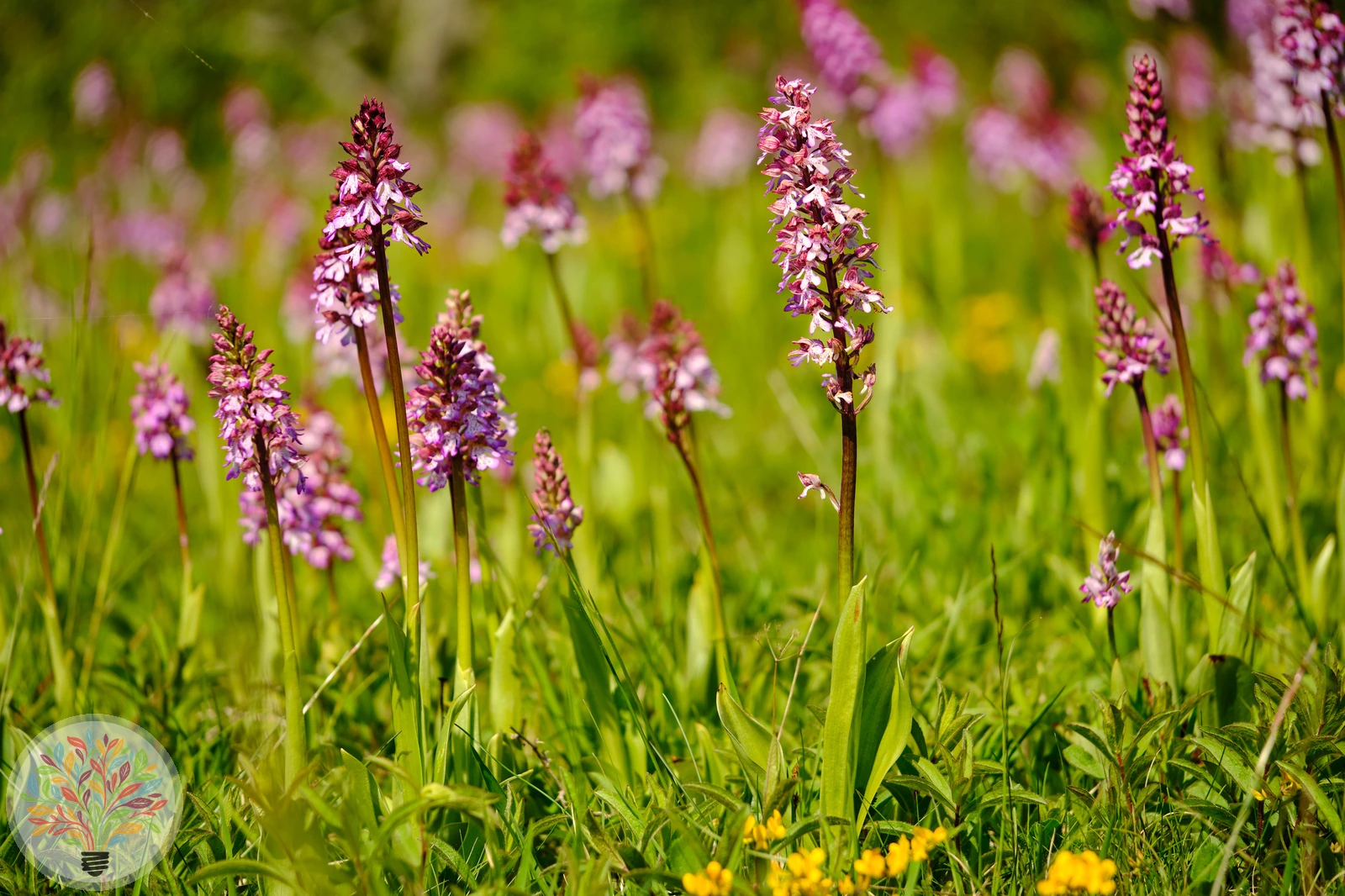
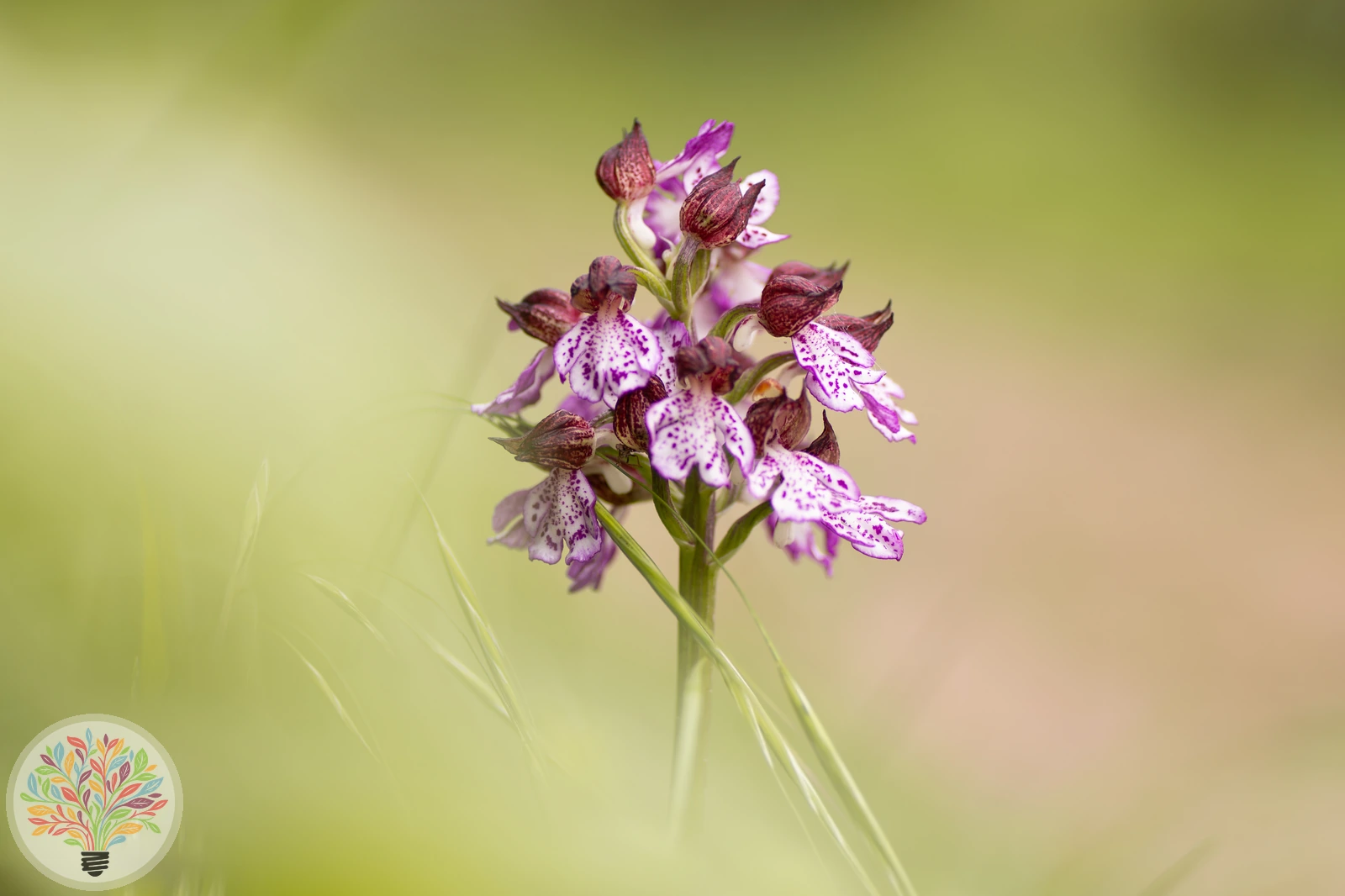
Orchis purpurea
Orchis purpurea
FamilyGenus: Orchisnative in Germany
🌿
7
Species
interact
🔗
11
Interactions
documented
About this species
A native terrestrial orchid of Great Britain, Orchis purpurea is a herbaceous perennial that produces broad leaves and a striking spike of blooms in spring. It thrives in semi-shaded, calcareous habitats where the soil remains fresh and moderately moist but nutrient‑poor, and it benefits from very low disturbance.
Ecological network
Click to highlight connections · Click again to open the species page
Loading network...
PollinationFlower visit
Ecological significance
As a native wildflower, Orchis purpurea integrates into low‑nutrient calcareous communities without exhibiting any invasive tendencies. Its persistence signals undisturbed, species‑rich grassland or woodland‑edge habitats that are of conservation value.
Annual cycle
A tight rosette of broad leaves emerges in early spring. Flowering stems rise from April to June, carrying the bloom spike. Once pollination occurs, seed capsules swell and the above‑ground parts wither during late summer. The plant survives underground as a dormant tuber through autumn and winter, re‑emerging the following spring.
Safety note
Specific safety hazards have not been recorded for this species.
Standort & Merkmale
Light
Halbschatten
Moisture
Frisch (Mäßig feucht)
Soil
Mittelzehrer (Normaler Boden)
Flowering period
Apr – Jun
Soil reaction
Basisch / Kalkhold
Bioregion
Continental
Growth form
Krautige Pflanze
Woodiness
Nicht verholzt
Leaf type
Breitblättrig
Plant height
0.413 m
Morphological traits: TRY ID3 (CC BY 3.0) & TRY ID81 (CC BY)
Pflege & Anbau
•
Light: Partial shade suits this orchid best; avoid full, scorching sun.
•
Soil: A well‑drained, calcareous (basic) soil that is nutrient‑poor. Heavy fertilisation will harm the plant.
•
Moisture: Keep the ground fresh and evenly moist during the growing season, but never waterlogged.
•
Siting: Choose a spot with very low disturbance; once established, the plant does not tolerate root interference or cultivation.
•
Sourcing: Garden plants should always originate from reputable, seed‑raised stock and never be taken from the wild.
Scientific profile
Orchis purpurea is a non-woody, broad-leaved terrestrial orchid that reaches about 41 cm in height. The plant sends up a flowering stem between April and June, bearing its characteristic blossoms during late spring. It is a warmth‑loving species, favouring partial shade and a calcareous, base‑rich substrate. The soil moisture requirement is best described as fresh and moderately moist, while nutrient demand is distinctly low. Its ecology points to habitats with minimal disturbance, such as semi‑natural grasslands and open woodland margins on limestone. The species is native in Great Britain.
Pollinators & visitors
4 Arten interagieren mit dieser Pflanze
Sources & data origin
•Interaktionsdaten via GloBI (CC-BY 4.0)
•pollinator_interactions
•FloraWeb / BfN
•EIVE 1.0 — Dengler et al. (2023), DOI: 10.3897/VCS.98324 (CC BY 4.0)
•GBIF Backbone Taxonomy — GBIF Secretariat (2024), DOI: 10.15468/39omei (CC BY 4.0)
•TRY Categorical Traits (ID3) — Kattge et al. (2012), DOI: 10.17871/TRY.3 (CC BY 3.0)
•TRY Global Spectrum (ID81) — Díaz et al. (2016/2021), DOI: 10.17871/TRY.81 (CC BY)
•Govaerts R et al. (2025) — World Checklist of Vascular Plants (WCVP) v14. Royal Botanic Gardens, Kew. DOI: 10.34885/xs7h-ze42 (CC BY 4.0)
•Foto: © Dr. Dietmar Najak / Adobe Stock / AdobeStock_561497381
All data is licensed under CC BY 4.0, CC0, or compatible terms. Attribution according to license conditions. Full source overview →