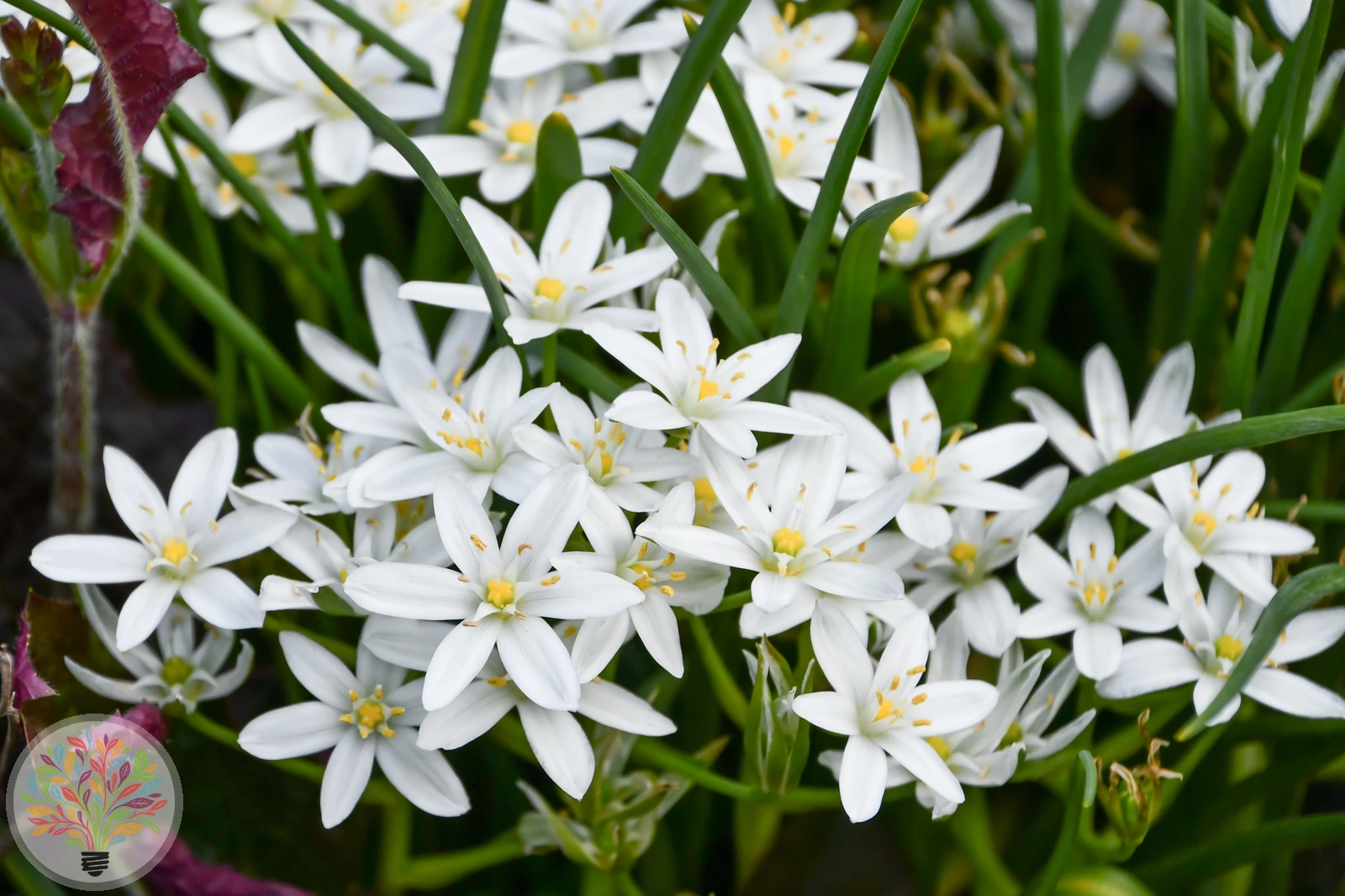
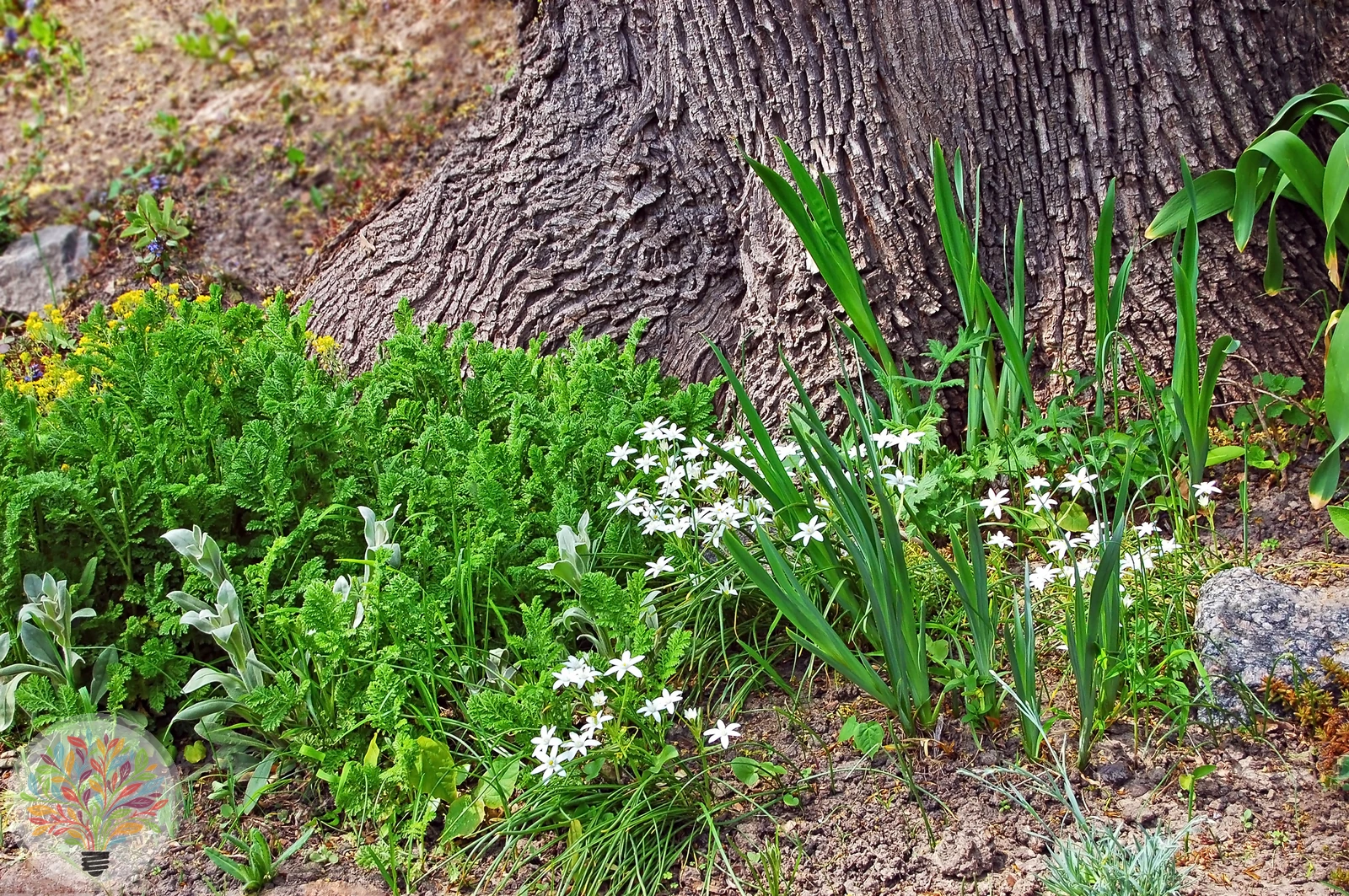
Ornithogalum umbellatum
Ornithogalum umbellatum
FamilyGenus: Ornithogalumnative in Germany
🌿
9
Species
interact
🔗
14
Interactions
documented
About this species
Ornithogalum umbellatum is an introduced, established bulbous perennial in Great Britain, bearing clusters of white, starry flowers in May and June.
Ecological network
Click to highlight connections · Click again to open the species page
Loading network...
Pollination
Ecological significance
Introduced and now firmly established in Great Britain, Ornithogalum umbellatum spreads mainly by bulb offsets. It can appear in grassy places and garden lawns.
Annual cycle
Foliage emerges in early spring. Clusters of white flowers open in May and June. Leaves die back after flowering and the plant remains dormant below ground through summer, autumn and winter.
Standort & Merkmale
Light
Halbschatten
Moisture
Frisch (Mäßig feucht)
Soil
Mittelzehrer (Normaler Boden)
Flowering period
Mai – Jun
Soil reaction
Basisch / Kalkhold
Bioregion
Continental
Nectar value
2
Pollen value
2
Growth form
Krautige Pflanze
Woodiness
Nicht verholzt
Leaf type
Breitblättrig
Plant height
0.195 m
Morphological traits: TRY ID3 (CC BY 3.0) & TRY ID81 (CC BY)
Pflege & Anbau
Plant bulbs in autumn in a spot with sun to partial shade. Any reasonably fertile, well-drained soil will do; the plant is a medium feeder and thrives on neutral to alkaline substrates. Keep the soil moderately moist during spring growth. Once established, bulbs tolerate low disturbance and will naturalise in lawns and borders without special attention.
Scientific profile
A herbaceous, non-woody plant reaching about 20 cm in height, with broad, glossy leaves. The leaf area averages 725 mm². It grows from a bulb and forms arbuscular mycorrhizal associations. The star-like flowers appear in clusters from May to June, offering moderate amounts of nectar and pollen (both scored 2). It grows in sun to partial shade and requires fresh, moderately moist soil. It is typically found on calcareous or basic ground, displaying a reaction value of 7, and shows a preference for medium nutrient levels. The plant has a low tolerance to salinity and generally occupies sites with low disturbance. In Great Britain it is recorded as an introduced species, well established since at least 1500.
Pollinators & visitors
9 Arten interagieren mit dieser Pflanze
Vanessa atalantaPieris rapaeApis melliferaEuclidia glyphicaOsmia cornutaLasioglossum pauxillumAndrena saxonicaAndrena labiataAndrena gravida
Sources & data origin
•Interaktionsdaten via GloBI (CC-BY 4.0)
•pollinator_interactions
•FloraWeb / BfN
•EIVE 1.0 — Dengler et al. (2023), DOI: 10.3897/VCS.98324 (CC BY 4.0)
•EuPPollNet — Kuppler et al. (2025), DOI: 10.1111/geb.70000 (CC BY 4.0)
•Database of Pollinator Interactions (DoPI) — Pocock et al. (2022), DOI: 10.1002/ecy.3801 (CC BY)
•GBIF Backbone Taxonomy — GBIF Secretariat (2024), DOI: 10.15468/39omei (CC BY 4.0)
•TRY Categorical Traits (ID3) — Kattge et al. (2012), DOI: 10.17871/TRY.3 (CC BY 3.0)
•TRY Global Spectrum (ID81) — Díaz et al. (2016/2021), DOI: 10.17871/TRY.81 (CC BY)
•Govaerts R et al. (2025) — World Checklist of Vascular Plants (WCVP) v14. Royal Botanic Gardens, Kew. DOI: 10.34885/xs7h-ze42 (CC BY 4.0)
•Foto: © Adobe Stock / AdobeStock_1463216070
All data is licensed under CC BY 4.0, CC0, or compatible terms. Attribution according to license conditions. Full source overview →