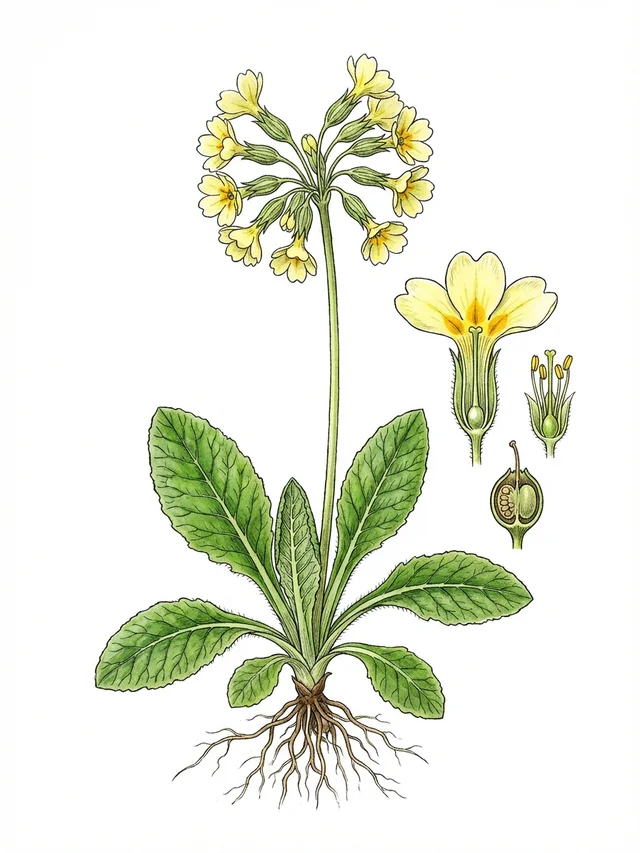
 Image to followAI-generated illustration
Ornithopus perpusillus
Ornithopus perpusillus
FamilyGenus: Ornithopusnative in Germany
🌿
6
Species
interact
🔗
9
Interactions
documented
🐛
2
Host relationships
Species
About this species
A low-growing, native annual legume of dry, acidic, nutrient-poor soils in Great Britain. Its tiny pinkish-white flowers appear from May to July, offering nectar to early pollinators, and as a nitrogen-fixer it can gradually improve impoverished open ground.
Ecological network
Click to highlight connections · Click again to open the species page
Loading network...
PollinationLarval host
Ecological significance
As a native annual of infertile, sunny places, Ornithopus perpusillus contributes to soil fertility through nitrogen fixation. Its small flowers furnish nectar and pollen for bees, hoverflies and other pollinating insects during late spring and early summer, supporting biodiversity in dry, acidic grasslands and heathlands.
Annual cycle
Seeds germinate in early spring, producing a low rosette or trailing stems. Flowering commences in May and continues into July; each flower can give rise to a narrow, segmented pod containing several seeds. The plant completes its life cycle and dies after setting seed, the seeds lying dormant through winter and germinating the following spring.
Standort & Merkmale
Light
Sonne
Moisture
Trocken
Soil
Schwachzehrer (Magerer Boden)
Flowering period
Mai – Jul
Soil reaction
Sauer (Säurezeiger)
Bioregion
Continental
Growth form
Krautige Pflanze
Woodiness
Nicht verholzt
Leaf type
Breitblättrig
Plant height
0.186 m
Morphological traits: TRY ID3 (CC BY 3.0) & TRY ID81 (CC BY)
Pflege & Anbau
Ornithopus perpusillus requires a sunny, free-draining spot on poor, acidic soil.
•
Light: Full sun.
•
Moisture: Dry; it will not thrive in moisture-retentive or nutrient-rich ground.
•
Soil: Low fertility, sharply draining, acid to neutral; avoid any fertiliser, manure or compost.
•
Maintenance: An annual that self-seeds reliably on suitable ground, so allow seed to ripen and fall. No pruning or staking is needed.
Scientific profile
Ornithopus perpusillus is a delicately built, softly hairy annual herb, typically growing to about 19 cm in height, with creeping to ascending stems. The leaves are imparipinnate, each bearing several pairs of small, oblong-elliptic leaflets, and at the leaf base there are two tiny linear stipules. The inflorescence is a long-stalked, tight cluster of 3–8 small pea-like flowers, each only 3–5 mm long and pale pink or whitish. Flowering takes place from May to July. The fruit is a narrow, compressed pod 1–2.5 cm long, deeply constricted between the seeds, with a short, sometimes hooked beak; the surface is net-veined and pubescent. As a member of the pea family (Fabaceae) it forms nitrogen-fixing root nodules, and arbuscular mycorrhiza has been recorded. The plant is a native of Great Britain, where it occupies open, sunny habitats on free-draining, distinctly acidic and impoverished substrates, such as sandy heaths, gravelly tracks and short, thin grassland. The diaspores are very light, weighing around 1 mg.
Pollinators & visitors
4 Arten interagieren mit dieser Pflanze
Sources & data origin
•Cook et al. (2025) UK Butterfly & Moth Traits (DOI: 10.5285/dbc7cc17-cbbd-49dd-bab4-8e8855768d66)
•Interaktionsdaten via GloBI (CC-BY 4.0)
•Middleton-Welling_2020
•pollinator_interactions
•FloraWeb / BfN
•EIVE 1.0 — Dengler et al. (2023), DOI: 10.3897/VCS.98324 (CC BY 4.0)
•GBIF Backbone Taxonomy — GBIF Secretariat (2024), DOI: 10.15468/39omei (CC BY 4.0)
•TRY Categorical Traits (ID3) — Kattge et al. (2012), DOI: 10.17871/TRY.3 (CC BY 3.0)
•TRY Global Spectrum (ID81) — Díaz et al. (2016/2021), DOI: 10.17871/TRY.81 (CC BY)
•Govaerts R et al. (2025) — World Checklist of Vascular Plants (WCVP) v14. Royal Botanic Gardens, Kew. DOI: 10.34885/xs7h-ze42 (CC BY 4.0)
All data is licensed under CC BY 4.0, CC0, or compatible terms. Attribution according to license conditions. Full source overview →