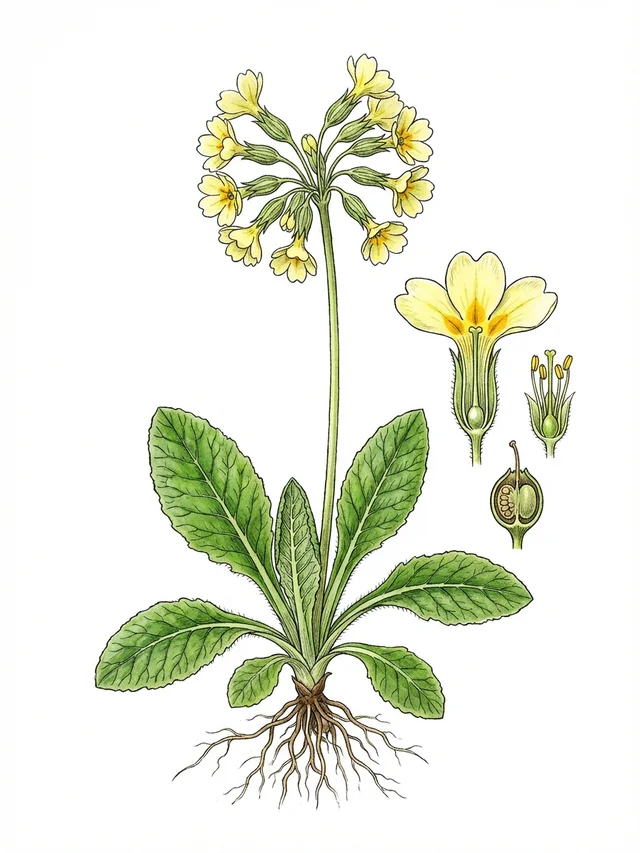
 Image to followAI-generated illustration
Orobanche hederae
Orobanche hederae
FamilyGenus: Orobanchenative in Germany
🌿
1
Species
interact
🔗
1
Interactions
documented
About this species
A native holoparasitic herb of shady woodlands, producing pale-flowered spikes from May to July. It lacks chlorophyll and grows to around 36 cm tall on neutral to weakly acidic, fresh soils.
Ecological network
Click to highlight connections · Click again to open the species page
Loading network...
Pollination
Ecological significance
As a root holoparasite, it relies entirely on a host plant for resources, which may affect host vigour locally. It is a natural component of British woodland flora, with no recorded invasive potential.
Annual cycle
Flowering shoots emerge above ground from May to July, bearing blooms in a spike. After seed set, the aerial stems wither, while the underground connections to the host persist until the next season.
Safety note
No specific safety concerns are recorded for this species.
Standort & Merkmale
Light
Schatten
Moisture
Frisch (Mäßig feucht)
Soil
Mittelzehrer (Normaler Boden)
Flowering period
Mai – Jul
Soil reaction
Mäßig sauer bis neutral
Bioregion
Continental
Growth form
Krautige Pflanze
Woodiness
Nicht verholzt
Leaf type
Breitblättrig
Plant height
0.364 m
Morphological traits: TRY ID3 (CC BY 3.0) & TRY ID81 (CC BY)
Pflege & Anbau
Orobanche hederae is not cultivated and has no care instructions. It requires a specific host plant to survive and is best observed in its natural habitat.
Scientific profile
Orobanche hederae is a native herbaceous plant in Great Britain, occurring in shady woodland habitats. It is a holoparasite, lacking chlorophyll and deriving all nutrients from the roots of its host plant. The plant reaches about 36 cm in height, with broad, non-woody leaves. It favours semi-shaded to shaded conditions, fresh to moderately moist soils, and neutral to weakly acidic reactions. The species is adapted to low-disturbance environments and forms arbuscular mycorrhiza. Flowering takes place from May to July, with the inflorescence bearing numerous blooms. Its diaspores are minute, weighing just 0.0066 mg, facilitating wind dispersal.
Sources & data origin
•Interaktionsdaten via GloBI (CC-BY 4.0)
•FloraWeb / BfN
•EIVE 1.0 — Dengler et al. (2023), DOI: 10.3897/VCS.98324 (CC BY 4.0)
•GBIF Backbone Taxonomy — GBIF Secretariat (2024), DOI: 10.15468/39omei (CC BY 4.0)
•TRY Categorical Traits (ID3) — Kattge et al. (2012), DOI: 10.17871/TRY.3 (CC BY 3.0)
•TRY Global Spectrum (ID81) — Díaz et al. (2016/2021), DOI: 10.17871/TRY.81 (CC BY)
•Govaerts R et al. (2025) — World Checklist of Vascular Plants (WCVP) v14. Royal Botanic Gardens, Kew. DOI: 10.34885/xs7h-ze42 (CC BY 4.0)
All data is licensed under CC BY 4.0, CC0, or compatible terms. Attribution according to license conditions. Full source overview →