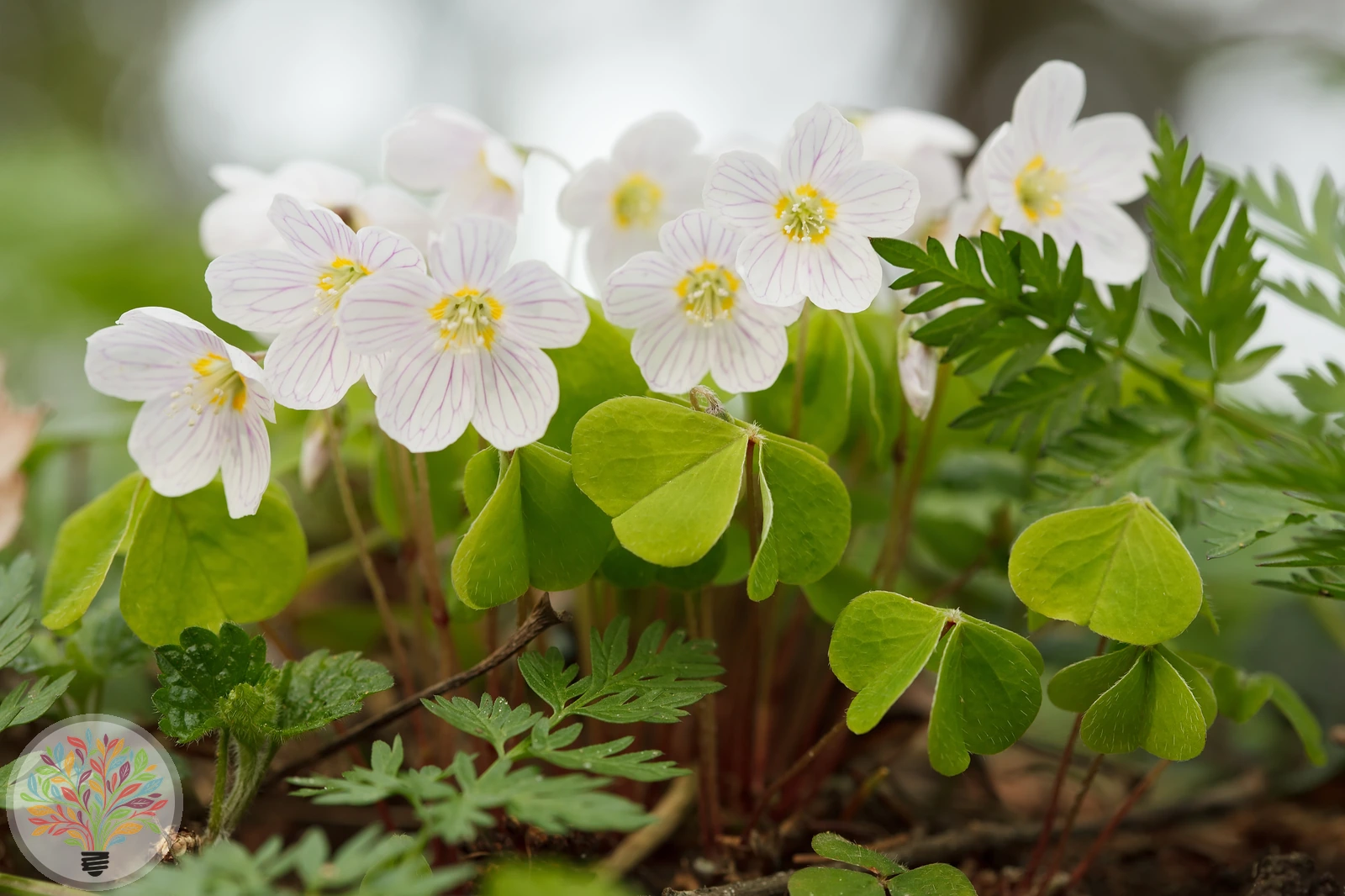
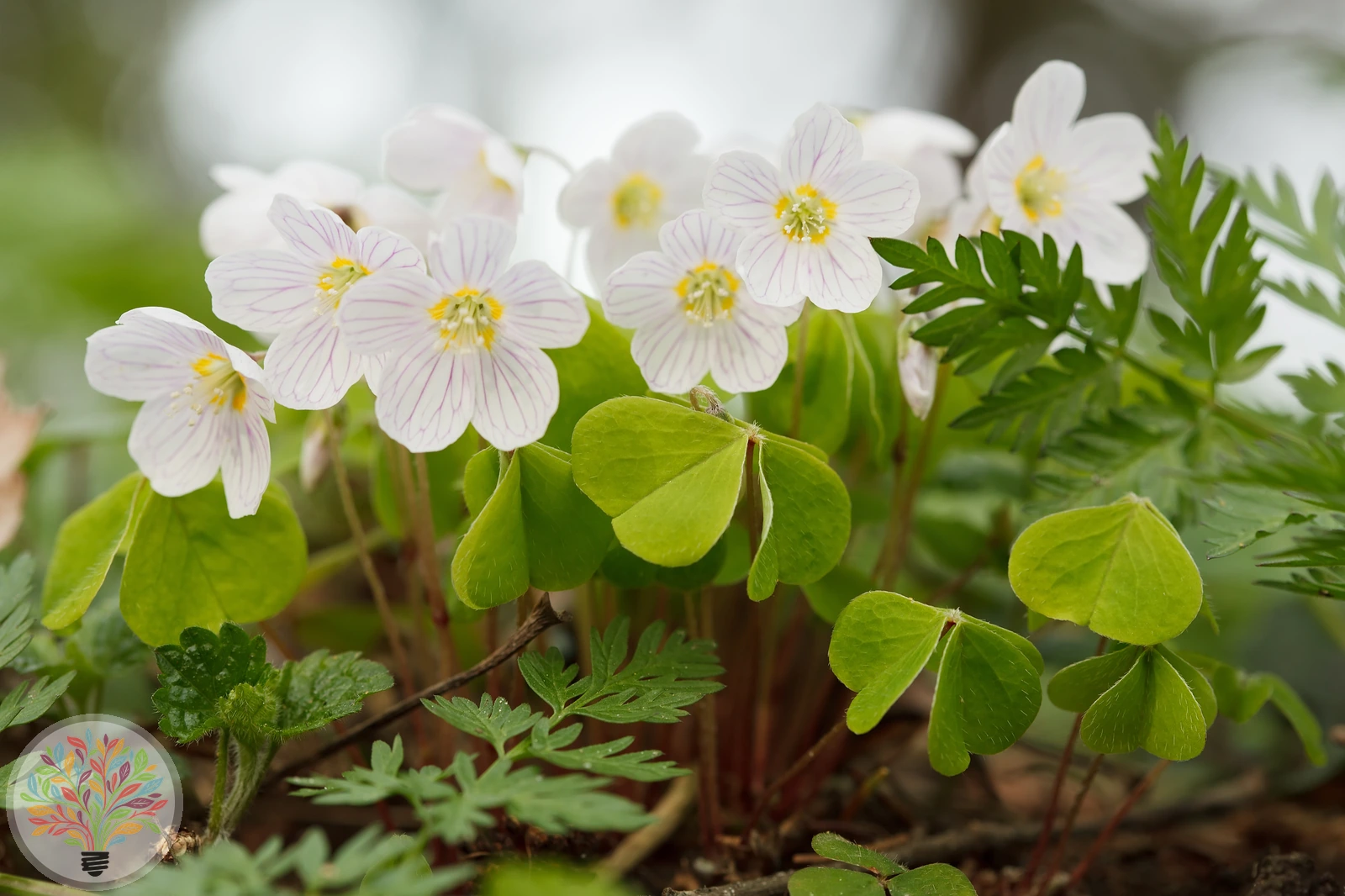
Oxalis acetosella
Oxalis acetosella
FamilyGenus: Oxalisnative in Germany
🌿
9
Species
interact
🔗
14
Interactions
documented
About this species
A shade-loving, broad-leaved woodland perennial that is native in Great Britain. It flowers almost continuously from early spring to early autumn on humus-rich, moderately moist soils.
Ecological network
Click to highlight connections · Click again to open the species page
Loading network...
PollinationFlower visit
Ecological significance
As a native component of the ground flora in semi-natural oak-hornbeam woods, it contributes to the structure of species-rich woodland communities. It forms arbuscular mycorrhizal partnerships, aiding nutrient cycling, and occurs predominantly in situations of low disturbance, indicating stable woodland soils.
Annual cycle
Flowering occurs from March to September.
Safety note
No specific safety data are available for this species.
Standort & Merkmale
Light
Schatten
Moisture
Frisch (Mäßig feucht)
Soil
Mittelzehrer (Normaler Boden)
Flowering period
Mär – Sep
Soil reaction
Mäßig sauer bis neutral
Bioregion
Continental
Growth form
Krautige Pflanze
Woodiness
Nicht verholzt
Leaf type
Breitblättrig
Plant height
0.091 m
Morphological traits: TRY ID3 (CC BY 3.0) & TRY ID81 (CC BY)
Pflege & Anbau
Grow in dappled to full shade in humus-rich, evenly moist but well-drained soil of moderate fertility. A mulch of leaf mould in autumn helps retain soil moisture and mimics natural woodland conditions. Suitable for shaded rock gardens, woodland edges and naturalistic planting schemes where the soil does not dry out.
Scientific profile
Oxalis acetosella is a low, herbaceous perennial reaching about 9 cm in height. It bears broad, trefoil leaves and is completely non-woody. A native species of ancient and semi-natural woodland, it is most typical of oak-hornbeam woods on neutral to weakly acid, fresh, moderately moist soils of average fertility. The plant forms arbuscular mycorrhizal associations and is associated with undisturbed ground. Its small, white to pink-veined flowers can appear from March through to September.
Pollinators & visitors
5 Arten interagieren mit dieser Pflanze
Other flower visitors
4 other species visit the flowers
Sources & data origin
•Interaktionsdaten via GloBI (CC-BY 4.0)
•pollinator_interactions
•Baden-Böhm F, App M, Thiele J (2022) — The FloRes Database: A floral resources trait database for pollinator habitat-assessment generated by a multistep workflow. Johann Heinrich von Thünen-Institut, Dryad, DOI: 10.5061/dryad.djh9w0w29 (CC0)
•FloraWeb / BfN
•EIVE 1.0 — Dengler et al. (2023), DOI: 10.3897/VCS.98324 (CC BY 4.0)
•GBIF Backbone Taxonomy — GBIF Secretariat (2024), DOI: 10.15468/39omei (CC BY 4.0)
•TRY Categorical Traits (ID3) — Kattge et al. (2012), DOI: 10.17871/TRY.3 (CC BY 3.0)
•TRY Global Spectrum (ID81) — Díaz et al. (2016/2021), DOI: 10.17871/TRY.81 (CC BY)
•Govaerts R et al. (2025) — World Checklist of Vascular Plants (WCVP) v14. Royal Botanic Gardens, Kew. DOI: 10.34885/xs7h-ze42 (CC BY 4.0)
•Foto: © Adobe Stock / AdobeStock_64061979
All data is licensed under CC BY 4.0, CC0, or compatible terms. Attribution according to license conditions. Full source overview →