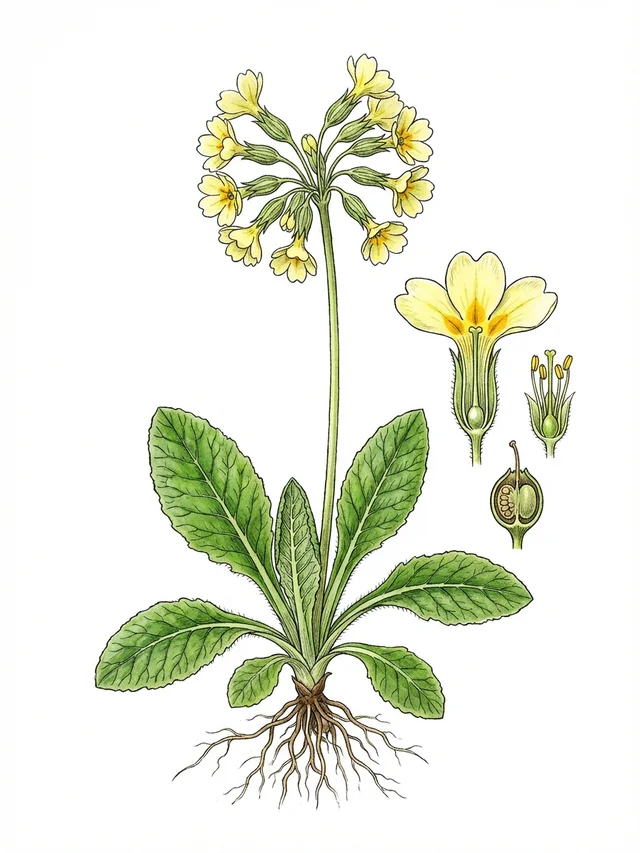
 Image to followAI-generated illustration
Parthenocissus quinquefolia
Parthenocissus quinquefolia
FamilyGenus: Parthenocissusnative in Germany
🌿
10
Species
interact
🔗
16
Interactions
documented
About this species
A woody, broad-leaved climber originating from the Americas, now introduced and established in parts of Britain. It grows in semi-shade on fresh, nutrient-rich soils, often near woodland edges or in fertile grasslands. Flowering occurs in July and August, after which small seeds develop.
Ecological network
Click to highlight connections · Click again to open the species page
Loading network...
PollinationFlower visit
Ecological significance
Introduced and established in Britain, Parthenocissus quinquefolia occurs in semi-shaded, nutrient-rich habitats. It can spread by seed and by vegetative means, and has naturalised in parts of its European range. It is not currently classified as invasive, but can persist and spread in suitable conditions.
Annual cycle
Flowering takes place in July and August. Seeds mature later in the same season and are shed close to the parent plant. The woody stems survive the winter and new growth resumes in spring.
Standort & Merkmale
Light
Halbschatten
Moisture
Frisch (Mäßig feucht)
Soil
Mittelzehrer (Normaler Boden)
Flowering period
Jul – Aug
Soil reaction
Mäßig sauer bis neutral
Bioregion
Continental
Growth form
Kletterpflanze
Woodiness
Verholzt
Leaf type
Breitblättrig
Plant height
1.149 m
Morphological traits: TRY ID3 (CC BY 3.0) & TRY ID81 (CC BY)
Pflege & Anbau
Best suited to a semi-shaded position with soil that remains moderately moist. Although it tolerates a range of soils, growth is most vigorous in nutrient-rich ground. Once established, it requires little attention; the woody framework can be trained against walls or trellises.
Scientific profile
Parthenocissus quinquefolia is a woody, broad-leaved climbing plant. The species naturally occurs in North America and parts of South America; it has been introduced to Europe and is established in Britain. It shows a preference for semi-shaded conditions (Ellenberg light value 6) and fresh, moderately moist soils (moisture value 5). It favours calcareous to basic ground (reaction value 7) and nutrient-rich substrates (nutrients value 7). Typical associated habitats include fertile meadows and woodland edges; disturbance tolerance is low (severity 0.69). An arbuscular mycorrhizal association is recorded. The plant can reach heights of around 1.15 m when free-standing, but its climbing habit allows it to ascend higher on supports. The broad leaves have a mean area of 6,572 mm². Flowers appear from July to August, and the diaspores (seeds) have an average mass of 25 mg.
Pollinators & visitors
6 Arten interagieren mit dieser Pflanze
Hylaeus punctatusApis melliferaVanessa atalantaBombus soroeensisBombus pascuorumLasioglossum calceatum
Other flower visitors
4 other species visit the flowers
Sources & data origin
•Interaktionsdaten via GloBI (CC-BY 4.0)
•pollinator_interactions
•EIVE 1.0 — Dengler et al. (2023), DOI: 10.3897/VCS.98324 (CC BY 4.0)
•GBIF Backbone Taxonomy — GBIF Secretariat (2024), DOI: 10.15468/39omei (CC BY 4.0)
•TRY Categorical Traits (ID3) — Kattge et al. (2012), DOI: 10.17871/TRY.3 (CC BY 3.0)
•TRY Global Spectrum (ID81) — Díaz et al. (2016/2021), DOI: 10.17871/TRY.81 (CC BY)
•Checklist Alien Plants Belgium — Verloove F (2023), Botanic Garden Meise (CC BY 4.0)
•Govaerts R et al. (2025) — World Checklist of Vascular Plants (WCVP) v14. Royal Botanic Gardens, Kew. DOI: 10.34885/xs7h-ze42 (CC BY 4.0)
All data is licensed under CC BY 4.0, CC0, or compatible terms. Attribution according to license conditions. Full source overview →