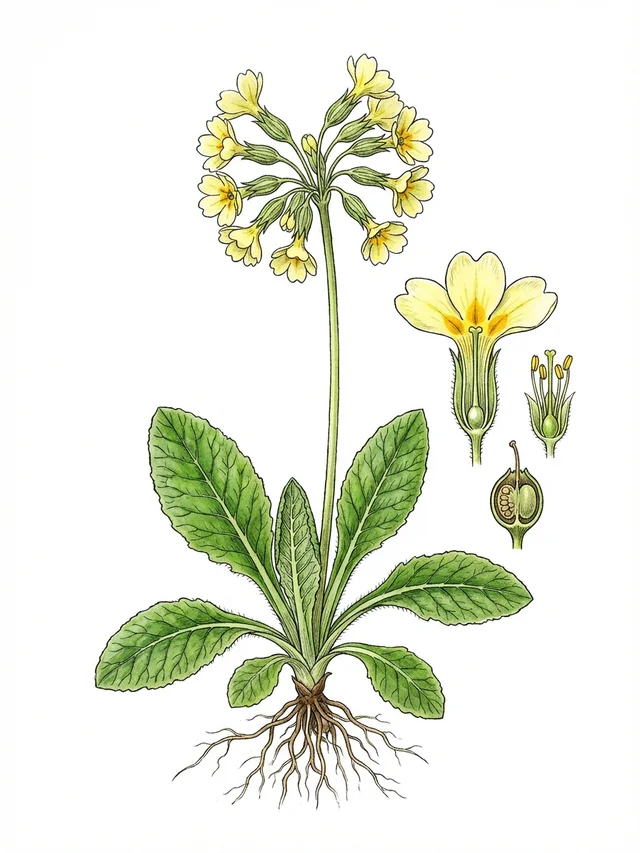
 Image to followAI-generated illustration
Pilosella officinarum
Pilosella officinarum
FamilyGenus: Pilosellanon-native in Germany
🌿
138
Species
interact
🔗
415
Interactions
documented
🐛
3
Host relationships
Species
About this species
A low-growing, perennial herb of dry, nutrient-poor, acidic grasslands, producing yellow flower heads from May to October; highly valued by pollinators for its abundant nectar and pollen.
Ecological network
Click to highlight connections · Click again to open the species page
Loading network...
PollinationLarval hostFlower visit
Ecological significance
This native wildflower supports a range of pollinating insects with its nectar and pollen. Its presence indicates species-rich, undisturbed dry grassland and it forms part of a healthy, low-nutrient ecosystem.
Annual cycle
Flowers from May to October; seeds ripen and are wind-dispersed through late summer and autumn.
Standort & Merkmale
Light
Sonne
Moisture
Trocken
Soil
Schwachzehrer (Magerer Boden)
Flowering period
Mai – Okt
Soil reaction
Mäßig sauer bis neutral
Nectar value
5
Pollen value
5
Growth form
Krautige Pflanze
Woodiness
Nicht verholzt
Leaf type
Breitblättrig
Plant height
0.111 m
Morphological traits: TRY ID3 (CC BY 3.0) & TRY ID81 (CC BY)
Pflege & Anbau
## Cultivation
Pilosella officinarum requires a sunny position and a very well-drained, nutrient-poor soil. It is ideally suited to a rock garden, gravel bed or a dry, south-facing bank where competition from other plants is low. Do not enrich the soil with fertiliser or organic matter, as this will encourage lush growth that is not in keeping with its natural habit. Once established, it is highly drought-tolerant and needs little attention beyond removing any neighbouring plants that shade it out. It may self-seed gently in suitable conditions, increasing the colony.
Scientific profile
Native in Great Britain, Pilosella officinarum is a small, herbaceous perennial reaching around 11 cm in height. It is a plant of dry, nutrient-poor, acidic grasslands, often on sandy or rocky ground, and also occurs in alpine meadows and extensive, low-intensity pastures. The broad leaves form a basal rosette, and the plant sends up flowering stems that bear yellow flower heads from May to October. The flowers are a rich source of nectar and pollen, attracting a variety of bees, hoverflies and other insects. The tiny, wind-dispersed seeds are produced in abundance and help the plant colonise open, disturbed patches within its preferred habitat. It thrives in full sun and tolerates very low soil fertility, making it a characteristic species of species-rich, unimproved grassland.
Pollinators & visitors
114 Arten interagieren mit dieser Pflanze
Boloria selene (Denis & Schiffermüller), 1775Pieris rapaeThymelicus sylvestrisBombus rupestrisAricia agestis (Denis & Schiffermüller), 1775Hesperia commaLasiommata megeraGonepteryx rhamniErebia aethiopsManiola jurtinaLasioglossum villosulumMelitaea cinxiaEuphydryas auriniaClossiana euphrosynePanurgus banksianusLysandra bellargusLasioglossum puncticolleHylaeus confususLasioglossum leucozoniumLasioglossum lativentreCoenonympha pamphilusCallophrys rubiErebia epiphronErynnis tagesAnthocharis cardaminesLasioglossum cupromicansBombus ruderariusAndrena carantonicaBombus lucorumBombus lapidariusAndrena bicolorBombus humilisBombus hortorumAndrena humilisLasioglossum leucopusPieris brassicaeDasypoda hirtipesAglais urticaeLycaena phlaeasOsmia leaianaPieris napiPlebejus argusBombus pascuorumCoelioxys elongatusLasioglossum morioBombus sylvarumAndrena minutulaHalictus tumulorumLasioglossum pauxillumNomada marshamella
Host relationships
3 species use this plant as a host
Diacrisia sannioAutographa bractea (Denis & Schiffermüller), 1775Hada plebeja
Other flower visitors
21 other species visit the flowers
Pyrrhula pyrrhulaOedemera luridaCryptocephalus aureolusLasius nigerFormica fuscaBrassicogethes aeneusPhyllopertha horticolaMeligethes aeneus (Fabricius,1775)?Saltella sphondylii (Schrank,1803)Eupeodes corollae (Fabricius,1794)Oedemera femorata (Scopoli,1763)Hoplomachus thunbergii (Fallén,1807)Olibrus affinis (Sturm,1807)Delia nigrescensSiphona geniculataHeterostylodes nominabilisEmpis chiopteraMeligethes viridescensPhaonia incanaPegoplata aestivaMeligethes solidus
Sources & data origin
•Interaktionsdaten via GloBI (CC-BY 4.0)
•Cook et al. (2025) UK Butterfly & Moth Traits (DOI: 10.5285/dbc7cc17-cbbd-49dd-bab4-8e8855768d66)
•pollinator_interactions
•Baden-Böhm F, App M, Thiele J (2022) — The FloRes Database: A floral resources trait database for pollinator habitat-assessment generated by a multistep workflow. Johann Heinrich von Thünen-Institut, Dryad, DOI: 10.5061/dryad.djh9w0w29 (CC0)
•FloraWeb / BfN
•EIVE 1.0 — Dengler et al. (2023), DOI: 10.3897/VCS.98324 (CC BY 4.0)
•EuPPollNet — Kuppler et al. (2025), DOI: 10.1111/geb.70000 (CC BY 4.0)
•Database of Pollinator Interactions (DoPI) — Pocock et al. (2022), DOI: 10.1002/ecy.3801 (CC BY)
•GBIF Backbone Taxonomy — GBIF Secretariat (2024), DOI: 10.15468/39omei (CC BY 4.0)
•TRY Categorical Traits (ID3) — Kattge et al. (2012), DOI: 10.17871/TRY.3 (CC BY 3.0)
•TRY Global Spectrum (ID81) — Díaz et al. (2016/2021), DOI: 10.17871/TRY.81 (CC BY)
•Govaerts R et al. (2025) — World Checklist of Vascular Plants (WCVP) v14. Royal Botanic Gardens, Kew. DOI: 10.34885/xs7h-ze42 (CC BY 4.0)
All data is licensed under CC BY 4.0, CC0, or compatible terms. Attribution according to license conditions. Full source overview →