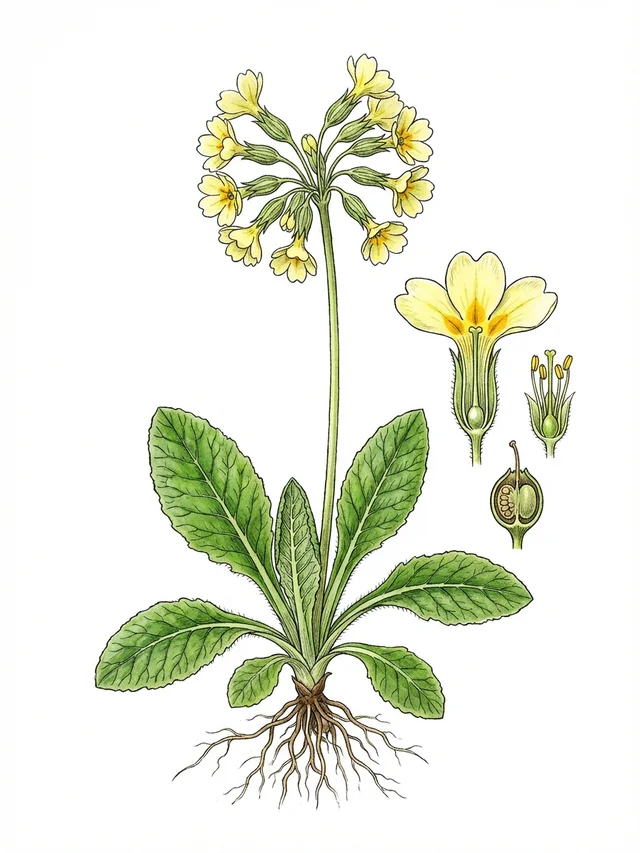
 Image to followAI-generated illustration
Pimpinella major
Pimpinella major
FamilyGenus: Pimpinellanative in Germany
🌿
194
Species
interact
🔗
933
Interactions
documented
🐛
1
Host relationships
Species
About this species
Pimpinella major is a native herbaceous perennial of Great Britain, found in nutrient-rich, calcareous soils in sunny sites. Its umbels of white flowers appear from March to September, providing pollen and nectar for insects.
Ecological network
Click to highlight connections · Click again to open the species page
Loading network...
PollinationLarval hostFlower visit
Ecological significance
As a native species, Pimpinella major plays a natural role in its ecosystems, supporting pollinators and soil mycorrhizal networks.
Annual cycle
Flowering occurs from March to September. The plant is herbaceous and dies back above ground in winter.
Standort & Merkmale
Light
Sonne
Moisture
Frisch (Mäßig feucht)
Soil
Starkzehrer (Nährstoffreicher/Fetter Boden)
Flowering period
Mär – Sep
Soil reaction
Basisch / Kalkhold
Bioregion
Continental
Nectar value
5
Pollen value
5
Growth form
Krautige Pflanze
Woodiness
Nicht verholzt
Leaf type
Breitblättrig
Plant height
0.62 m
Morphological traits: TRY ID3 (CC BY 3.0) & TRY ID81 (CC BY)
Pflege & Anbau
Grow in full sun on fertile, moderately moist, neutral to calcareous soil. No specific care is required once established.
Scientific profile
This herbaceous perennial reaches about 0.62 metres in height, with broad leaves and non-woody stems. It grows in full sun on fresh, moderately moist, nutrient-rich soils, often calcareous. The white flowers are held in umbels and bloom over a long period from March to September. The nectar and pollen scores are both 5, indicating good value for pollinators. The species forms arbuscular mycorrhizal associations and is native in Great Britain.
Pollinators & visitors
68 Arten interagieren mit dieser Pflanze
Hylaeus communisAthalia rosaeParacorymbia maculicornisPseudovadonia lividaAnastrangalia sanguinolentaStenurella melanuraStenocorus meridianusBombus lucorumAphantopus hyperantusPachytodes cerambyciformisAthalia circularisLasioglossum nigripesBombus hortorumHylaeus sinuatusLasioglossum lativentreLasioglossum politumAndrena congruensSyrphus ribesiiSyrphus vitripennisEpisyrphus balteatusCheilosia nigripesCheilosia longulaCheilosia impressaCheilosia barbataSphaerophoria scriptaLeucozona glauciaPlatycheirus albimanusSphaerophoria interruptaEupeodes corollaeMelanostoma scalareMelanostoma mellinumBombus terrestris complexCheilosia mutabilisSyrphus torvusMelangyna compositarumCheilosia vicinaEristalis tenaxMyathropa floreaEristalis pertinaxEristalis horticolaSyritta pipiensEristalis arbustorumLasioglossum fulvicorneChrysogaster solstitialisScaeva pyrastriLasioglossum laevigatumCheilosia scutellataXylota jakutorumAndrena minutulaAndrena flavipes
Host relationships
1 species use this plant as a host
Eupithecia pimpinellata
Other flower visitors
125 other species visit the flowers
Brassicogethes aeneusTenthredo nothaAmara communisHarpalus griseusAmara ovataCantharis fuscaTrechus quadristriatusAmara lunicollisAgriotes obscurusAmara plebejaHemicrepidius hirtusHemicrepidius nigerDiachromus germanusHarpalus latusAmara similataAmara familiarisAmara convexiorPoecilus cupreusOphonus azureusOphonus ardosiacusRhagonycha fulvaBlondelia nigripesThricops longipesThricops nigrifronsOrthonerva nobilisTenthredo sp.1Macquartia tenebricosaMeigenia dorsalisSepsis fulgensIchnomonidae sp.5Coenosia molliculaThricops nigritellusSarcophaga vagansBotanophila brunneilineaNeomyia viridescensEloceria delectaThricops cunctansAllophorocera ferrugineaBotanophila fugaxFannia fusculaBillaea trianguliferaPhaonia servaSarcophaga variegataThricops beckeriBicellaria vanaLoewia phaeopteraSiphona geniculataChaetostomella cylindricaTabanus bovinusChloromyia formosa
Sources & data origin
•Cook et al. (2025) UK Butterfly & Moth Traits (DOI: 10.5285/dbc7cc17-cbbd-49dd-bab4-8e8855768d66)
•Interaktionsdaten via GloBI (CC-BY 4.0)
•pollinator_interactions
•FloraWeb / BfN
•EIVE 1.0 — Dengler et al. (2023), DOI: 10.3897/VCS.98324 (CC BY 4.0)
•EuPPollNet — Kuppler et al. (2025), DOI: 10.1111/geb.70000 (CC BY 4.0)
•Database of Pollinator Interactions (DoPI) — Pocock et al. (2022), DOI: 10.1002/ecy.3801 (CC BY)
•GBIF Backbone Taxonomy — GBIF Secretariat (2024), DOI: 10.15468/39omei (CC BY 4.0)
•TRY Categorical Traits (ID3) — Kattge et al. (2012), DOI: 10.17871/TRY.3 (CC BY 3.0)
•TRY Global Spectrum (ID81) — Díaz et al. (2016/2021), DOI: 10.17871/TRY.81 (CC BY)
•Govaerts R et al. (2025) — World Checklist of Vascular Plants (WCVP) v14. Royal Botanic Gardens, Kew. DOI: 10.34885/xs7h-ze42 (CC BY 4.0)
All data is licensed under CC BY 4.0, CC0, or compatible terms. Attribution according to license conditions. Full source overview →