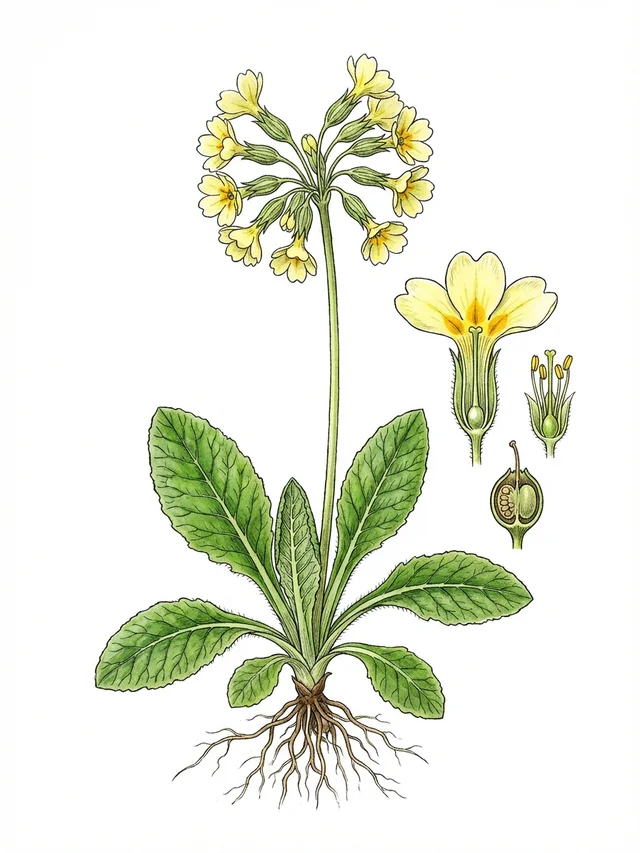
 Image to followAI-generated illustration
Pinguicula vulgaris
Pinguicula vulgaris
FamilyGenus: Fettkräuternative in Germany
🌿
2
Species
interact
🔗
4
Interactions
documented
About this species
A small native carnivorous plant of damp, nutrient-poor places, bearing sticky leaves that trap insects and producing flowers between May and August.
Ecological network
Click to highlight connections · Click again to open the species page
Loading network...
Pollination
Ecological significance
As a native plant of wet, low-nutrient habitats, it forms part of the local food web by trapping small invertebrates. There is no indication of adverse ecological impact.
Annual cycle
Flowering takes place from May to August.
Standort & Merkmale
Light
Sonne
Moisture
Feucht
Soil
Schwachzehrer (Magerer Boden)
Flowering period
Mai – Aug
Soil reaction
Basisch / Kalkhold
Bioregion
Continental
Growth form
Krautige Pflanze
Woodiness
Nicht verholzt
Leaf type
Breitblättrig
Plant height
0.058 m
Morphological traits: TRY ID3 (CC BY 3.0) & TRY ID81 (CC BY)
Pflege & Anbau
Grow in full sun in a very moist, nutrient-poor medium. The plant captures insects on its sticky leaves; do not apply fertiliser. Keep the growing medium constantly damp, as it naturally inhabits wet, oligotrophic sites.
Scientific profile
Pinguicula vulgaris is a herbaceous, non-woody plant that forms a basal rosette of broad, adhesive leaves. The leaves are covered with glandular hairs that capture small insects, making the plant carnivorous and enabling it to obtain nutrients in infertile habitats. It typically attains a height of about 6 centimetres. Mycorrhizal associations of the arbuscular type support phosphorus uptake. The species requires full sun and constantly moist, nutrient-poor soil. Flowers appear from May to August.
Sources & data origin
•Interaktionsdaten via GloBI (CC-BY 4.0)
•pollinator_interactions
•FloraWeb / BfN
•EIVE 1.0 — Dengler et al. (2023), DOI: 10.3897/VCS.98324 (CC BY 4.0)
•GBIF Backbone Taxonomy — GBIF Secretariat (2024), DOI: 10.15468/39omei (CC BY 4.0)
•TRY Categorical Traits (ID3) — Kattge et al. (2012), DOI: 10.17871/TRY.3 (CC BY 3.0)
•TRY Global Spectrum (ID81) — Díaz et al. (2016/2021), DOI: 10.17871/TRY.81 (CC BY)
•Govaerts R et al. (2025) — World Checklist of Vascular Plants (WCVP) v14. Royal Botanic Gardens, Kew. DOI: 10.34885/xs7h-ze42 (CC BY 4.0)
All data is licensed under CC BY 4.0, CC0, or compatible terms. Attribution according to license conditions. Full source overview →