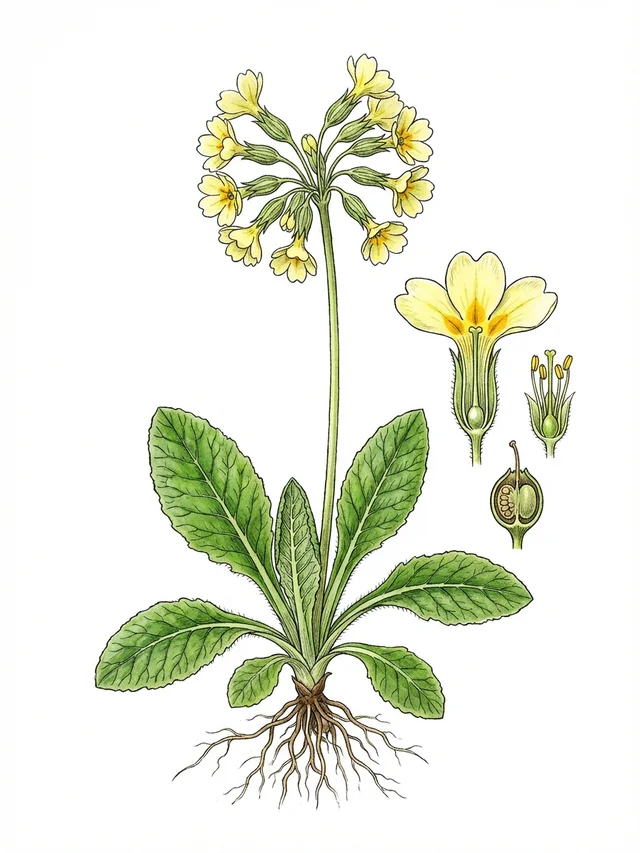
 Image to followAI-generated illustration
Polygala calcarea
Polygala calcarea
FamilyGenus: Polygalanative in Germany
🌿
9
Species
interact
🔗
10
Interactions
documented
About this species
A small, native chalk‑grassland perennial with evergreen leaves and late‑spring blooms.
Ecological network
Click to highlight connections · Click again to open the species page
Loading network...
Pollination
Ecological significance
Polygala calcarea is a natural component of species‑rich chalk grassland. Its presence adds to the structural diversity of the sward and can provide nectar for pollinating insects during late spring and early summer.
Annual cycle
This evergreen perennial carries broad leaves throughout the year. Flowering takes place from May to June. Growth is concentrated in the warmer months, and the plant requires excellent drainage to avoid winter wet.
Safety note
No specific safety information is available for this species.
Standort & Merkmale
Light
Sonne
Moisture
Trocken
Soil
Schwachzehrer (Magerer Boden)
Flowering period
Mai – Jun
Soil reaction
Basisch / Kalkhold
Bioregion
Continental
Growth form
Krautige Pflanze
Woodiness
Nicht verholzt
Leaf type
Breitblättrig
Leaf phenology
Immergrün
Plant height
0.094 m
Morphological traits: TRY ID3 (CC BY 3.0) & TRY ID81 (CC BY)
Pflege & Anbau
Grow in full sun in a sharply drained, dry, low‑fertility, lime‑rich soil. Avoid adding fertiliser or organic matter; the plant is adapted to lean conditions and will struggle in richer, moisture‑retentive ground.
Scientific profile
Polygala calcarea is a native perennial wildflower of the British Isles, found naturally in dry, sun‑bathed chalk grassland and nutrient‑poor calcareous soils. The plant forms a low, evergreen cushion of broad leaves, typically reaching about 9 cm in height. It is completely herbaceous and non‑woody. The flowering period runs from May to June. Like many grassland herbs, it forms arbuscular mycorrhizal associations, and it favours warm, low‑disturbance sites on lime‑rich substrates.
Pollinators & visitors
9 Arten interagieren mit dieser Pflanze
Coenonympha pamphilusAndrena afzeliellaLasioglossum subhirtumApis melliferaLasioglossum interruptumCheilosia urbanaBombus gr. terrestrisBombus pratorumNomada succincta
Sources & data origin
•Interaktionsdaten via GloBI (CC-BY 4.0)
•pollinator_interactions
•FloraWeb / BfN
•EIVE 1.0 — Dengler et al. (2023), DOI: 10.3897/VCS.98324 (CC BY 4.0)
•GBIF Backbone Taxonomy — GBIF Secretariat (2024), DOI: 10.15468/39omei (CC BY 4.0)
•TRY Categorical Traits (ID3) — Kattge et al. (2012), DOI: 10.17871/TRY.3 (CC BY 3.0)
•TRY Global Spectrum (ID81) — Díaz et al. (2016/2021), DOI: 10.17871/TRY.81 (CC BY)
•Govaerts R et al. (2025) — World Checklist of Vascular Plants (WCVP) v14. Royal Botanic Gardens, Kew. DOI: 10.34885/xs7h-ze42 (CC BY 4.0)
All data is licensed under CC BY 4.0, CC0, or compatible terms. Attribution according to license conditions. Full source overview →