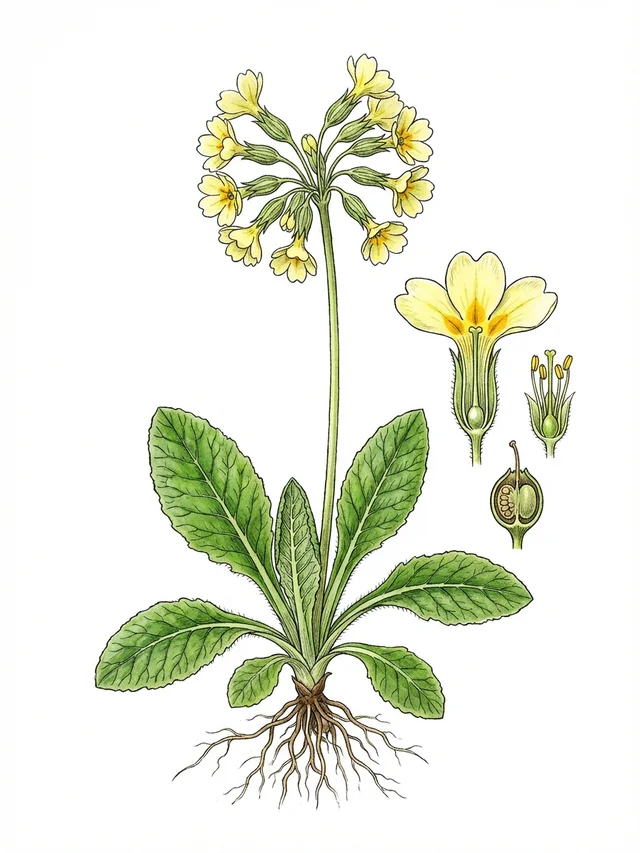
 Image to followAI-generated illustration
Argentina anserina
Argentina anserina
FamilyGenus: Fingerkräuternative in Germany
🌿
19
Species
interact
🔗
19
Interactions
documented
🐛
1
Host relationships
Species
About this species
A low-growing, herbaceous perennial of damp, sunny places, notable for its long flowering season and value to pollinators.
Ecological network
Click to highlight connections · Click again to open the species page
Loading network...
PollinationLarval hostFlower visit
Ecological significance
As a native wildflower, it provides an extended source of forage for pollinating insects, with nectar and pollen available from winter well into autumn. Its mycorrhizal network contributes to soil health and nutrient cycling.
Annual cycle
Flowering may begin as early as January and continue through to November, with the greatest show in mild regions. The herbaceous top growth dies back in harsh cold, but underground runners persist.
Standort & Merkmale
Light
Sonne
Moisture
Feucht
Soil
—
Flowering period
Jan – Nov
Bioregion
Continental
Nectar value
3
Pollen value
3
Growth form
Krautige Pflanze
Woodiness
Nicht verholzt
Leaf type
Breitblättrig
Morphological traits: TRY ID3 (CC BY 3.0) & TRY ID81 (CC BY)
Pflege & Anbau
Provide a sunny position with moisture‑retentive, alkaline soil. This species copes with occasional slight salinity and light disturbance, but thrives best where the ground stays damp. Avoid high nutrient levels or heavy soil upheaval; once settled it needs little attention.
Scientific profile
Argentina anserina is a herbaceous, non-woody perennial belonging to the rose family (Rosaceae). It produces broad leaves and spreads by runners to form mats in open, moist sites. The plant favours full sun and consistently damp, alkaline soils that are moderately rich in nutrients, yet it tolerates slight salinity and only low levels of disturbance. Flowering can extend from January through to November, with the blooms supplying both nectar and pollen for visiting insects. Below ground it forms arbuscular mycorrhizal associations, supporting nutrient uptake.
Pollinators & visitors
17 Arten interagieren mit dieser Pflanze
Anthonomus rubiLasioglossum morioApis melliferaPieris napiHylaeus annulatusSpialia sertoriusSpialia rosaeSpialia orbiferMuschampia cribrellumMuschampia tessellumBoloria polarisBoloria friggaBoloria freijaBoloria charicleaPolygonia c-albumNymphalis polychlorosMelitaea diamina
Host relationships
1 species use this plant as a host
Dysstroma citrata
Sources & data origin
•Interaktionsdaten via GloBI (CC-BY 4.0)
•Middleton-Welling_2020
•EIVE 1.0 — Dengler et al. (2023), DOI: 10.3897/VCS.98324 (CC BY 4.0)
•EuPPollNet — Kuppler et al. (2025), DOI: 10.1111/geb.70000 (CC BY 4.0)
•Database of Pollinator Interactions (DoPI) — Pocock et al. (2022), DOI: 10.1002/ecy.3801 (CC BY)
•GBIF Backbone Taxonomy — GBIF Secretariat (2024), DOI: 10.15468/39omei (CC BY 4.0)
•TRY Categorical Traits (ID3) — Kattge et al. (2012), DOI: 10.17871/TRY.3 (CC BY 3.0)
•TRY Global Spectrum (ID81) — Díaz et al. (2016/2021), DOI: 10.17871/TRY.81 (CC BY)
•Govaerts R et al. (2025) — World Checklist of Vascular Plants (WCVP) v14. Royal Botanic Gardens, Kew. DOI: 10.34885/xs7h-ze42 (CC BY 4.0)
All data is licensed under CC BY 4.0, CC0, or compatible terms. Attribution according to license conditions. Full source overview →