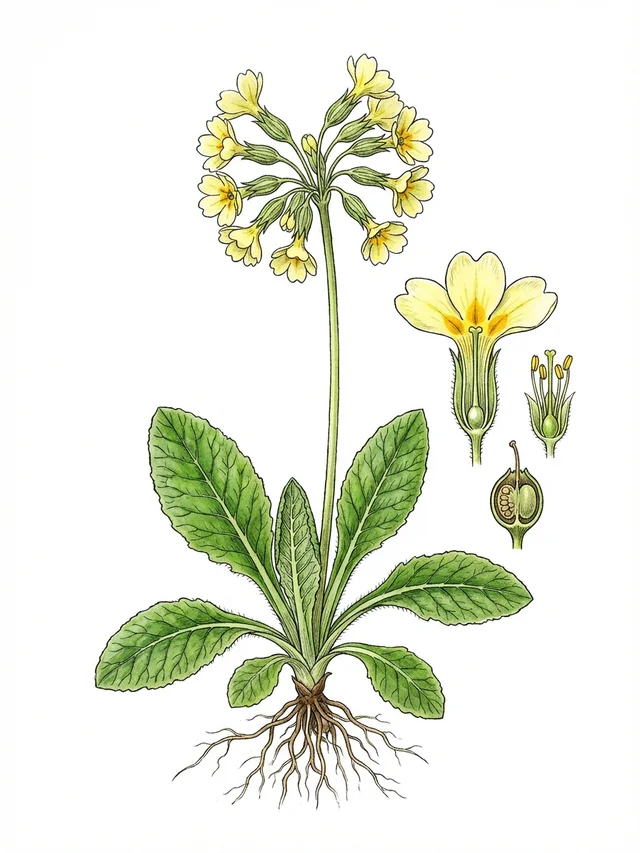
 Image to followAI-generated illustration
Potentilla argentea
Potentilla argentea subsp. impolita
FamilyGenus: Potentillanative in Germany
🌿
11
Species
interact
🔗
11
Interactions
documented
About this species
A low-growing native perennial of dry, sunny places, Potentilla argentea produces its small yellow flowers from June to July. With silver-backed, broad leaves and a preference for poor, free-draining soils, it is a discreet presence in short grassland and open, rocky habitats.
Ecological network
Click to highlight connections · Click again to open the species page
Loading network...
PollinationFlower visit
Ecological significance
As a native species of impoverished soils, Potentilla argentea contributes to the character of dry grassland and heathland communities.
Annual cycle
Flowering periodJune to July.
Standort & Merkmale
Light
Sonne
Moisture
Trocken
Soil
Schwachzehrer (Magerer Boden)
Flowering period
Jun – Jul
Soil reaction
Mäßig sauer bis neutral
Bioregion
Continental
Growth form
Krautige Pflanze
Woodiness
Nicht verholzt
Leaf type
Breitblättrig
Plant height
0.254 m
Morphological traits: TRY ID3 (CC BY 3.0) & TRY ID81 (CC BY)
Pflege & Anbau
Grow in full sun in very well-drained, poor soil. Avoid rich or moisture-retentive ground. Once established, it needs little water. Suitable for rock gardens, gravel beds or impoverished grassland. No routine pruning is needed beyond removing spent flower stems if desired.
Scientific profile
Potentilla argentea is a native herbaceous perennial of dry, sunny habitats in Great Britain. It typically reaches 10 to 40 centimetres in height, forming low mounds of broad, palmately divided leaves whose undersides are densely silvery-hairy. Flowering stems carry loose clusters of small, five-petalled yellow blossoms from June into July. The plant is not woody and is fully terrestrial. Its ecological niche reflects a strong preference for full sun (Ellenberg light value 8), free-draining soils (moisture value 2) that are nutrient-poor (value 3), with a neutral to slightly acid reaction (value 5) and moderately warm temperatures (value 4). The diaspores are tiny, averaging around 0.08 milligrams, and individual leaves have a mean area of approximately 275 square millimetres.
Pollinators & visitors
8 Arten interagieren mit dieser Pflanze
Sources & data origin
•Interaktionsdaten via GloBI (CC-BY 4.0)
•EIVE 1.0 — Dengler et al. (2023), DOI: 10.3897/VCS.98324 (CC BY 4.0)
•GBIF Backbone Taxonomy — GBIF Secretariat (2024), DOI: 10.15468/39omei (CC BY 4.0)
•TRY Categorical Traits (ID3) — Kattge et al. (2012), DOI: 10.17871/TRY.3 (CC BY 3.0)
•TRY Global Spectrum (ID81) — Díaz et al. (2016/2021), DOI: 10.17871/TRY.81 (CC BY)
•Govaerts R et al. (2025) — World Checklist of Vascular Plants (WCVP) v14. Royal Botanic Gardens, Kew. DOI: 10.34885/xs7h-ze42 (CC BY 4.0)
All data is licensed under CC BY 4.0, CC0, or compatible terms. Attribution according to license conditions. Full source overview →