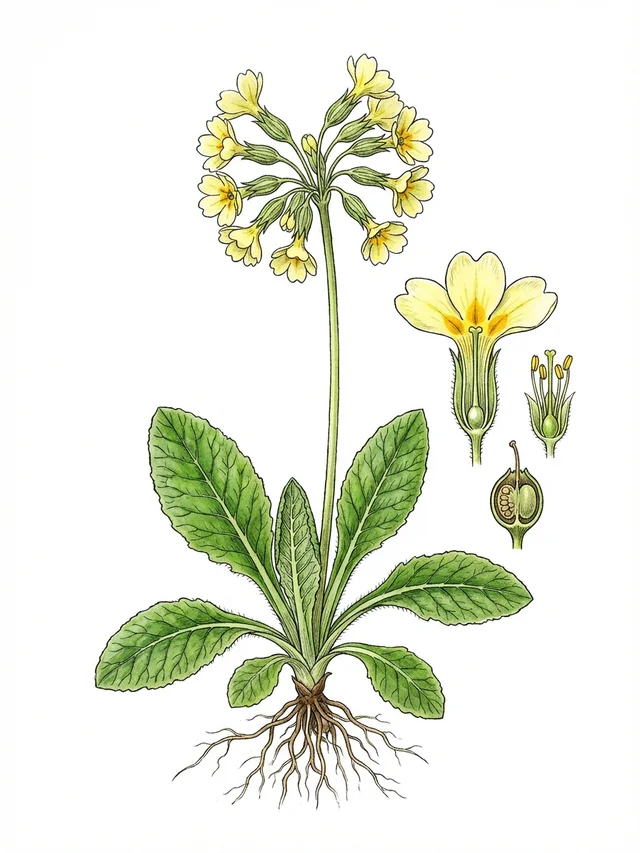
 Image to followAI-generated illustration
Potentilla erecta
Potentilla erecta
FamilyGenus: Potentillanative in Germany
🌿
185
Species
interact
🔗
2123
Interactions
documented
🐛
4
Host relationships
Species
About this species
A low-growing perennial wildflower of semi-shaded, nutrient-poor damp soils, bearing small yellow flowers from spring to autumn and highly valued by pollinators.
Ecological network
Click to highlight connections · Click again to open the species page
Loading network...
PollinationLarval hostFlower visit
Ecological significance
Provides high-value nectar and pollen for a range of insect visitors, making it a significant contributor to local pollinator networks. It forms variable mycorrhizal associations, typical of low-fertility grassland and heath communities.
Annual cycle
Herbaceous perennial flowering from March to September.
Standort & Merkmale
Light
Halbschatten
Moisture
Frisch (Mäßig feucht)
Soil
Schwachzehrer (Magerer Boden)
Flowering period
Mär – Sep
Soil reaction
Mäßig sauer bis neutral
Bioregion
Continental
Nectar value
5
Pollen value
5
Growth form
Krautige Pflanze
Woodiness
Nicht verholzt
Leaf type
Breitblättrig
Plant height
0.167 m
Morphological traits: TRY ID3 (CC BY 3.0) & TRY ID81 (CC BY)
Pflege & Anbau
Prefers semi-shade and fresh, nutrient-poor, slightly acid to neutral soil. Suitable for naturalistic planting in damp, undisturbed spots. Flowers March–September.
Scientific profile
Tormentil is a native herbaceous perennial widely distributed across Great Britain. It typically reaches about 17 cm in height, with broad-leaved, non-woody stems. Growth is terrestrial and it favours semi-shaded positions on fresh, moderately moist, nutrient-poor substrates; the soil reaction is usually neutral to slightly acid. Flowering extends from March to September, offering both nectar and pollen in abundance (rated 5 out of 5 for each reward). Ellenberg indicator values from central European datasets suggest a preference for moderately warm conditions, low disturbance severity, and a variable mycorrhizal association. The species is listed as of least concern (Red List category *) and is regarded as indigenous or archaeophytic.
Pollinators & visitors
101 Arten interagieren mit dieser Pflanze
Lasioglossum pauxillumLasioglossum morioAndrena subopacaHalictus subauratusHalictus confususLasioglossum albipesLasioglossum fulvicorneSphaerophoria scriptaSphaerophoria interruptaChrysotoxum arcuatumEupeodes corollaeEpisyrphus balteatusMelanostoma mellinumSyrphus vitripennisParagus haemorrhousParasyrphus annulatusMerodon rufusCheilosia vicinaMerodon cinereusPanurginus montanusCheilosia nivalisMerodon albifronsPlatycheirus albimanusMelanostoma scalareCheilosia mutabilisXylota jakutorumMelanostoma dubiumLasioglossum calceatumParasyrphus vittigerCheilosia rhynchopsPipiza quadrimaculataNeoascia annexaSyritta pipiensBombus ssBombus wurfleniiBombus pratorumBombus lucorumEupeodes lunigerManiola jurtinaAndrena minutulaPlatycheirus granditarsusLejogaster metallinaBombus jonellusHalictus rubicundusAndrena semilaevisLasioglossum fratellumRhingia campestrisEupeodes latifasciatusSyrphus ribesiiPlatycheirus manicatus
Host relationships
4 species use this plant as a host
Pyrgus malvaeChlorissa viridataElaphria venustulaSaturnia pavonia
Other flower visitors
80 other species visit the flowers
Sphaerophoria specPipiziella viduataSphecidae sp.3Drymeia tetraPegoplata aestivaHerina frondescentiaePhaonia angelicaeSarcophaga variegataThricops nigritellusFannia serenaSphaerophoria scripta.groupExorista larvarumPollenia pediculataMerodon cf constansParasyrphus punctulatusThricops semicinereusFannia posticaHydrophoria diabataSphaerophoriaRhamphomyia heterochromaPyrophaena granditarsisAnthonomus rubiBellardia vulgarisRhamphomyia longipesSepsis punctumTetanocera elataThamnotettix dilutiorThricops cunctansDelia florilegaBotanophila varicolorThricops longipesDrymeia alpicolaDinera carinifronsPhaonia hybridaSarcophaga okalianaBotanophila fugaxPhaonia servaRhinophora lepidaSarcophaga pumilaPipiziella nigrianaMelinda viridicyaenaBellardia pandiaPollenia amentariaEmpis scoticaDrymeia hamataFormica cuniculariaFannia armataEusphalerum minutumHelina obscurataHydrotaea irritans
Sources & data origin
•Cook et al. (2025) UK Butterfly & Moth Traits (DOI: 10.5285/dbc7cc17-cbbd-49dd-bab4-8e8855768d66)
•pollinator_interactions
•FloraWeb / BfN
•EIVE 1.0 — Dengler et al. (2023), DOI: 10.3897/VCS.98324 (CC BY 4.0)
•EuPPollNet — Kuppler et al. (2025), DOI: 10.1111/geb.70000 (CC BY 4.0)
•Database of Pollinator Interactions (DoPI) — Pocock et al. (2022), DOI: 10.1002/ecy.3801 (CC BY)
•GBIF Backbone Taxonomy — GBIF Secretariat (2024), DOI: 10.15468/39omei (CC BY 4.0)
•TRY Categorical Traits (ID3) — Kattge et al. (2012), DOI: 10.17871/TRY.3 (CC BY 3.0)
•TRY Global Spectrum (ID81) — Díaz et al. (2016/2021), DOI: 10.17871/TRY.81 (CC BY)
•Govaerts R et al. (2025) — World Checklist of Vascular Plants (WCVP) v14. Royal Botanic Gardens, Kew. DOI: 10.34885/xs7h-ze42 (CC BY 4.0)
All data is licensed under CC BY 4.0, CC0, or compatible terms. Attribution according to license conditions. Full source overview →