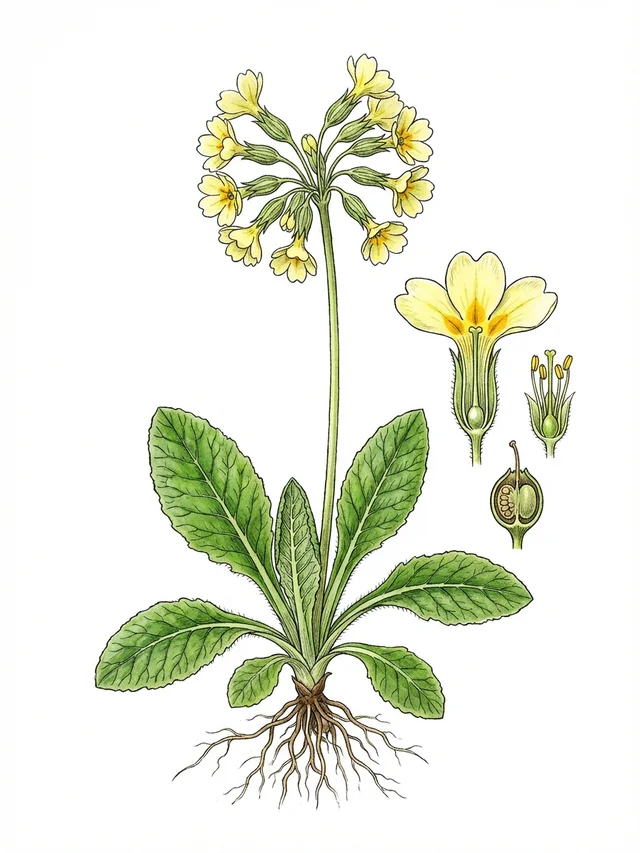
 Image to followAI-generated illustration
Pulicaria dysenterica
Pulicaria dysenterica
FamilyGenus: Pulicarianative in Germany
🌿
128
Species
interact
🔗
323
Interactions
documented
🐛
10
Host relationships
Species
About this species
Pulicaria dysenterica is a native perennial herb of moist, sunny places in Great Britain. Its flower heads appear from May to August, and it thrives on calcareous, damp soils with low disturbance.
Ecological network
Click to highlight connections · Click again to open the species page
Loading network...
PollinationLarval hostFlower visit
Ecological significance
As a native component of damp, base-rich grasslands, Pulicaria dysenterica contributes to the structure of these habitats.
Annual cycle
A perennial; flowers appear from May to August.
Standort & Merkmale
Light
Sonne
Moisture
Feucht
Soil
—
Flowering period
Mai – Aug
Bioregion
Continental
Growth form
Krautige Pflanze
Woodiness
Nicht verholzt
Leaf type
Breitblättrig
Plant height
0.455 m
Morphological traits: TRY ID3 (CC BY 3.0) & TRY ID81 (CC BY)
Pflege & Anbau
Grow in full sun on a moisture-retentive, preferably calcareous or alkaline soil. It suits damp meadows, pond margins or bog gardens. Keep the soil consistently moist throughout the growing season. Cut back after flowering if self-seeding is undesirable.
Scientific profile
Pulicaria dysenterica is a broad-leaved, non-woody perennial herb in the daisy family (Asteraceae). It is native in Great Britain and is classified as Vulnerable (V) on the national Red List. The plant typically reaches around 0.45 m in height. Its leaves are broad and the whole plant is terrestrial. The composite flower heads, borne from May to August, are produced in full sun. It is a species of moist, calcareous to basic soils, showing slight salt tolerance and a preference for moderate nutrient levels. The diaspore mass is very light (around 0.07 mg). Ecological indicator values point to full light (value 8) and consistently damp ground (moisture value 7), and it thrives in habitats subject to low levels of disturbance.
Pollinators & visitors
95 Arten interagieren mit dieser Pflanze
Melitaea athaliaLycaena phlaeasthecla betulaePieris brassicaePyronia tithonusPieris rapaePieris napiPolyommatus icarusPararge aegeriaAglais urticaeCeratina cyaneaSphecodes gibbusMegachile versicolorLasioglossum villosulumManiola jurtinaGonepteryx rhamniNomada flavopictaMegachile centuncularisAricia agestisSphecodes puncticepsOsmia spinulosaHalictus tumulorumNomada fucataCoelioxys inermisCelastrina argiolusColletes hederaeLasioglossum zonulumColias croceusLasioglossum calceatumHylaeus brevicornisSphecodes scabricollisLasioglossum malachurumMegachile lignisecaAphantopus hyperantusArgynnis paphiaLasioglossum puncticolleLasioglossum fratellumAndrena flavipesBombus lapidariusApis melliferaAnthophora bimaculataAndrena denticulataAndrena ovatulaBombus pascuorumHalictus rubicundusAnthophila fabricianaPolygonia c-albumLasioglossum albipesLasioglossum leucozoniumLasiommata megera
Host relationships
10 species use this plant as a host
Vanessa atalantaEupithecia centaureataEupithecia absinthiataEuproctis chrysorrhoeaEublemma parvaGortyna flavagoPhragmatobia fuliginosaOrthosia gracilisEupithecia subfuscataHeliothis peltigera
Other flower visitors
23 other species visit the flowers
Brassicogethes aeneusRhagonycha fulvaPhalangium opilioOedemera flavipesExoprosopa pandoraSeladonia phryganicaPodontaBotanophila striolataMusca autumnalisParegle audaculaPegoplata aestivaSiphona geniculataCalliphora vicinaDrymeia hamataHylemya vagansMeligethes aeneusMeligethes obscurusMeligethes viridescensScathophaga stercorariaDiglyphus isaeaPhaedrotoma exiguaSeladerma diffinePodonta spec. 1
Sources & data origin
•Interaktionsdaten via GloBI (CC-BY 4.0)
•Cook et al. (2025) UK Butterfly & Moth Traits (DOI: 10.5285/dbc7cc17-cbbd-49dd-bab4-8e8855768d66)
•pollinator_interactions
•Baden-Böhm F, App M, Thiele J (2022) — The FloRes Database: A floral resources trait database for pollinator habitat-assessment generated by a multistep workflow. Johann Heinrich von Thünen-Institut, Dryad, DOI: 10.5061/dryad.djh9w0w29 (CC0)
•FloraWeb / BfN
•EIVE 1.0 — Dengler et al. (2023), DOI: 10.3897/VCS.98324 (CC BY 4.0)
•GBIF Backbone Taxonomy — GBIF Secretariat (2024), DOI: 10.15468/39omei (CC BY 4.0)
•TRY Categorical Traits (ID3) — Kattge et al. (2012), DOI: 10.17871/TRY.3 (CC BY 3.0)
•TRY Global Spectrum (ID81) — Díaz et al. (2016/2021), DOI: 10.17871/TRY.81 (CC BY)
•Govaerts R et al. (2025) — World Checklist of Vascular Plants (WCVP) v14. Royal Botanic Gardens, Kew. DOI: 10.34885/xs7h-ze42 (CC BY 4.0)
All data is licensed under CC BY 4.0, CC0, or compatible terms. Attribution according to license conditions. Full source overview →