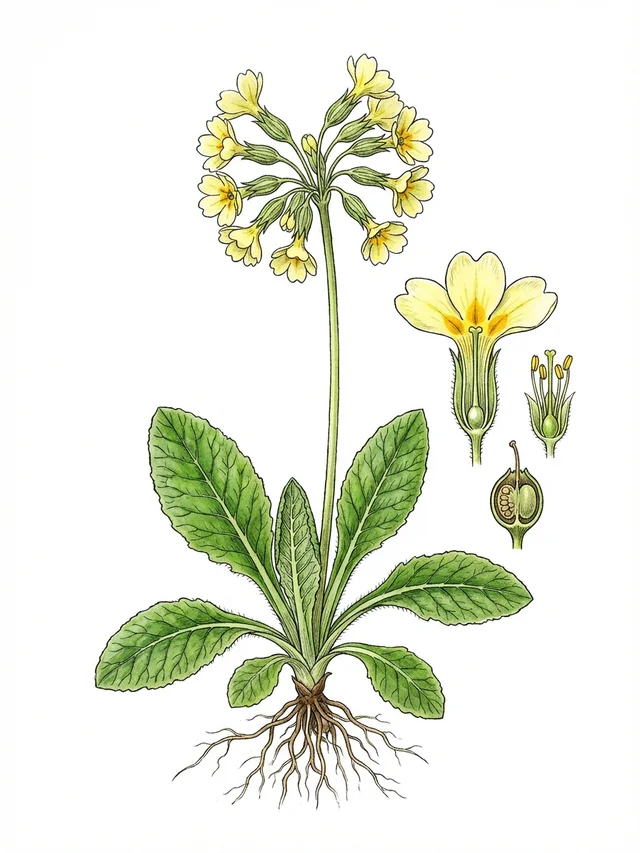
 Image to followAI-generated illustration
Ranunculus flammula
Ranunculus flammula
FamilyGenus: Ranunculusnative in Germany
🌿
74
Species
interact
🔗
82
Interactions
documented
About this species
A native herbaceous plant of sunny, wet, nutrient-poor places, flowering from May to September and offering nectar and pollen to insects.
Ecological network
Click to highlight connections · Click again to open the species page
Loading network...
PollinationFlower visit
Ecological significance
As a native wildflower, it supports pollinating insects with moderate levels of nectar and pollen across a long flowering season. It is associated with sunny, wet, nutrient-poor conditions and tolerates low levels of disturbance, helping to reinforce the diversity of such marginal habitats.
Annual cycle
Flowering occurs from May to September. The foliage is present during the warmer months; additional seasonal detail is not provided.
Safety note
No specific safety information is available for this species in the source material.
Standort & Merkmale
Light
Sonne
Moisture
Feucht
Soil
Schwachzehrer (Magerer Boden)
Flowering period
Mai – Sep
Soil reaction
Mäßig sauer bis neutral
Bioregion
Continental
Nectar value
2
Pollen value
2
Growth form
Krautige Pflanze
Woodiness
Nicht verholzt
Leaf type
Breitblättrig
Plant height
0.285 m
Morphological traits: TRY ID3 (CC BY 3.0) & TRY ID81 (CC BY)
Pflege & Anbau
This species thrives in full sun and consistently moist, nutrient-poor soil, making it suitable for pond margins or damp meadows. Keep the substrate lean and wet; no other specific care is recorded in the available evidence.
Scientific profile
Ranunculus flammula is a broad-leaved, non-woody herbaceous plant reaching about 29 cm in height. It is native in Great Britain and typically occupies sunny, moist, low-nutrient habitats. The flowering period runs from May until September, during which the blooms provide a moderate supply of both nectar and pollen. The species forms arbuscular mycorrhizal associations, and its ecological indicators point to a preference for neutral to slightly acidic, moisture-rich soils with little disturbance.
Pollinators & visitors
59 Arten interagieren mit dieser Pflanze
Pyrgus malvaePolyommatus icarusHalictus tumulorumOsmia bicornisNomada striataClossiana euphrosyneGonepteryx rhamniCallophrys rubiBoloria selene (Denis & Schiffermüller), 1775Lasioglossum morioMelitaea athalia Wachtelweizen-ScheckenfalterManiola jurtinaAglais urticaeLasioglossum calceatumLasioglossum zonulumLasioglossum albipesBombus sylvestrisHalictus rubicundusNomada goodenianaOsmia bicolorLycaena phlaeasLeptidea sinapisOsmia spinulosaHamearis lucinaLasioglossum fulvicorneErynnis tagesLasiommata megeraAndrena labiataAndrena bicolorAndrena haemorrhoaBombus pratorumBombus lapidariusAndrena nitidaAndrena nigroaeneaAndrena labialisThymelicus sylvestrisCoenonympha pamphilusCelastrina argiolusEuphydryas auriniaFixsenia pruniPieris napiLasioglossum xanthopusNomada fucataHylaeus brevicornisLasioglossum pauxillumChelostoma florisomneLasioglossum malachurumCoenotephria salicataColias croceusSphaerophoria scripta
Other flower visitors
15 other species visit the flowers
Brassicogethes aeneusPhaonia servaPhaonia incanaPegoplata aestivaDelia nigrescensDilophus femoratusPlateumaris discolorTetanocera ferrugineaHylemya vagansThricops cunctansDelia radicumHydrotaea dentipesEmpis tessellataDrymeia hamataMeligethes viridescens
Sources & data origin
•Interaktionsdaten via GloBI (CC-BY 4.0)
•pollinator_interactions
•Baden-Böhm F, App M, Thiele J (2022) — The FloRes Database: A floral resources trait database for pollinator habitat-assessment generated by a multistep workflow. Johann Heinrich von Thünen-Institut, Dryad, DOI: 10.5061/dryad.djh9w0w29 (CC0)
•FloraWeb / BfN
•EIVE 1.0 — Dengler et al. (2023), DOI: 10.3897/VCS.98324 (CC BY 4.0)
•EuPPollNet — Kuppler et al. (2025), DOI: 10.1111/geb.70000 (CC BY 4.0)
•Database of Pollinator Interactions (DoPI) — Pocock et al. (2022), DOI: 10.1002/ecy.3801 (CC BY)
•GBIF Backbone Taxonomy — GBIF Secretariat (2024), DOI: 10.15468/39omei (CC BY 4.0)
•TRY Categorical Traits (ID3) — Kattge et al. (2012), DOI: 10.17871/TRY.3 (CC BY 3.0)
•TRY Global Spectrum (ID81) — Díaz et al. (2016/2021), DOI: 10.17871/TRY.81 (CC BY)
•Govaerts R et al. (2025) — World Checklist of Vascular Plants (WCVP) v14. Royal Botanic Gardens, Kew. DOI: 10.34885/xs7h-ze42 (CC BY 4.0)
All data is licensed under CC BY 4.0, CC0, or compatible terms. Attribution according to license conditions. Full source overview →