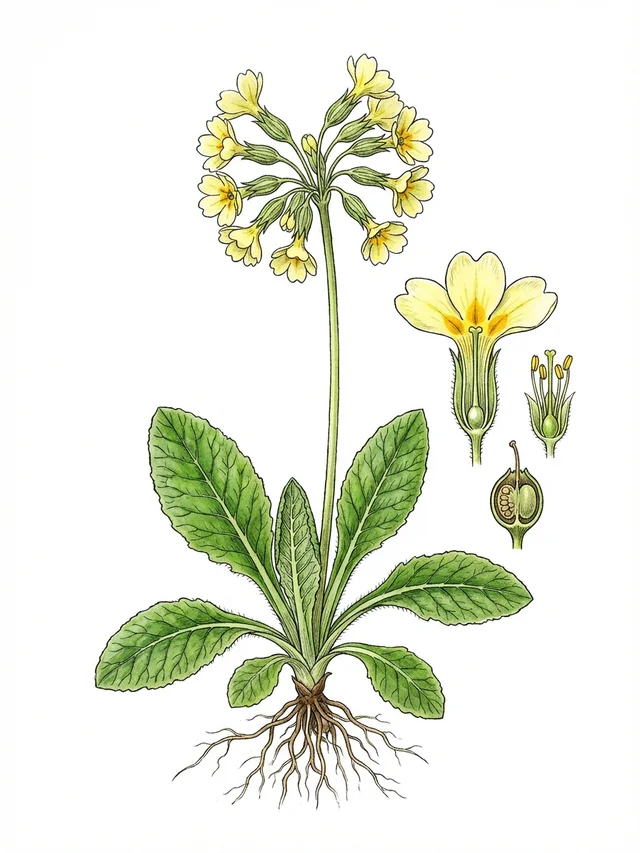
 Image to followAI-generated illustration
Rhinanthus minor
Rhinanthus minor
FamilyGenus: Rhinanthusnative in Germany
🌿
32
Species
interact
🔗
210
Interactions
documented
🐛
4
Host relationships
Species
About this species
A native British wildflower that thrives in sunny, low-nutrient grasslands. Its roots tap into neighbouring plants as a hemiparasite, and it produces nectar- and pollen-rich flowers from March to September, reaching about 25 cm in height.
Ecological network
Click to highlight connections · Click again to open the species page
Loading network...
PollinationLarval host
Ecological significance
The flowers supply abundant nectar and pollen (value 5), supporting pollinating insects. As a hemiparasite, it attaches to the roots of surrounding plants, though host-range details are not specified in the source.
Annual cycle
Flowering spans from March to September.
Standort & Merkmale
Light
Sonne
Moisture
Frisch (Mäßig feucht)
Soil
Schwachzehrer (Magerer Boden)
Flowering period
Mär – Sep
Soil reaction
Mäßig sauer bis neutral
Bioregion
Continental
Nectar value
5
Pollen value
5
Growth form
Krautige Pflanze
Woodiness
Nicht verholzt
Leaf type
Breitblättrig
Plant height
0.255 m
Morphological traits: TRY ID3 (CC BY 3.0) & TRY ID81 (CC BY)
Pflege & Anbau
•
Light requirement: full sun
•
Soil: low-nutrient, fresh (moderately moist), neutral to slightly acid
•
Avoid fertilising, as rich soil discourages the plant.
Scientific profile
Rhinanthus minor is native in Great Britain, recorded from lowland meadows and grassy places. It is a hemiparasitic, non-woody herb with broad leaves, typically attaining a height of around 25 cm. The species thrives in full sun on fresh, moderately moist soils that are neutral to slightly acid and low in nutrients; it tolerates only limited soil disturbance. Flowering extends from March to September, offering generous amounts of nectar and pollen (both rated 5 on a relative 9-point scale) to insect visitors. Below ground, the plant forms arbuscular mycorrhizas while also tapping into the roots of nearby grasses and other herbs through haustorial connections.
Pollinators & visitors
28 Arten interagieren mit dieser Pflanze
Bombus campestrisBombus pratorumBombus sylvarumBombus ruderariusBombus muscorumBombus hypnorumBombus lapidariusBombus pascuorumBombus jonellusBombus humilisBombus hortorumBombus monticolaBombus lucorumPieris rapaeBombus terrestrisBombus vestalisAmmophila sabulosaBombus magnusBombus sylvestrisLasioglossum laevigatumPolyommatus icarusApis melliferaThymelicus lineolaBombus wurfleniiBombus ssBombus unknownRhingia campestrisBombus soroeensis
Host relationships
4 species use this plant as a host
Perizoma albulata (Denis & Schiffermüller), 1775Eupithecia plumbeolataEupithecia satyrataHeliothis peltigera
Sources & data origin
•Interaktionsdaten via GloBI (CC-BY 4.0)
•Cook et al. (2025) UK Butterfly & Moth Traits (DOI: 10.5285/dbc7cc17-cbbd-49dd-bab4-8e8855768d66)
•pollinator_interactions
•FloraWeb / BfN
•EIVE 1.0 — Dengler et al. (2023), DOI: 10.3897/VCS.98324 (CC BY 4.0)
•EuPPollNet — Kuppler et al. (2025), DOI: 10.1111/geb.70000 (CC BY 4.0)
•Database of Pollinator Interactions (DoPI) — Pocock et al. (2022), DOI: 10.1002/ecy.3801 (CC BY)
•GBIF Backbone Taxonomy — GBIF Secretariat (2024), DOI: 10.15468/39omei (CC BY 4.0)
•TRY Categorical Traits (ID3) — Kattge et al. (2012), DOI: 10.17871/TRY.3 (CC BY 3.0)
•TRY Global Spectrum (ID81) — Díaz et al. (2016/2021), DOI: 10.17871/TRY.81 (CC BY)
•Govaerts R et al. (2025) — World Checklist of Vascular Plants (WCVP) v14. Royal Botanic Gardens, Kew. DOI: 10.34885/xs7h-ze42 (CC BY 4.0)
All data is licensed under CC BY 4.0, CC0, or compatible terms. Attribution according to license conditions. Full source overview →