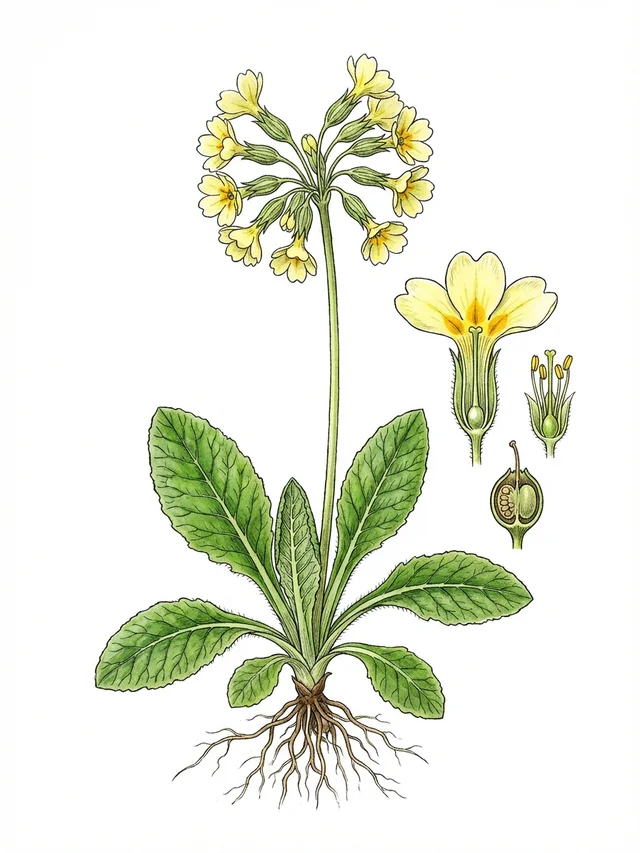
 Image to followAI-generated illustration
Rorippa amphibia
Rorippa amphibia
FamilyGenus: Rorippanative in Germany
🌿
13
Species
interact
🔗
157
Interactions
documented
About this species
A native perennial herb of wet meadows, marshes and nutrient-rich disturbed ground, bearing clusters of yellow flowers from May to August. Its blooms are a rich source of nectar and pollen.
Ecological network
Click to highlight connections · Click again to open the species page
Loading network...
PollinationFlower visit
Ecological significance
The flowers offer high levels of both nectar and pollen (score 5 for each), making the plant a valuable resource for bees, hoverflies and other flower-visiting insects. It forms part of wet-meadow and marsh communities, where it contributes to the structural diversity and food-web support for local wildlife.
Annual cycle
Shoots emerge from overwintering rootstock in spring. The main flowering period runs from May through August. After flowering, numerous small seeds develop and are shed. The above-ground stems die back in autumn, and the plant remains dormant over winter.
Standort & Merkmale
Light
Sonne
Moisture
Feucht
Soil
Starkzehrer (Nährstoffreicher/Fetter Boden)
Flowering period
Mai – Aug
Soil reaction
Basisch / Kalkhold
Bioregion
Continental
Nectar value
5
Pollen value
5
Growth form
Krautige Pflanze
Woodiness
Nicht verholzt
Leaf type
Breitblättrig
Plant height
0.688 m
Morphological traits: TRY ID3 (CC BY 3.0) & TRY ID81 (CC BY)
Pflege & Anbau
If grown in a garden, provide a position in full sun with consistently moist to wet soil. A fertile, lime-rich loam or clay is ideal. It will tolerate shallow water at the margins of a pond or in a bog garden. The plants can be raised from seed sown in spring. No special maintenance is required beyond ensuring the soil does not dry out.
Scientific profile
Rorippa amphibia is a herbaceous, non-woody perennial that typically reaches about 0.7 metres in height. Its leaves are broad, and the plant adopts a terrestrial growth form. The species is native in Great Britain. It favours full sun and wet to very moist conditions, and is almost always found on nutrient-rich, calcareous to basic soils where disturbance is low. Typical habitats include wet meadows, marshland, tall-herb fringes and nutrient-rich ruderal ground. The plant is non-mycorrhizal. Flowering takes place from May to August, and the tiny seeds (diaspore mass about 0.07 milligrams) are produced in quantity. The species is not considered threatened according to the Red List assessment.
Pollinators & visitors
12 Arten interagieren mit dieser Pflanze
Andrena flavipesEristalis tenaxAndrena alfkenellaEristalis arbustorumSyritta pipiensApis melliferaLasioglossum sp2Hylaeus hyalinatusMelanostoma mellinumSphaerophoria scriptaLasioglossum pauxillumEristalinus sepulchralis
Other flower visitors
1 other species visit the flowers
Calopteryx splendens
Sources & data origin
•Interaktionsdaten via GloBI (CC-BY 4.0)
•pollinator_interactions
•FloraWeb / BfN
•EIVE 1.0 — Dengler et al. (2023), DOI: 10.3897/VCS.98324 (CC BY 4.0)
•EuPPollNet — Kuppler et al. (2025), DOI: 10.1111/geb.70000 (CC BY 4.0)
•Database of Pollinator Interactions (DoPI) — Pocock et al. (2022), DOI: 10.1002/ecy.3801 (CC BY)
•GBIF Backbone Taxonomy — GBIF Secretariat (2024), DOI: 10.15468/39omei (CC BY 4.0)
•TRY Categorical Traits (ID3) — Kattge et al. (2012), DOI: 10.17871/TRY.3 (CC BY 3.0)
•TRY Global Spectrum (ID81) — Díaz et al. (2016/2021), DOI: 10.17871/TRY.81 (CC BY)
•Govaerts R et al. (2025) — World Checklist of Vascular Plants (WCVP) v14. Royal Botanic Gardens, Kew. DOI: 10.34885/xs7h-ze42 (CC BY 4.0)
All data is licensed under CC BY 4.0, CC0, or compatible terms. Attribution according to license conditions. Full source overview →