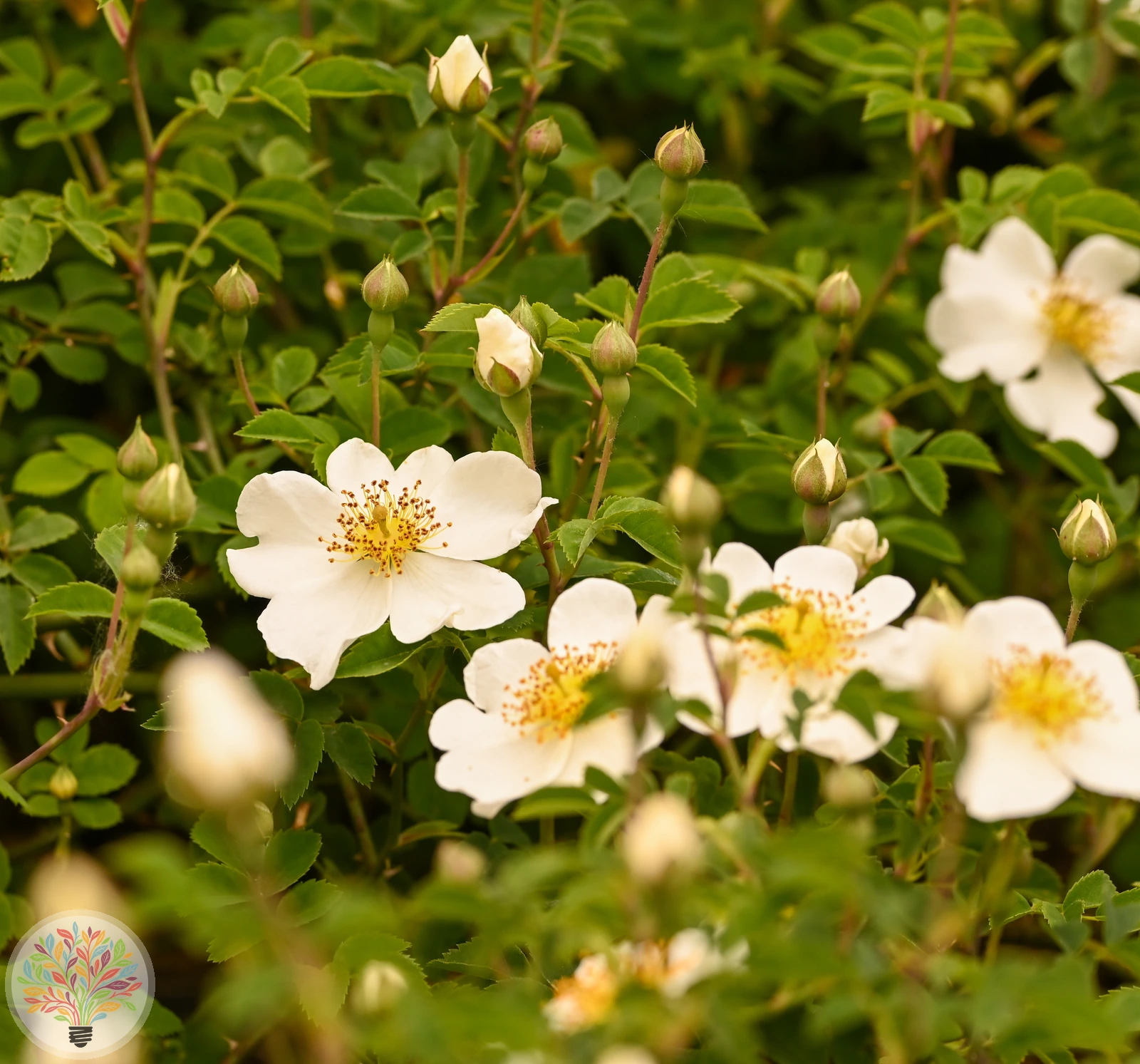
Rosa arvensis
Rosa arvensis
FamilyGenus: Rosanative in Germany
🌿
42
Species
interact
🔗
62
Interactions
documented
🐛
1
Host relationships
Species
About this species
Rosa arvensis is a native climbing rose found in Great Britain. It produces simple white flowers from June to July, and thrives in semi-shaded sites with moderately moist, normal soil. Its woody stems and broad leaves are typical of wild roses in hedgerows and woodland edges.
Ecological network
Click to highlight connections · Click again to open the species page
Loading network...
PollinationLarval hostFlower visit
Ecological significance
The open flowers can supply pollen and nectar for a range of pollinating insects. As a native species, it fits naturally into local food webs, though specific documented interactions are limited.
Annual cycle
Flowering occurs in June and July. New growth emerges in spring, and the plant typically enters dormancy during winter.
Safety note
This plant is considered safe for children.
Standort & Merkmale
Light
Halbschatten
Moisture
Frisch (Mäßig feucht)
Soil
Mittelzehrer (Normaler Boden)
Flowering period
Jun – Jul
Soil reaction
Basisch / Kalkhold
Bioregion
Continental
Growth form
Kletterpflanze
Woodiness
Verholzt
Leaf type
Breitblättrig
Plant height
1.159 m
Morphological traits: TRY ID3 (CC BY 3.0) & TRY ID81 (CC BY)
Pflege & Anbau
Cultivate Rosa arvensis in partial shade, in soil that remains moderately moist but well-drained. A normal garden soil with average fertility suits it well. Provide a support such as a trellis or fence for the climbing stems. Prune after flowering if shaping is desired. It is a low-maintenance shrub once established and considered safe for children.
Scientific profile
Rosa arvensis belongs to the rose family (Rosaceae). It is a woody, broad-leaved climber typically reaching about 1.2 metres in height. Its leaves are relatively large, with a leaf area averaging around 301 mm², and the dry seeds (diaspores) weigh roughly 10.8 mg. The plant flowers in June and July, producing white blossoms. It prefers semi-shaded conditions and moderately moist, calcareous to neutral soils of medium fertility. Ellenberg indicator values suggest it is associated with low-disturbance sites, moderately warm temperatures, and basic soil reaction. A vesicular-arbuscular mycorrhizal association aids nutrient uptake. This species is native in Great Britain, often encountered in hedgerows, scrub, and the edges of woodland.
Pollinators & visitors
37 Arten interagieren mit dieser Pflanze
Lasioglossum morioPieris brassicaePolyommatus icarusOsmia bicolorFabriciana adippe (Denis & Schiffermüller), 1775Lycaena phlaeasLasioglossum calceatumCallophrys rubiCelastrina argiolusBombus lapidariusBombus hypnorumApis melliferaPieris rapaeManiola jurtinaAndrena subopacaAndrena minutuloidesAndrena haemorrhoaAglais urticaePyronia tithonusLasioglossum albipesAndrena flavipesAndrena helvolaAndrena fucataAndrena clarkellaAndrena barbilabrisBombus pratorumAndrena chrysoscelesLasioglossum zonulumBombus jonellusBombus lucorumBombus pascuorumBombus sylvestrisBombus hortorumAndrena bicolorBombus terrestrisEristalis arbustorumMeliscaeva auricollis
Host relationships
1 species use this plant as a host
Diplolepis rosae
Other flower visitors
4 other species visit the flowers
Anaspis frontalisBrassicogethes aeneusRutpela maculataMeligethes aeneus
Sources & data origin
•Interaktionsdaten via GloBI (CC-BY 4.0)
•pollinator_interactions
•FloraWeb / BfN
•EIVE 1.0 — Dengler et al. (2023), DOI: 10.3897/VCS.98324 (CC BY 4.0)
•GBIF Backbone Taxonomy — GBIF Secretariat (2024), DOI: 10.15468/39omei (CC BY 4.0)
•TRY Categorical Traits (ID3) — Kattge et al. (2012), DOI: 10.17871/TRY.3 (CC BY 3.0)
•TRY Global Spectrum (ID81) — Díaz et al. (2016/2021), DOI: 10.17871/TRY.81 (CC BY)
•Govaerts R et al. (2025) — World Checklist of Vascular Plants (WCVP) v14. Royal Botanic Gardens, Kew. DOI: 10.34885/xs7h-ze42 (CC BY 4.0)
•Foto: © Adobe Stock / AdobeStock_507336364
All data is licensed under CC BY 4.0, CC0, or compatible terms. Attribution according to license conditions. Full source overview →