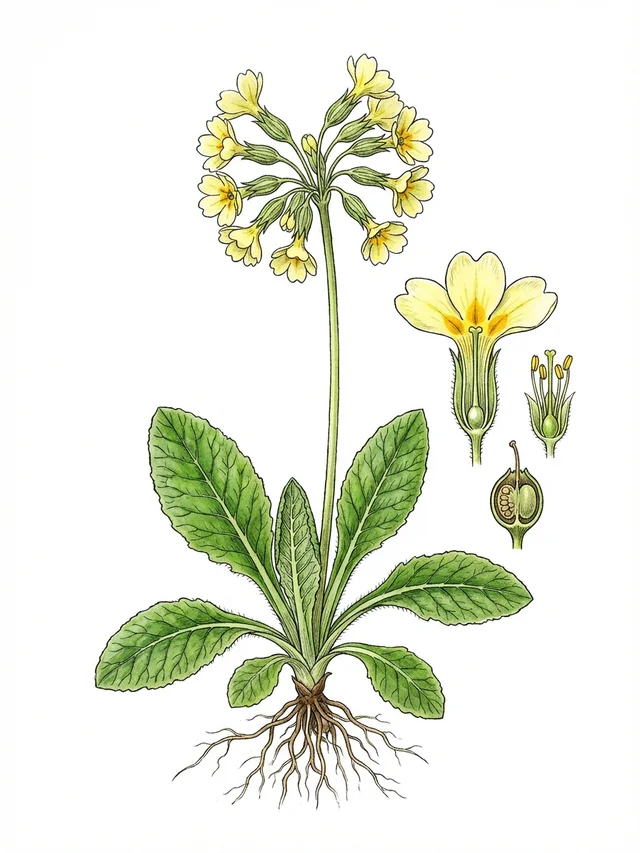
 Image to followAI-generated illustration
Rosa sherardii
Rosa sherardii
FamilyGenus: Rosennative in Germany
🌿
41
Species
interact
🔗
42
Interactions
documented
🐛
28
Host relationships
Species
About this species
A native deciduous shrub of Great Britain, Rosa sherardii reaches about 1.2 m in height and bears pink flowers in June and July. It thrives in sunny, fresh, calcareous meadows and provides nectar and pollen for pollinators.
Ecological network
Click to highlight connections · Click again to open the species page
Loading network...
PollinationLarval host
Ecological significance
As a native shrub, Rosa sherardii supports local biodiversity. Its summer flowers provide nectar and pollen for a range of insects. The plant forms arbuscular mycorrhiza, which can aid soil structure and nutrient cycling.
Annual cycle
In spring, fresh green foliage emerges. Flowering takes place in June and July, with pink blooms attracting pollinators. The leaves are shed in autumn, and the shrub remains dormant over winter.
Standort & Merkmale
Light
Sonne
Moisture
Frisch (Mäßig feucht)
Soil
Mittelzehrer (Normaler Boden)
Flowering period
Jun – Jul
Soil reaction
Basisch / Kalkhold
Bioregion
Continental
Nectar value
1
Pollen value
1
Growth form
Strauch
Woodiness
Verholzt
Leaf type
Breitblättrig
Leaf phenology
Laubabwerfend
Plant height
1.213 m
Morphological traits: TRY ID3 (CC BY 3.0) & TRY ID81 (CC BY)
Pflege & Anbau
Plant in full sun in moisture-retentive but well-drained soil that is neutral to alkaline. A moderately fertile loam is ideal. Water during dry spells in the first growing season to help establishment. Prune lightly after flowering to maintain shape. No regular feeding is required; an annual mulch of well-rotted compost is beneficial.
Scientific profile
Rosa sherardii is a deciduous shrub native in Great Britain, typically growing to around 1.2 metres tall. It bears broad, deciduous leaves and produces flowers from June to July. The species is associated with fresh, moderately infertile meadows on calcareous soils, where it experiences low disturbance. It prefers sunny positions with moderately moist, neutral to alkaline ground and moderately warm conditions. Its root system forms arbuscular mycorrhizal associations, and the flowers offer nectar and pollen to visiting insects.
Pollinators & visitors
13 Arten interagieren mit dieser Pflanze
Bombus hypnorumSpialia sertoriusSpialia rosaeSpialia orbiferMuschampia cribrellumMuschampia tessellumBoloria polarisBoloria friggaBoloria freijaBoloria charicleaPolygonia c-albumNymphalis polychlorosMelitaea diamina
Host relationships
28 species use this plant as a host
Eulithis testataDysstroma truncataAsthena albulataGymnoscelis rufifasciataCampaea margaritariaPtilodon capucinaEuproctis similisOrgyia recensAcronicta psiLasiocampa quercusDiloba caeruleocephalaXestia baja (Denis & Schiffermüller), 1775Colocasia coryliDiaphora mendicaCrocallis elinguariaOrthosia cruda (Denis & Schiffermüller), 1775Conistra vacciniiArctia villicaEuplagia quadripunctariaOrgyia antiquaAcronicta acerisChloroclysta miataBiston betulariaAgrochola lituraDeilephila elpenorAlsophila aescularia (Denis & Schiffermüller), 1775Peribatodes rhomboidaria (Denis & Schiffermüller), 1775Anticlea derivata
Sources & data origin
•Cook et al. (2025) UK Butterfly & Moth Traits (DOI: 10.5285/dbc7cc17-cbbd-49dd-bab4-8e8855768d66)
•Interaktionsdaten via GloBI (CC-BY 4.0)
•Middleton-Welling_2020
•pollinator_interactions
•FloraWeb / BfN
•EIVE 1.0 — Dengler et al. (2023), DOI: 10.3897/VCS.98324 (CC BY 4.0)
•EuPPollNet — Kuppler et al. (2025), DOI: 10.1111/geb.70000 (CC BY 4.0)
•Database of Pollinator Interactions (DoPI) — Pocock et al. (2022), DOI: 10.1002/ecy.3801 (CC BY)
•GBIF Backbone Taxonomy — GBIF Secretariat (2024), DOI: 10.15468/39omei (CC BY 4.0)
•TRY Categorical Traits (ID3) — Kattge et al. (2012), DOI: 10.17871/TRY.3 (CC BY 3.0)
•TRY Global Spectrum (ID81) — Díaz et al. (2016/2021), DOI: 10.17871/TRY.81 (CC BY)
•Govaerts R et al. (2025) — World Checklist of Vascular Plants (WCVP) v14. Royal Botanic Gardens, Kew. DOI: 10.34885/xs7h-ze42 (CC BY 4.0)
All data is licensed under CC BY 4.0, CC0, or compatible terms. Attribution according to license conditions. Full source overview →